
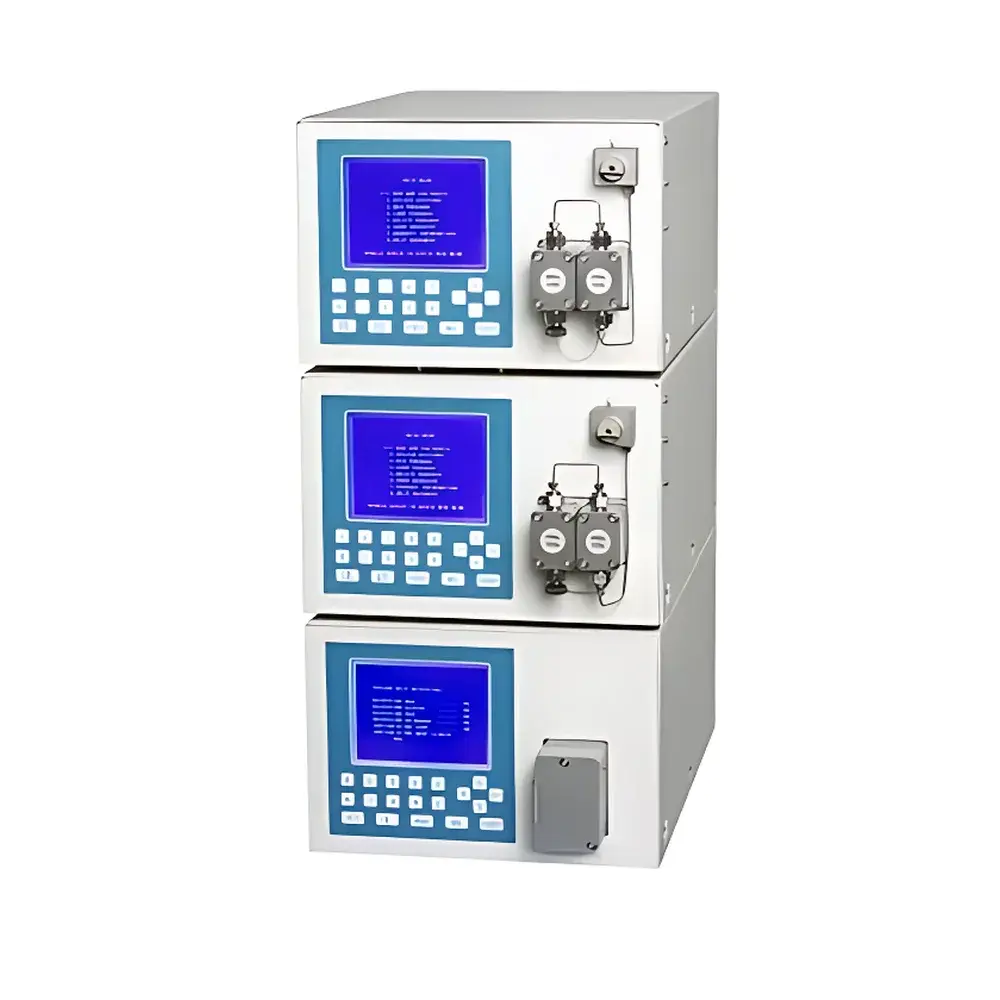
Kyocera LC3000A High-Pressure Preparative Liquid Chromatography System
| Brand | Kyocera |
|---|---|
| Origin | Beijing, China |
| Manufacturer Type | Authorized Distributor |
| Product Category | Domestic |
| Model | LC3000A |
| Instrument Type | High-Pressure Preparative Liquid Chromatograph |
| Maximum Pressure (P3210) | 42 MPa |
| Maximum Pressure (P3220) | 30 MPa |
| Flow Rate Range (P3210) | 0.001–9.999 mL/min |
| Flow Rate Range (P3220) | 0.01–49.99 mL/min |
| Flow Accuracy | ≤0.4% |
| Flow Precision (RSD) | ≤0.1% |
| UV/VIS Detector (UV3000A) | Wavelength Range 190–700 nm |
| Light Source | Deuterium Lamp (standard), Tungsten Lamp (optional) |
| Wavelength Accuracy | ≤±2 nm |
| Wavelength Repeatability | 0.4 nm |
| Absorbance Range | 0–2 AU |
| Absorbance Error | <±5% |
| Baseline Noise (254 nm) | ≤1.5×10⁻⁵ AU (dynamic, 1 mL/min, MeOH/H₂O 80:20) |
| Baseline Drift (254 nm) | ≤4×10⁻⁴ AU/h (dynamic, 1 mL/min, MeOH/H₂O 80:20) |
| Time Constants | 0.1/0.2/0.5/1/2/5/10 s |
| Auto-Zero Function | Full-scale |
Overview
The Kyocera LC3000A High-Pressure Preparative Liquid Chromatography System is an engineered solution for scalable purification and isolation of target compounds from complex mixtures in research, process development, and early-stage manufacturing environments. Based on high-pressure liquid chromatography (HPLC) principles—specifically gradient-elution reversed-phase chromatography—the system delivers precise solvent delivery, robust detection, and reproducible fraction collection under controlled backpressure conditions. Its dual-pump architecture (P3210 and P3220 variants) supports both analytical-scale method scouting and milligram-to-gram preparative separations, enabling seamless transition from method development to purification without re-optimization. The system operates within ISO 17025-aligned laboratory workflows and is designed to meet the foundational requirements of GLP-compliant purification protocols, including traceable parameter logging and stable baseline performance essential for quantitative recovery assessment.
Key Features
- High-stability dual-plunger reciprocating pumps with automatic head flushing—minimizes seal wear, reduces carryover, and extends maintenance intervals.
- Low-pulsation fluidic design achieving RSD ≤0.1% flow precision, critical for consistent retention time and peak shape across repeated injections.
- UV3000A dual-lamp UV/VIS detector with programmable wavelength scanning (start/end points and step size user-definable), supporting spectral confirmation of collected fractions.
- Deuterium lamp (standard) and optional tungsten lamp provide continuous coverage from 190 nm to 700 nm, accommodating diverse chromophores including conjugated aromatics, carbonyls, and transition-metal complexes.
- Real-time baseline stability: noise ≤1.5×10⁻⁵ AU and drift ≤4×10⁻⁴ AU/h at 254 nm—enabling reliable low-concentration detection and accurate integration of minor peaks in crude extracts.
- Configurable time constants (0.1–10 s) and full-scale auto-zero function allow optimization for both high-speed gradient runs and high-sensitivity isocratic applications.
Sample Compatibility & Compliance
The LC3000A accommodates a broad range of sample matrices—including natural product extracts, synthetic reaction mixtures, peptide digests, and pharmaceutical intermediates—when paired with commercially available preparative columns (20–50 mm i.d., C18, silica, amino, or ion-exchange phases). Column compatibility extends to maximum operating pressures of 42 MPa (P3210) and 30 MPa (P3220), supporting sub-10 µm particle-packed media for enhanced resolution. The system adheres to fundamental instrumentation requirements outlined in USP , ICH Q2(R2), and ASTM D7827 for chromatographic method validation. While not pre-certified for 21 CFR Part 11, its detector and pump firmware support audit-trail-ready data export (CSV, ASCII) compatible with third-party LIMS and electronic lab notebook (ELN) platforms used in regulated environments.
Software & Data Management
The LC3000A operates via Kyocera’s proprietary ChromoView™ control software (Windows-based), offering intuitive method building, real-time chromatogram visualization, and fraction-triggered collection logic based on threshold absorbance or time windows. All acquisition parameters—including flow rate, gradient profile, wavelength program, and detector time constant—are stored with timestamps and user ID metadata. Raw data files include embedded instrument configuration logs, facilitating retrospective analysis and method transfer. Export formats comply with ASTM E1957 and are interoperable with Open Chromatography Data Format (CDF)-compatible tools such as Chromeleon™, Empower™, and open-source libraries (e.g., pyOpenMS). No cloud connectivity or remote access capabilities are included; all data reside locally unless manually exported.
Applications
- Purification of synthetic organic compounds prior to NMR or MS characterization.
- Isolation of bioactive constituents from botanical extracts for structure–activity relationship (SAR) studies.
- Desalting and buffer exchange of oligonucleotides and small peptides.
- Removal of catalyst residues (e.g., Pd, Ru) from cross-coupling reaction products.
- Stability-indicating purification of degradants in forced degradation studies (ICH Q1A–Q1D).
- Supporting DOE (Design of Experiments)-driven method development for downstream GMP manufacturing processes.
FAQ
What column dimensions and particle sizes are supported?
The LC3000A is compatible with preparative columns ranging from 10 mm to 50 mm internal diameter and packing materials with particle sizes from 5 µm to 25 µm, provided system pressure limits are observed.
Can the system be integrated with an automated fraction collector?
Yes—via TTL-level digital output signals synchronized to UV peak detection or user-defined time windows; third-party collectors with standard trigger input are fully supported.
Is method transfer to analytical HPLC systems feasible?
Method transfer is achievable using linear velocity scaling and column volume normalization; Kyocera provides application notes outlining retention time correlation protocols between LC3000A and common analytical platforms (e.g., Waters ACQUITY, Agilent 1260).
What maintenance intervals are recommended for the P3210 pump head?
With typical use (≤8 h/day, aqueous/organic mobile phases), seal replacement is recommended every 6–9 months; automatic head flush cycles should be performed daily when using buffered or viscous solvents.
Does the UV3000A detector support multi-wavelength quantitation?
No—it acquires data at a single user-selected wavelength per run; however, sequential runs at different wavelengths (e.g., 214 nm and 254 nm) can be programmed and correlated post-acquisition.





