
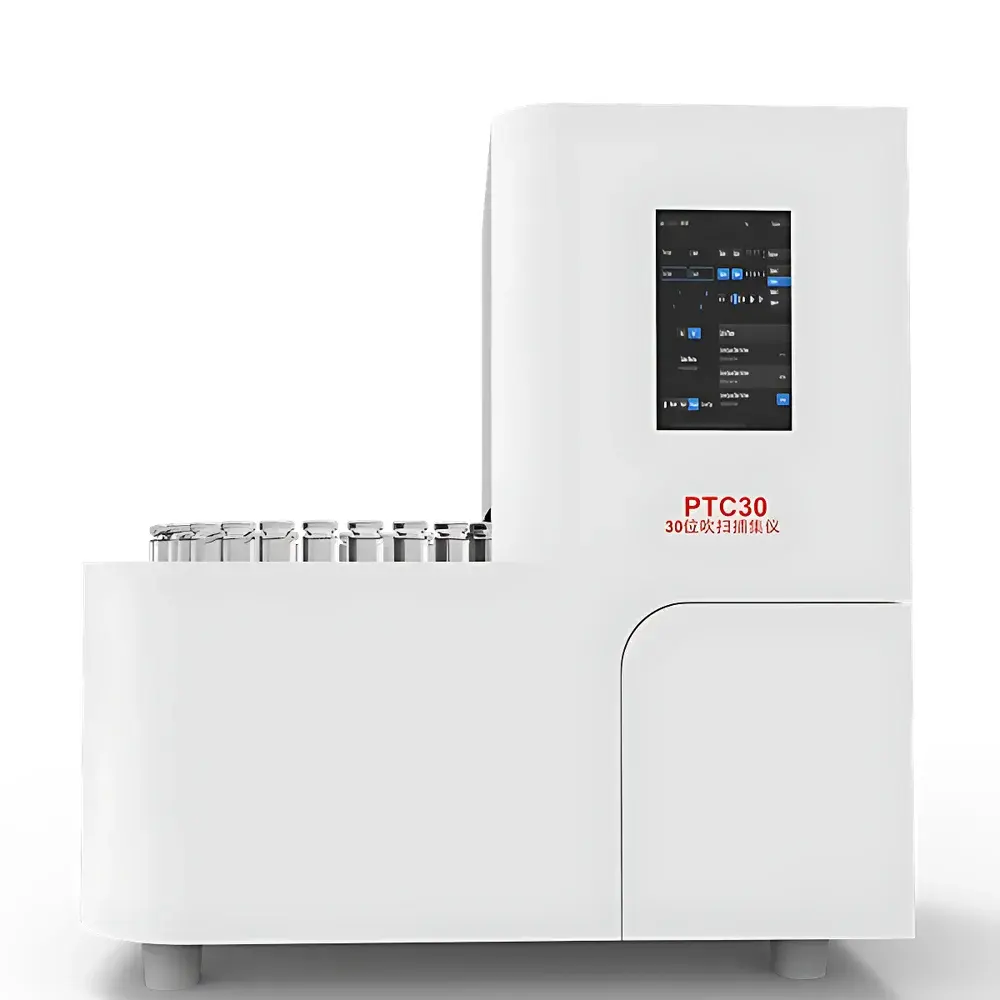
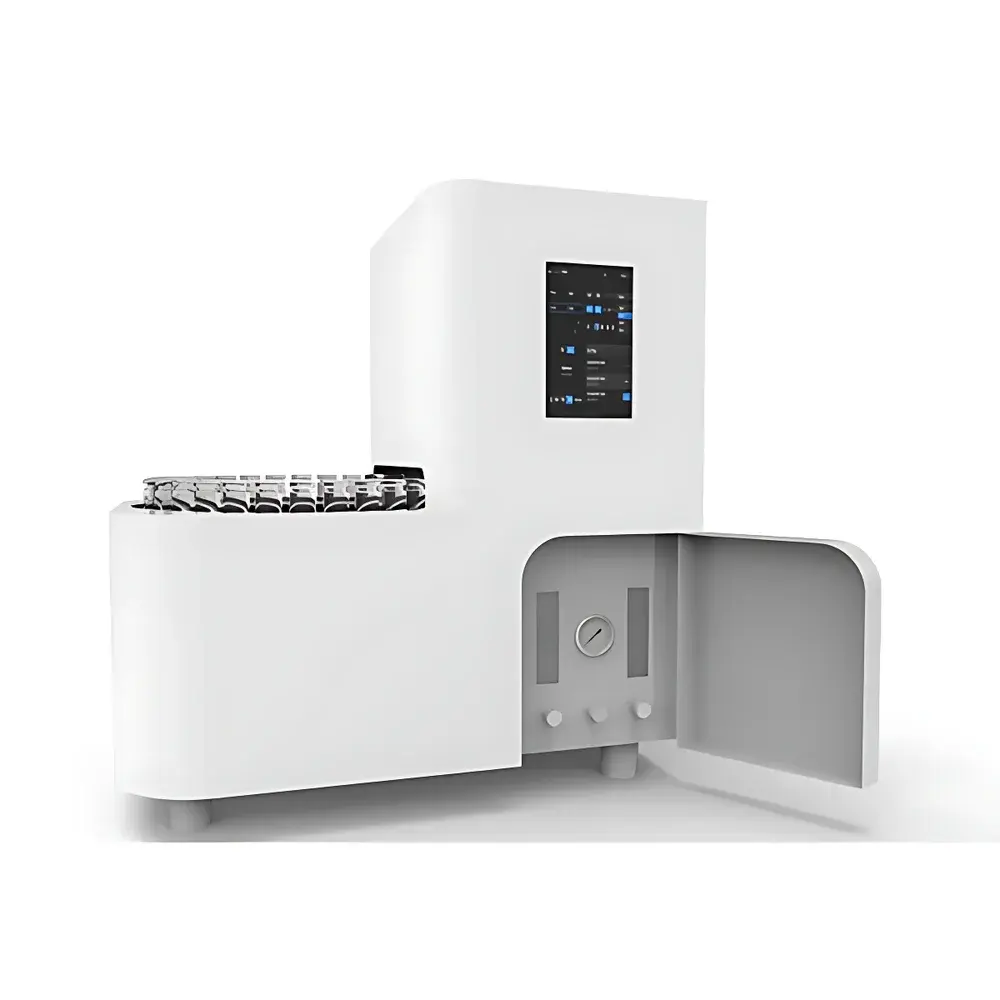
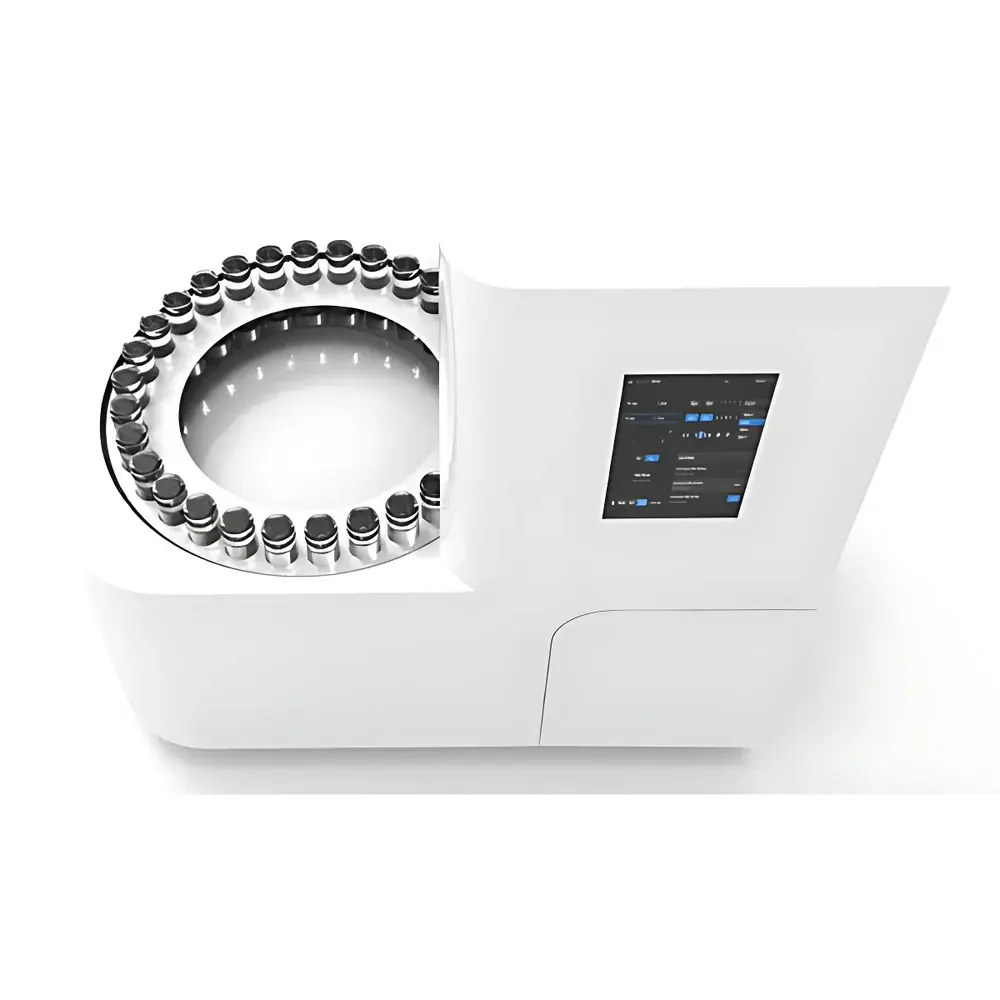
Kyocera PTC-30A Fully Automated Water-and-Soil Integrated Purge and Trap Concentrator
| Brand | Kyocera |
|---|---|
| Origin | Beijing, China |
| Manufacturer Type | Authorized Distributor |
| Instrument Category | Domestic |
| Model | PTC-30A |
| Sample Capacity | 30-position |
| Instrument Type | Water-and-Soil Integrated Purge and Trap System |
| Dehumidification Trap Temp Range | Ambient to 240 °C (1 °C increments) |
| Valve & Transfer Line Temp Range | Ambient to 220 °C (1 °C increments) |
| Trap Cooling/Desorption Temp Range | −30 °C to 400 °C (electronic cooling, 1 °C increments) |
| Sample Heating Temp Range | Ambient to 240 °C (1 °C increments) |
| Purge Flow Rate | 0–100 mL/min (adjustable) |
| Back-Flush Flow Rate | 0–100 mL/min (adjustable) |
| Sample Vial | 40 mL |
Overview
The Kyocera PTC-30A is a fully automated, water-and-soil integrated purge and trap concentrator engineered for trace-level volatile organic compound (VOC) analysis in environmental, regulatory, and food safety laboratories. It operates on the principle of dynamic headspace extraction: inert gas (typically helium or nitrogen) purges VOCs from aqueous or solid-phase samples into a cryogenically cooled or electrically refrigerated trap, where analytes are adsorbed and concentrated. Following desorption via rapid resistive heating, the enriched analytes are transferred quantitatively to a gas chromatograph (GC) or GC–mass spectrometer (GC–MS) for separation and detection. Designed to meet stringent U.S. EPA Method 502.2, 524.2, 624, and Chinese national standards—including HJ 639–2012, HJ 686–2014, and HJ 605–2011—the PTC-30A ensures method-compliant performance for routine monitoring of regulated VOCs such as benzene, chloroform, trichloroethylene, and vinyl chloride in drinking water, groundwater, soil, sediment, and food matrices.
Key Features
- Fully automated 30-position sample handling with programmable sequence execution—no manual intervention required between runs.
- Independent, precision temperature control across four critical zones: purge valve assembly (ambient to 220 °C), sample transfer line (ambient to 220 °C), dehumidification trap (ambient to 240 °C), and adsorbent trap (−30 °C to 400 °C via electronic cooling).
- Integrated magnetic stirring with adjustable speed for homogeneous sample agitation during purge, enhancing extraction efficiency for heterogeneous soil/sediment samples.
- Dual-stage moisture management: a dedicated heated dehumidification trap removes water vapor prior to trapping, minimizing water-induced column degradation and detector saturation in downstream GC/GC–MS systems.
- Automated back-flush functionality for both the transfer line and six-port valve—prevents carryover and cross-contamination between samples without operator input.
- Universal GC/GC–MS synchronization: TTL-compatible start signal output and configurable hardware interface support seamless integration with all major GC platforms (Agilent, Thermo Fisher, Shimadzu, PerkinElmer, etc.) including those compliant with 21 CFR Part 11 audit trail requirements.
- Intuitive time-programmable method editor aligned with standard protocols (e.g., HJ 686–2014): users define pre-heating, purge duration (up to 30 min), dry purge (N₂ sweep), trap desorption (1–3 min), and high-temperature bake-out (up to 250 °C for 5+ min) in a single workflow.
Sample Compatibility & Compliance
The PTC-30A accommodates 40 mL EPA-compliant vials and supports direct analysis of liquid samples (groundwater, surface water, wastewater) as well as solid-phase matrices (soil, sediment, sludge) using spiking and aqueous slurry preparation per HJ 605–2011. Its robust thermal architecture maintains stable temperature gradients across all heated zones, ensuring reproducible analyte recovery across variable sample types and moisture contents. The system conforms to ISO/IEC 17025:2017 requirements for method validation and is routinely deployed in GLP-certified environmental testing labs conducting compliance monitoring under China’s Ministry of Ecology and Environment (MEE) mandates. All temperature setpoints, flow rates, and timing events are logged with timestamps and user IDs, supporting full traceability for regulatory audits.
Software & Data Management
The embedded control software provides real-time graphical animation of system status (valve positions, trap temperature profile, gas flow states) and enables method cloning, parameter locking, and password-protected user roles. Raw method files include metadata fields for analyst ID, sample ID, instrument ID, and calibration verification records. Export formats include CSV and XML for LIMS integration. Audit trail functionality logs all configuration changes, run initiations, and error events—meeting minimum data integrity expectations outlined in FDA 21 CFR Part 11 and EU Annex 11 when operated on validated networked workstations.
Applications
- Regulatory VOC analysis in municipal and industrial wastewater per HJ 639–2012 and HJ 686–2014.
- Soil and sediment screening for chlorinated solvents and fuel hydrocarbons under HJ 605–2011.
- Food and beverage quality control: detection of residual solvents (e.g., ethyl acetate, dichloromethane) in packaged products.
- Method development and validation studies requiring precise control over purge kinetics, trap conditioning, and thermal desorption profiles.
- Research applications involving low-concentration VOC profiling in atmospheric particulate extracts or bioremediation effluents.
FAQ
Does the PTC-30A support unattended overnight operation?
Yes—its 30-position carousel, automatic vial recognition, and fault-tolerant thermal control enable fully unattended batch processing of up to 30 samples with customizable pause/resume logic.
Can the system be validated for GMP/GLP environments?
Yes—when installed with documented IQ/OQ protocols and operated under controlled access, the PTC-30A supports 21 CFR Part 11-compliant data handling when paired with validated GC–MS software and network infrastructure.
Is electronic cooling of the trap sufficient for cryofocusing of C2–C12 VOCs?
Yes—the −30 °C minimum trap temperature ensures quantitative retention of light-end volatiles including vinyl chloride and methyl chloride, consistent with EPA Method 524.2 performance criteria.
How is carryover mitigated during high-moisture soil analysis?
Through sequential use of the heated dehumidification trap (to remove bulk water), dry-purge N₂ step, and post-run trap bake-out at 250 °C—verified by blank analysis per HJ 605–2011 Section 8.3.
What maintenance intervals are recommended for routine operation?
Trap cartridge replacement every 200–300 injections; O-ring inspection every 500 cycles; annual calibration verification of all temperature zones and mass flow controllers using NIST-traceable references.




