
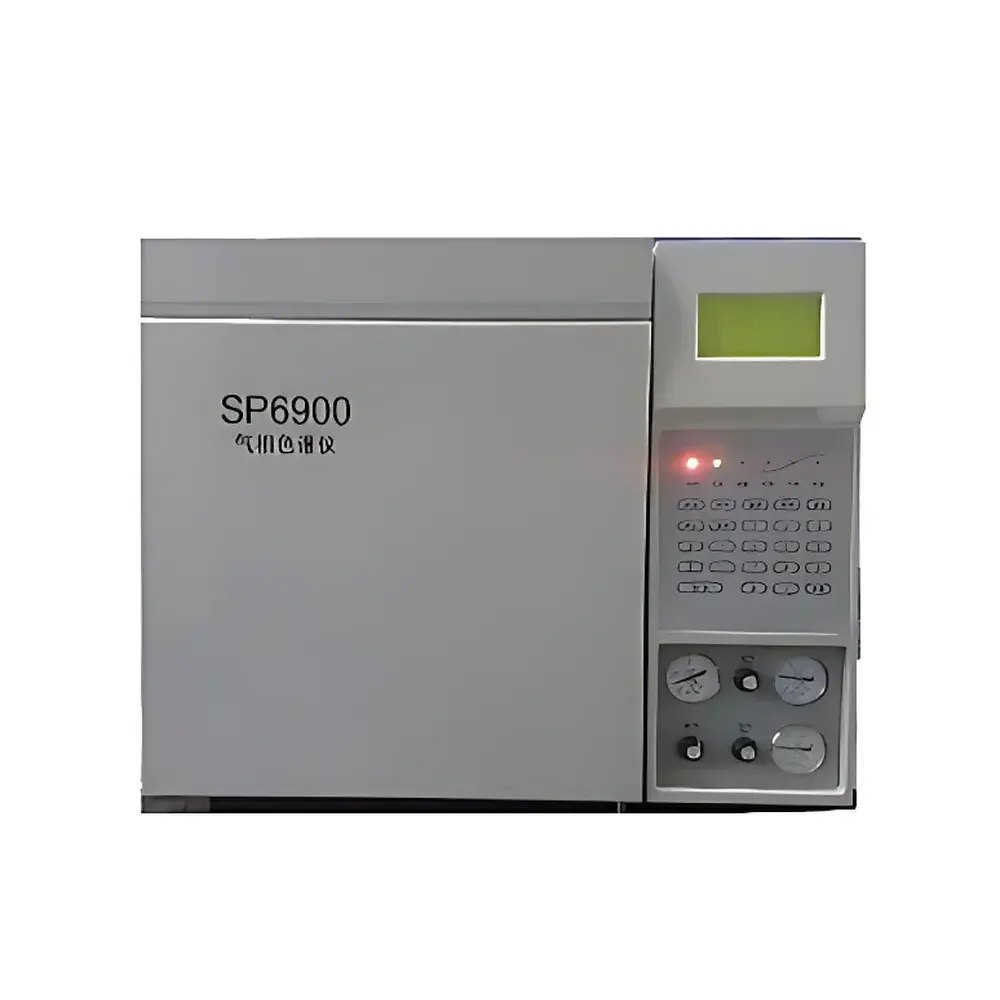
Kyocera SP6900 Liquefied Petroleum Gas (LPG) Analyzer with DME Detection Capability
| Brand | Kyocera |
|---|---|
| Origin | Beijing, China |
| Manufacturer Type | Authorized Distributor |
| Country of Origin | China |
| Model | SP6900 |
| Application Field | Petrochemical Industry |
| Temperature Control | 5 independent zones, 5-step programmable ramping |
| Column Oven Range | Ambient +15°C to 399°C |
| Temperature Stability | Better than ±0.1°C |
| Heating Rate | 0.1–40°C/min |
| Time Programming | 0–255 min per step |
| TCD Sensitivity | ≥3500 mV·mL/mg (benzene) |
| Baseline Noise | ≤0.02 mV |
| Drift | <0.1 mV/h |
| Weight | ~60 kg |
| Sample Introduction | 6-port gas sampling valve |
| Data Output | Real-time purity and component quantification via PC interface |
Overview
The Kyocera SP6900 Liquefied Petroleum Gas (LPG) Analyzer is a dedicated gas chromatograph engineered for precise compositional analysis of commercial LPG streams, with validated capability for quantitative detection of dimethyl ether (DME) — a common adulterant in LPG supply chains. Operating on the principle of capillary or packed-column gas chromatography with thermal conductivity detection (TCD), the system separates volatile hydrocarbon components (e.g., propane, butane, isobutane, propylene) and oxygenated contaminants such as DME based on differential partitioning and retention time. Its design adheres to fundamental chromatographic requirements for reproducible gas-phase separation under controlled temperature gradients, enabling compliance with routine quality control protocols in refinery off-gas monitoring, bulk LPG terminal verification, and regulatory screening per GB/T 13610–2022 (Chinese standard for gaseous hydrocarbon analysis) and ASTM D2505 (Standard Test Method for Analysis of Liquefied Petroleum (LP) Gases by Gas Chromatography). The instrument is not intended for trace-level environmental VOC analysis or high-resolution petrochemical fingerprinting but delivers robust, field-deployable performance for routine LPG specification testing.
Key Features
- Five independently controlled temperature zones—including column oven, injector, and three detector compartments—support complex multi-step temperature programming essential for resolving closely eluting LPG components.
- High-stability TCD with ≥3500 mV·mL/mg sensitivity (benzene reference) ensures reliable quantification of major hydrocarbons and DME at concentration levels relevant to commercial LPG specifications (typically 0.1–5.0 vol%).
- Integrated 6-port gas sampling valve enables repeatable, contamination-free introduction of pressurized LPG samples without cryogenic trapping or dilution, minimizing operator variability and calibration drift.
- Column oven accommodates standard 30 m × 0.32 mm ID capillary columns or stainless-steel packed columns optimized for C1–C5 hydrocarbon separation; maximum operating temperature of 399°C supports method flexibility across diverse LPG feedstocks.
- Real-time data acquisition and calculation engine runs on embedded firmware with optional PC-based software; displays individual component percentages, total purity index, and pass/fail status against user-defined specification limits.
- Thermal management architecture maintains better than ±0.1°C isothermal stability and linear ramp fidelity—critical for retention time repeatability across shifts and operators.
Sample Compatibility & Compliance
The SP6900 is validated for direct analysis of vapor-phase LPG samples collected from cylinder valves, pipeline taps, or vaporizers at ambient pressure or regulated backpressure (up to 300 kPa). It accepts both commercial-grade and refinery-grade LPG mixtures containing propane, butanes, olefins, and intentional or incidental DME. No derivatization, pre-concentration, or solvent extraction is required. The system meets functional requirements outlined in ISO 6974-2:2016 (Natural gas — Determination of composition with defined methods — Part 2: Gas-chromatographic method for hydrocarbon components C1 to C5 and carbon dioxide) and aligns with GLP-aligned laboratory practices when paired with audit-trail-enabled data handling software. While not certified to IEC 61000-6-3 (EMC) or ATEX/IECEx for hazardous area installation, it is rated for use in ventilated analytical laboratories compliant with OSHA 1910.1200 (Hazard Communication Standard).
Software & Data Management
Data acquisition and reporting are managed via Kyocera’s proprietary ChromaView™ Lite software, compatible with Windows 10/11 systems. The interface provides real-time chromatogram visualization, peak integration using tangent skim or valley-to-valley algorithms, and automated calibration curve generation (linear or quadratic) from up to 12 standard points. All raw chromatograms, method parameters, integration logs, and final reports are timestamped and stored in encrypted .chd binary format. Audit trail functionality records user logins, method modifications, calibration events, and result exports—supporting basic 21 CFR Part 11 readiness when deployed with Windows domain authentication and file server backup policies. Export options include CSV, PDF, and XML formats suitable for LIMS ingestion.
Applications
- Verification of DME adulteration in retail LPG cylinders per national fuel quality regulations (e.g., China’s GB 11174–2011).
- Batch release testing of LPG cargoes at import terminals and distribution depots.
- In-process monitoring of LPG fractionation units to ensure product cut-point consistency.
- Technical service support for LPG equipment manufacturers requiring composition feedback for burner optimization.
- Training and method development in vocational technical colleges specializing in petrochemical instrumentation.
FAQ
Does the SP6900 require carrier gas certification or special grade helium?
No—standard industrial-grade helium or hydrogen (99.999% purity) is sufficient; no ultra-high-purity certification is mandated for routine LPG analysis.
Can the system be upgraded to support flame ionization detection (FID)?
No—the SP6900 hardware platform is configured exclusively for TCD operation; FID integration is not supported due to structural and electrical constraints.
Is method validation documentation included with the instrument?
Yes—a basic IQ/OQ protocol package is provided, including temperature mapping reports, TCD linearity verification data (using benzene/nitrogen standards), and retention time reproducibility test results across three consecutive injections.
What maintenance intervals are recommended for the 6-port valve?
Valve rotor seal replacement is advised every 12 months or after 5,000 injections, whichever occurs first; Kyocera supplies OEM-certified seal kits with torque specifications.
Does the system comply with ISO/IEC 17025 requirements for accredited testing labs?
The SP6900 itself is not accredited, but its performance characteristics—when operated under documented SOPs, calibrated with NIST-traceable standards, and maintained with full metrological records—support compliance with ISO/IEC 17025:2017 clause 6.4 (Equipment) and 6.6 (Measurement Traceability).






