
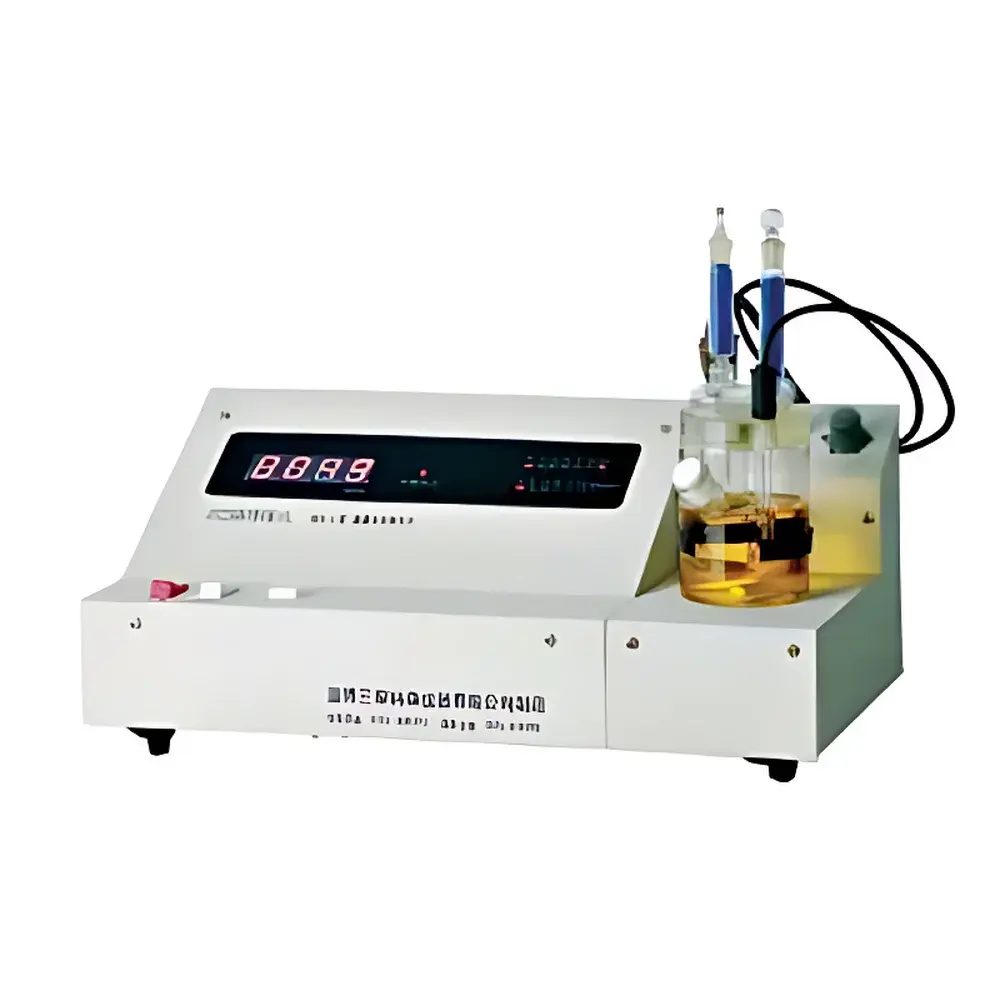
Kyocera WS-1 Coulometric Karl Fischer Moisture Analyzer
| Brand | Kyocera |
|---|---|
| Origin | Beijing, China |
| Manufacturer Type | Authorized Distributor |
| Country of Origin | PRC |
| Model | WS-1 |
| Price | Upon Request |
| Display | 4-digit LED, microgram (µg) resolution |
| Water Quantification Range | 5 µg – 30 mg H₂O |
| Detection Limit | 1 µg H₂O |
| Accuracy | ±3 µg for 5–1000 µg |
| Electrolysis Current | 0–300 mA (auto-controlled) |
| Power Supply | 220 V ±10%, 50 Hz ±5% |
| Power Consumption | <40 VA |
| Operating Temperature | 5–40 °C |
| Operating Humidity | ≤85% RH |
| Dimensions (W×D×H) | 450 × 230 × 200 mm |
| Weight | ~7 kg |
Overview
The Kyocera WS-1 Coulometric Karl Fischer Moisture Analyzer is a precision laboratory instrument engineered for trace-level water quantification in liquid, solid, and gaseous samples using the coulometric Karl Fischer titration principle. Unlike volumetric KF methods, coulometric detection generates iodine electrochemically at the anode in real time, enabling ultra-sensitive measurement without manual reagent dispensing. This architecture delivers high reproducibility and eliminates reagent calibration drift—critical for compliance-driven environments such as pharmaceutical QC, petrochemical refining, and insulating oil testing. The WS-1 is designed specifically for applications requiring quantification in the 5 µg to 30 mg water range, with a verified detection threshold of 1 µg H₂O—making it suitable for low-moisture matrices including transformer oils, active pharmaceutical ingredients (APIs), agrochemical formulations, and hygroscopic mineral powders.
Key Features
- Coulometric KF titration with auto-controlled electrolysis current (0–300 mA), ensuring optimal iodine generation across dynamic moisture concentrations.
- High-resolution 4-digit LED display calibrated in micrograms of water—providing direct, unambiguous readout without unit conversion errors.
- Stable thermal design operating reliably between 5 °C and 40 °C ambient temperature, with humidity tolerance up to 85% RH for routine lab deployment.
- Compact footprint (450 × 230 × 200 mm) and lightweight construction (~7 kg) facilitate integration into fume hoods, QC benches, or mobile analytical units.
- Low power consumption (<40 VA) supports continuous operation without thermal load concerns or dedicated circuit requirements.
- Validated accuracy performance: ±3 µg absolute error for measurements between 5–1000 µg H₂O; ±0.5% relative standard deviation for samples exceeding 1 mg H₂O.
Sample Compatibility & Compliance
The WS-1 accommodates diverse sample types via standardized KF-compatible sampling protocols—including direct injection of liquids (e.g., hydrocarbon solvents, polar aprotic solvents), oven-vaporization coupling for solids (e.g., polymers, catalysts, APIs), and gas-phase sampling using permeation tubes or flow-through cells. It complies with core international standards governing moisture analysis: ASTM D6304 (Standard Test Method for Determination of Water in Petroleum Products by Coulometric Karl Fischer Titration), ISO 12937 (Petroleum products — Determination of water — Coulometric Karl Fischer titration method), and USP (Water Determination). While the instrument itself does not include built-in 21 CFR Part 11 audit trail functionality, its analog/digital output interface supports integration with LIMS or validated data acquisition systems meeting GLP/GMP documentation requirements.
Software & Data Management
The WS-1 operates as a standalone benchtop analyzer with embedded firmware controlling titration kinetics, endpoint detection, and current regulation. It features no onboard data storage or USB/RS-232 connectivity; instead, results are displayed in real time on the front-panel LED and may be manually recorded or captured via external digital logging devices. For laboratories requiring electronic record retention, the instrument is compatible with third-party analog voltage output interfaces (0–5 V DC proportional to µg H₂O), enabling seamless integration with programmable logic controllers (PLCs), SCADA systems, or validated PC-based acquisition software compliant with ALCOA+ data integrity principles.
Applications
- Petrochemical QA/QC: Quantifying trace moisture in insulating oils per IEC 60814 and ASTM D1533—critical for dielectric strength assurance in high-voltage equipment.
- Pharmaceutical manufacturing: Monitoring residual moisture in lyophilized products, excipients, and packaging headspace per ICH Q5C and USP .
- Agrochemical formulation: Verifying water content in pesticide concentrates and wettable powders to ensure chemical stability and shelf-life compliance.
- Inorganic materials analysis: Measuring hydration levels in catalyst supports, battery electrode precursors, and ceramic raw materials where stoichiometric water affects sintering behavior.
- Research laboratories: Supporting method development for novel KF solvent systems, electrode fouling studies, and kinetic modeling of iodine generation efficiency.
FAQ
What sample types can be analyzed directly without auxiliary hardware?
Liquid samples miscible with KF reagents (e.g., methanol, chloroform, acetonitrile) may be injected directly. Solids and gases require optional accessories—such as a heating oven module or gas sampling valve—to release bound or dissolved water prior to titration.
Is the WS-1 compliant with FDA 21 CFR Part 11 for electronic records?
No—the device lacks integrated user authentication, electronic signatures, or audit trail generation. However, its analog output enables connection to validated external systems that meet Part 11 requirements.
What maintenance is required for long-term accuracy?
Routine electrode cleaning with dry acetone, periodic replacement of KF reagent and molecular sieve drying tubes, and annual verification against NIST-traceable water standards (e.g., 1.00 mg/g certified reference material) are recommended.
Can the WS-1 measure water in silicone oils or highly viscous fluids?
Yes—with appropriate dilution in KF-compatible solvents and use of a high-shear stirrer accessory to ensure homogeneous mixing and rapid iodine diffusion during titration.
Does the instrument support automatic blank correction?
No—blank determination must be performed manually before sample analysis using reagent-only titration, and the resulting background value subtracted from final readings during data processing.



