
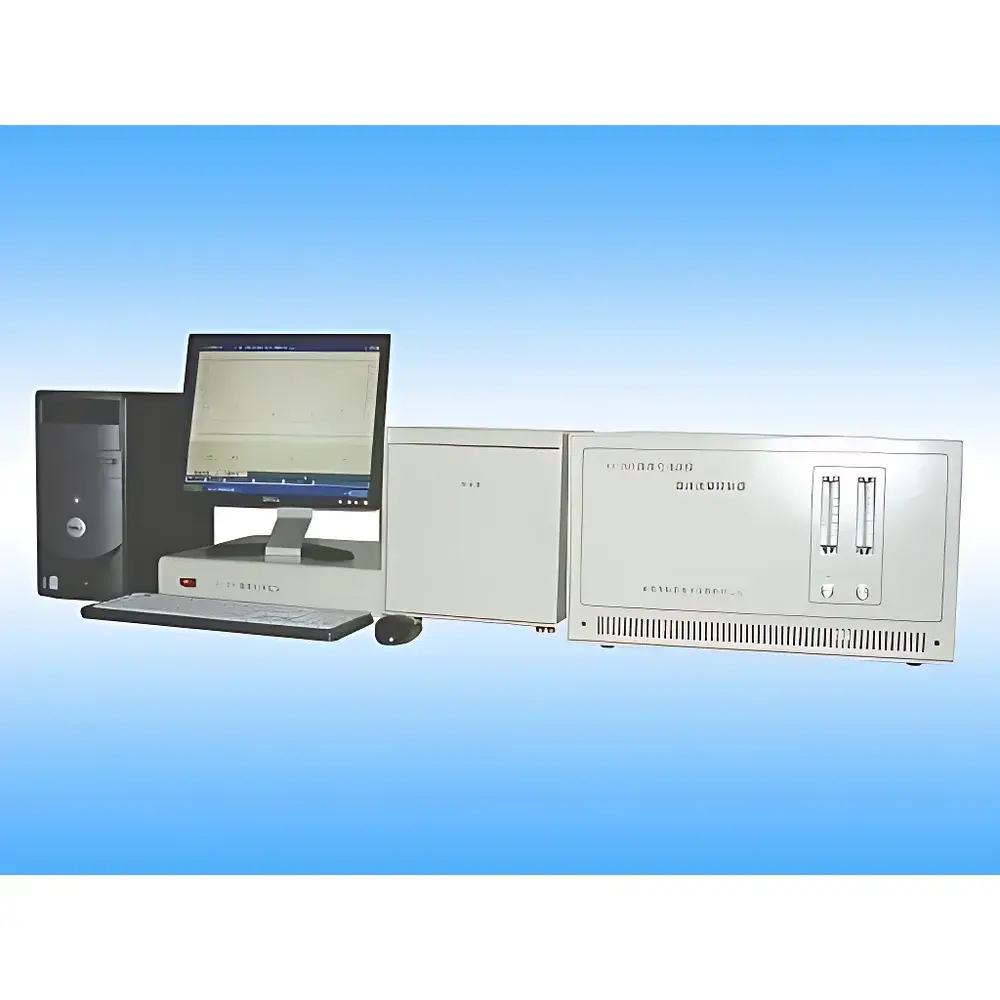
Kyoyuan KY-202 Microcoulometric Total Sulfur Analyzer
| Brand | Kyoyuan |
|---|---|
| Origin | Jiangsu, China |
| Manufacturer Type | Manufacturer |
| Country of Origin | China |
| Model | KY-202 |
| Price Range | USD 4,200 – 7,000 (FOB) |
| Analyte | Total Sulfur |
| Principle | Microcoulometric Titration (ASTM D3227, SH/T 0253, GB/T 11061.4, SH/T 0222) |
| Sample Forms | Liquid, Solid, Gas (with optional injectors) |
| Detection Range | 0.2 mg/L – 10,000 mg/L (S) |
| LOD | 0.2 mg/L (S) |
| Repeatability | As per SH/T 0253 specifications (Cv ≤ 3% for [S] > 10 mg/L |
| Temperature Control | Ambient to 1100 °C, ±1 °C |
| Power | 1500 W |
| Carrier Gases | Technical-grade O₂ and N₂ |
| Cooling | Air-cooled pyrolysis furnace with auto-controlled fan |
Overview
The Kyoyuan KY-202 Microcoulometric Total Sulfur Analyzer is a fully automated, high-precision analytical system engineered for quantitative determination of total sulfur in petroleum products and related hydrocarbon matrices. It operates on the fundamental principle of microcoulometric titration: samples—liquid, solid, or gaseous—are introduced into a high-temperature combustion zone (up to 1100 °C) under controlled nitrogen/oxygen carrier gas flow. Organic and inorganic sulfur species are quantitatively converted to sulfur dioxide (SO₂). The SO₂ is swept into a dual-electrode microcoulometric titration cell, where it reacts stoichiometrically with electrogenerated iodine (I₂) according to the reaction: SO₂ + I₂ + 2H₂O → H₂SO₄ + 2HI. The instrument continuously monitors the current required to regenerate I₂ to maintain endpoint potential, and calculates sulfur mass based on Faraday’s law of electrolysis. This method delivers trace-level accuracy with inherent linearity and minimal matrix interference—critical for compliance with refinery process control, product specification verification (e.g., ultra-low-sulfur diesel), and regulatory reporting.
Key Features
- Fully integrated digital microcoulometric architecture with embedded microprocessor and real-time feedback control loops for both pyrolysis temperature and titration endpoint stability.
- Computer-controlled operation via dedicated Windows-based software: automated sequence execution, real-time status monitoring, parameter logging, and report generation—including calibration curves, sample IDs, integration windows, and audit-ready metadata.
- Modular sample introduction system supporting liquid syringe injection, solid boat loading (with quartz crucibles), and gas loop injection—enabling analysis across gasoline, jet fuel, lubricants, LPG, natural gas condensates, and catalyst samples.
- Patented air-cooled high-temperature furnace with intelligent fan logic: cooling initiates automatically post-run and deactivates when chamber temperature falls below 150 °C—reducing thermal stress and extending heater lifetime without external water lines or chillers.
- Compliance-ready hardware design: analog signal isolation, non-volatile memory for method storage, and timestamped event logs aligned with GLP/GMP data integrity expectations.
Sample Compatibility & Compliance
The KY-202 accommodates diverse sample physical states without reconfiguration of core detection electronics. Liquids (e.g., naphtha, kerosene) are injected via programmable liquid autosampler; solids (e.g., spent catalysts, polymer pellets) require quartz boat loading and optional ash pre-treatment; gases (e.g., refinery off-gas, LNG) utilize a pressure-regulated gas sampling loop with moisture trap and flow metering. Method validation adheres strictly to internationally recognized standards: SH/T 0253 (light distillates), GB/T 11061.4 (natural gas), and SH/T 0222 (LPG). While not FDA 21 CFR Part 11-certified out-of-box, its raw data export (CSV/ASCII) and full audit trail support retrospective validation for regulated environments under ISO/IEC 17025 or ASTM D7042 workflows.
Software & Data Management
The KY-202 is operated through Kyoyuan’s proprietary “SulfurTrace” software, compatible with Windows 10/11 (64-bit). It provides intuitive workflow navigation: method setup (combustion temp, gain, integration time), calibration (multi-point linear or quadratic), batch queue definition, and real-time chromatogram visualization. All raw coulometric current traces, temperature profiles, and calculated results are stored with immutable timestamps and operator ID tags. Export options include PDF reports (with lab header, instrument ID, and QC flags), Excel-compatible CSV files, and XML for LIMS integration. Software supports user-level access control (administrator/operator modes) and configurable electronic signature prompts—facilitating alignment with internal QA documentation protocols.
Applications
- Refinery quality assurance: monitoring sulfur content in feedstocks, intermediates (e.g., hydrotreated naphtha), and finished fuels against ISO 8217, ASTM D975, and EN 590 limits.
- Research & development: kinetic studies of sulfur removal efficiency in hydrodesulfurization (HDS) catalysts under varying temperature/pressure conditions.
- Environmental compliance testing: quantification of sulfur emissions precursors in marine fuels (IMO 2020), bio-blends, and shale-derived crudes.
- Contract laboratories: accredited testing per CNAS-CL01 (equivalent to ISO/IEC 17025) for commercial certification of sulfur speciation in petrochemical exports.
- Educational use: hands-on training in electroanalytical chemistry, combustion stoichiometry, and trace elemental quantification principles.
FAQ
What sulfur species does the KY-202 detect?
It measures total sulfur—regardless of chemical form (e.g., mercaptans, sulfides, disulfides, thiophenes, sulfate salts)—as all are quantitatively oxidized to SO₂ under the specified pyrolysis conditions.
Can the instrument analyze chlorine simultaneously?
No. The KY-202 is configured exclusively for sulfur detection. A separate microcoulometric chlorine analyzer (e.g., KY-203) uses identical hardware but a silver-based titration cell and distinct electrolyte chemistry.
Is sample dilution supported within the software?
Yes. The software allows manual entry of dilution factors during sample setup; final reported concentrations are automatically corrected, and uncertainty propagation follows ISO/IEC Guide 98-3 (GUM) conventions.
What maintenance intervals are recommended?
Quartz combustion tube cleaning every 200 injections; titration cell electrolyte replacement every 30 days or after 500 analyses; ceramic thermocouple verification annually using NIST-traceable reference sources.
Does the system support remote diagnostics?
Basic remote viewing (screen sharing, log file transfer) is enabled via secure VPN; however, no cloud-based telemetry or over-the-air firmware updates are implemented—consistent with industrial cybersecurity best practices for lab instrumentation.






