
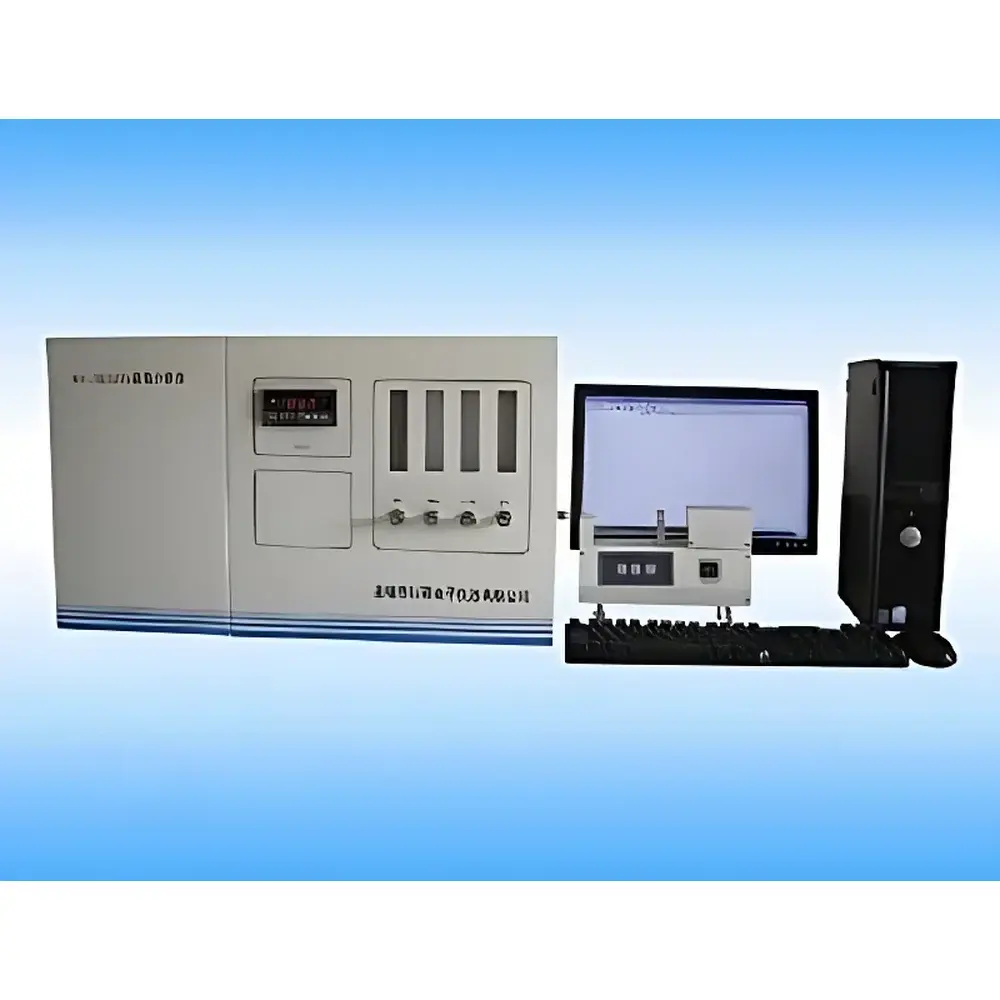
Kyoyuan KY-3000 S/N Total Sulfur and Nitrogen Analyzer
| Brand | Kyoyuan |
|---|---|
| Model | KY-3000 S/N |
| Measurement Principle | UV Fluorescence (S), Chemiluminescence (N) |
| Sample Types | Liquid, Solid, Gas (with optional injectors) |
| Detection Limits | 0.2 mg/L (S), 0.1 mg/L (N) |
| Calibration | Single- or multi-point standard calibration |
| Temperature Control Range | Ambient to 1100 °C |
| Temperature Accuracy | ±0.5% ±3 °C |
| Carrier Gas | Argon ≥99.98%, Oxygen ≥99.98% |
| Power Supply | AC 220 V ±10%, 50 Hz ±0.5 Hz, 2 kW |
| Dimensions | 680 × 480 × 400 mm |
| Compliance Standards | SH/T 0689, ASTM D5453 (S) |
Overview
The Kyoyuan KY-3000 S/N Total Sulfur and Nitrogen Analyzer is a dual-detection elemental analyzer engineered for precise quantification of total sulfur and total nitrogen in hydrocarbon-based matrices. It operates on two complementary, standardized physicochemical detection principles: ultraviolet fluorescence (UVF) for sulfur and chemiluminescence (CLD) for nitrogen—both following high-temperature oxidative combustion (up to 1100 °C) to convert heteroatoms into measurable gaseous species (SO2 and NO, respectively). This architecture ensures stoichiometric conversion and minimizes matrix interference, delivering trace-level accuracy required for regulatory compliance in refining, petrochemical quality control, and research laboratories. The instrument is designed for routine analysis of liquid fuels (e.g., gasoline, diesel, jet fuel), crude oil, distillates, LPG, natural gas condensates, and solid polymers—fully aligned with internationally recognized test methods including ASTM D5453 and D4629, as well as Chinese industry standards SH/T 0689 and SH/T 0657.
Key Features
- High-temperature oxidation furnace with programmable temperature control (ambient to 1100 °C) and precision thermal stability (±0.5% ±3 °C), ensuring complete sample decomposition across diverse matrices.
- Dual-channel detection system: UV fluorescence detector optimized for SO2 emission at 394 nm, and chemiluminescent NOx detector with integrated ozone generator and reaction chamber for selective NO detection.
- 24-bit high-resolution analog-to-digital conversion with USB 2.0 interface, enabling sub-microvolt signal resolution and low-noise baseline stability.
- Adjustable photomultiplier tube (PMT) high-voltage supply for dynamic gain optimization—critical for maintaining linearity over wide concentration ranges (0.1–100% w/w for N; 0.2–100% w/w for S).
- Modular injector design supporting liquid autosamplers, solid combustion boats, and gas sampling loops—enabling seamless method switching without hardware reconfiguration.
- Robust gas delivery system requiring only two ultra-high-purity gases: argon (≥99.98%) as carrier and oxygen (≥99.98%) as oxidant—no reactive or hazardous reagents needed.
Sample Compatibility & Compliance
The KY-3000 S/N accommodates heterogeneous sample forms—volatile liquids, viscous oils, powdered polymers, and compressed gases—via application-specific sample introduction modules. All measurement protocols adhere strictly to the performance criteria defined in ASTM D5453 (sulfur in light hydrocarbons, motor fuels, and oils) and ASTM D4629 (nitrogen in liquid petroleum hydrocarbons). For regulated environments, the system supports audit-ready operation: full electronic record retention, user-access logs, parameter change tracking, and report generation compliant with GLP and GMP documentation requirements. While not pre-certified for FDA 21 CFR Part 11, its software architecture permits configuration of electronic signatures, audit trails, and data integrity controls when deployed in pharmaceutical excipient or specialty chemical QA/QC workflows.
Software & Data Management
The KY-3000 S/N runs Kyoyuan’s proprietary Elemental Analysis Suite (EAS v3.x), a cross-platform application compatible with Windows 10/11, macOS 12+, and Linux LTS distributions via Wine compatibility layer. EAS provides real-time chromatogram visualization, peak integration using tangent skim and valley-to-valley algorithms, and customizable calibration curves (linear, quadratic, or weighted least-squares). All raw data—including detector voltage traces, furnace temperature profiles, and gas flow logs—are stored in vendor-neutral HDF5 format with embedded metadata (operator ID, timestamp, method name, instrument serial number). Export options include CSV, PDF analytical reports, and XML for LIMS integration. Built-in diagnostic tools monitor PMT aging, ozone generator efficiency, and combustion efficiency via post-reaction CO2 monitoring—enabling predictive maintenance scheduling.
Applications
- Refinery process control: monitoring sulfur removal efficiency in hydrotreaters and predicting catalyst deactivation trends.
- Fuel certification: verifying compliance with Euro 6, Tier 3, and China VI sulfur limits (≤10 ppm) and nitrogen specifications in aviation turbine fuels (ASTM D1655 Annex A2).
- Petrochemical R&D: quantifying heteroatom content in feedstocks, intermediates, and polymer additives to correlate with corrosion behavior or catalytic poisoning potential.
- Environmental testing labs: analyzing sulfur/nitrogen speciation in biofuels, shale oil fractions, and waste-derived synthetic crudes per EPA Method 1664B adaptations.
- Academic research: supporting fundamental studies on heteroatom migration during thermal cracking, catalytic upgrading, or Fischer–Tropsch synthesis.
FAQ
What sample preparation is required for solid samples?
Minimal preparation: solids must be homogenized and weighed into quartz combustion boats (typically 1–10 mg). No acid digestion or solvent extraction is necessary—the high-temperature combustion module achieves quantitative release of bound S/N.
Can the instrument analyze samples containing halogens or metals?
Yes—halogenated compounds (e.g., chlorinated solvents) and organometallics (e.g., Ni/V porphyrins) are fully combusted. However, high concentrations of chlorine (>5 wt%) may require quartz liner replacement after 200+ injections to prevent corrosion-induced baseline drift.
Is method validation support available?
Kyoyuan provides IQ/OQ documentation templates, certified reference materials (CRM) compatibility lists (e.g., NIST SRM 2724b, IFIA 012-S), and application notes demonstrating recovery rates, LOD/LOQ verification, and ruggedness testing per ICH Q2(R2) guidelines.
How often does the ozone generator require servicing?
Under continuous operation (8 h/day), the UV-based ozone generator maintains stable output for ≥12 months. Output is monitored continuously via built-in photodiode feedback; service alerts trigger at <95% nominal O3 yield.
Does the system support automated calibration verification?
Yes—EAS software includes scheduled auto-calibration checks using mid-range check standards. Results are logged with pass/fail flags based on user-defined %RSD and recovery tolerance thresholds (default: ±5% recovery, ≤3% RSD).





