
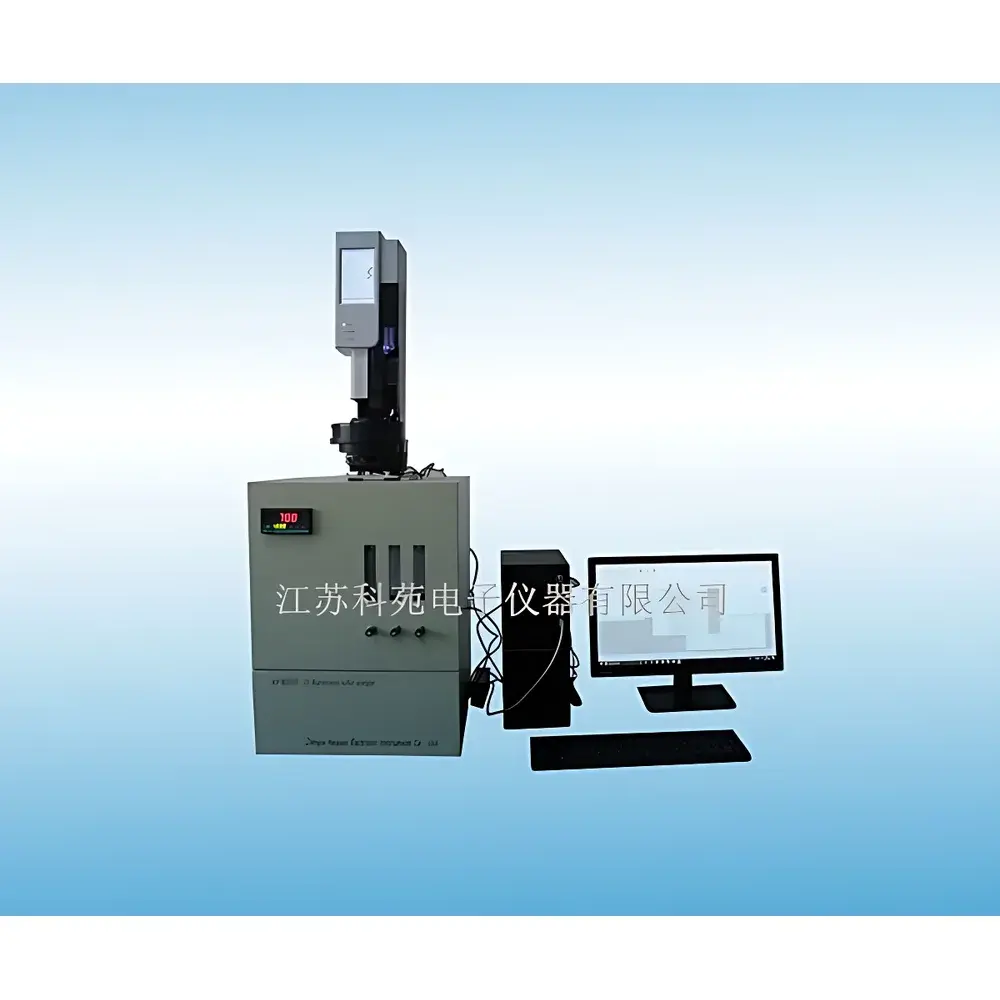
Kyoyuan KY-9000S Fully Automated UV Fluorescence Sulfur Analyzer
| Brand | Kyoyuan |
|---|---|
| Model | KY-9000S |
| Measurement Principle | UV Fluorescence (for Total Sulfur in Liquids) |
| Sample Type | Liquid |
| Sample Capacity | 19-position autosampler tray |
| Solvent Bottles | 2 |
| Waste Bottle | 1 |
| Injection Volume | 0.1–250 µL |
| Detection Range | 0.1–20,000 mg/L |
| LOD | 0.1 mg/L |
| Repeatability | ±0.2 mg/L at 1.0 mg/L |
| Furnace Temperature Range | Ambient to 1100 °C |
| Temperature Control Accuracy | ±2 °C |
| Gas Requirements | High-purity O₂ (≥99.99%) and Ar (≥99.99%) |
| Power Consumption | 1800 W |
| Compliance | ASTM D5453, D6667, D7183 |
Overview
The Kyoyuan KY-9000S Fully Automated UV Fluorescence Sulfur Analyzer is a high-performance elemental analyzer engineered for precise, trace-level quantification of total sulfur in liquid hydrocarbon matrices. It operates on the well-established ultraviolet fluorescence detection principle: samples are combusted in a high-temperature quartz furnace under controlled oxygen/argon atmosphere, converting sulfur compounds quantitatively to sulfur dioxide (SO₂). The resulting SO₂ is carried into a reaction chamber where it is excited by pulsed UV light; the intensity of the emitted fluorescence at 340–360 nm is linearly proportional to sulfur concentration and measured via a low-noise photomultiplier tube (PMT). This method delivers exceptional selectivity for sulfur—free from interference by nitrogen, carbon, or halogens—and meets stringent regulatory requirements for ultra-low sulfur diesel (ULSD), jet fuel, gasoline, lubricants, and biofuels.
Key Features
- Fully automated 19-position sample carousel with programmable injection volumes (0.1–250 µL), enabling unattended batch analysis and optimized throughput for QC laboratories.
- High-stability quartz combustion furnace with precise temperature control (ambient to 1100 °C, ±2 °C), ensuring complete oxidation of refractory sulfur species including thiophenes and sulfoxides.
- Low-noise, high-gain PMT detector with user-adjustable high-voltage bias—enabling dynamic optimization across wide concentration ranges without hardware modification.
- 24-bit analog-to-digital conversion and USB 2.0 interface ensure high-resolution signal acquisition, with minimum detectable signal <1 µV—critical for sub-ppm sulfur quantification.
- Critical components—including optical filters, reaction cell, and gas flow controllers—sourced from original-equipment manufacturers (OEMs) in Europe and Japan, contributing to long-term baseline stability and inter-laboratory reproducibility.
- Modular design supports field-replaceable consumables (quartz boats, combustion tubes, desiccant traps) and remote diagnostics via secure SSH or VNC protocols—reducing instrument downtime and service costs.
Sample Compatibility & Compliance
The KY-9000S is validated for direct analysis of neat liquid fuels (gasoline, kerosene, diesel, biodiesel blends), refinery intermediates (naphtha, FCC feedstocks), lubricating oils, and environmental water extracts. It complies fully with internationally recognized standard methods, including ASTM D5453 (light hydrocarbons, spark-ignition and diesel fuels, engine oils), ASTM D6667 (LPG and gaseous hydrocarbons), ASTM D7183 (aromatics and related compounds), ISO 17198 (DME), SH/T 0689 and GB/T 34100 (Chinese national standards for UV fluorescence sulfur determination), as well as GB/T 11060.8 for natural gas condensates. All calibration protocols support single-point and multi-point linear/nonlinear curve fitting, with built-in audit trails meeting GLP and GMP documentation requirements. Optional 21 CFR Part 11-compliant software modules provide electronic signatures, role-based access control, and immutable data archiving.
Software & Data Management
The Kyoyuan Analytical Suite v4.x is a platform-independent application compatible with Windows 10/11, macOS 12+, and Linux LTS distributions. It provides real-time chromatogram visualization, peak integration with baseline correction algorithms, automatic dilution factor calculation, and customizable report templates (PDF, CSV, XML). Raw data files are stored in open, non-proprietary formats—ensuring seamless integration with enterprise LIMS (e.g., LabWare, Thermo Fisher SampleManager) and ELN systems. Audit trail logs record all user actions, method changes, calibration events, and instrument status transitions—supporting FDA, EPA, and CNAS inspection readiness. Data export functions include full spectral traces, calibration curves, QC check results, and uncertainty estimation per ISO/IEC 17025 guidelines.
Applications
- Refinery process control: monitoring sulfur removal efficiency in hydrotreating units and predicting catalyst lifetime.
- Fuel certification: verifying compliance with global specifications (e.g., EN 590, ASTM D975, China VI, Euro 5/6).
- Research & development: evaluating sulfur speciation impact on exhaust aftertreatment systems (SCR, DPF) and fuel stability.
- Environmental testing: quantifying sulfur in wastewater effluents, soil leachates, and atmospheric particulate matter (PM₂.₅) digests.
- Quality assurance in petrochemical manufacturing: sulfur verification in solvents, monomers (e.g., butadiene), and specialty chemicals.
FAQ
What types of samples can be analyzed directly without derivatization?
Liquid hydrocarbons—including gasoline, diesel, jet fuel, naphtha, lubricating oils, biodiesel (B100), and ethanol blends (E10, E85)—can be injected directly. Aqueous samples require solvent extraction or acid digestion prior to analysis.
Is the instrument compatible with existing laboratory gas supply infrastructure?
Yes—the KY-9000S requires only standard high-purity oxygen (≥99.99%) and argon (≥99.99%), both delivered via stainless-steel tubing with dual-stage pressure regulators and particulate/moisture traps.
How does the system handle high-sulfur samples to prevent memory effects?
The analyzer incorporates an integrated high-efficiency scrubber module with regenerable copper oxide and silica gel traps, plus programmable post-run purge cycles (up to 120 s) to eliminate residual SO₂ from the optical path and reaction chamber.
Can calibration curves be transferred between instruments?
Yes—calibration parameters (slope, intercept, weighting factors) are stored in portable .cal files and can be imported across KY-9000S units within the same software version, supporting method transfer validation per ICH Q2(R2).
What maintenance intervals are recommended for routine operation?
Quartz combustion tubes should be inspected weekly and replaced every 3–6 months depending on sample matrix; PMT gain recalibration is advised monthly; full system performance verification using certified reference materials (CRM) is required before each analytical batch.





