
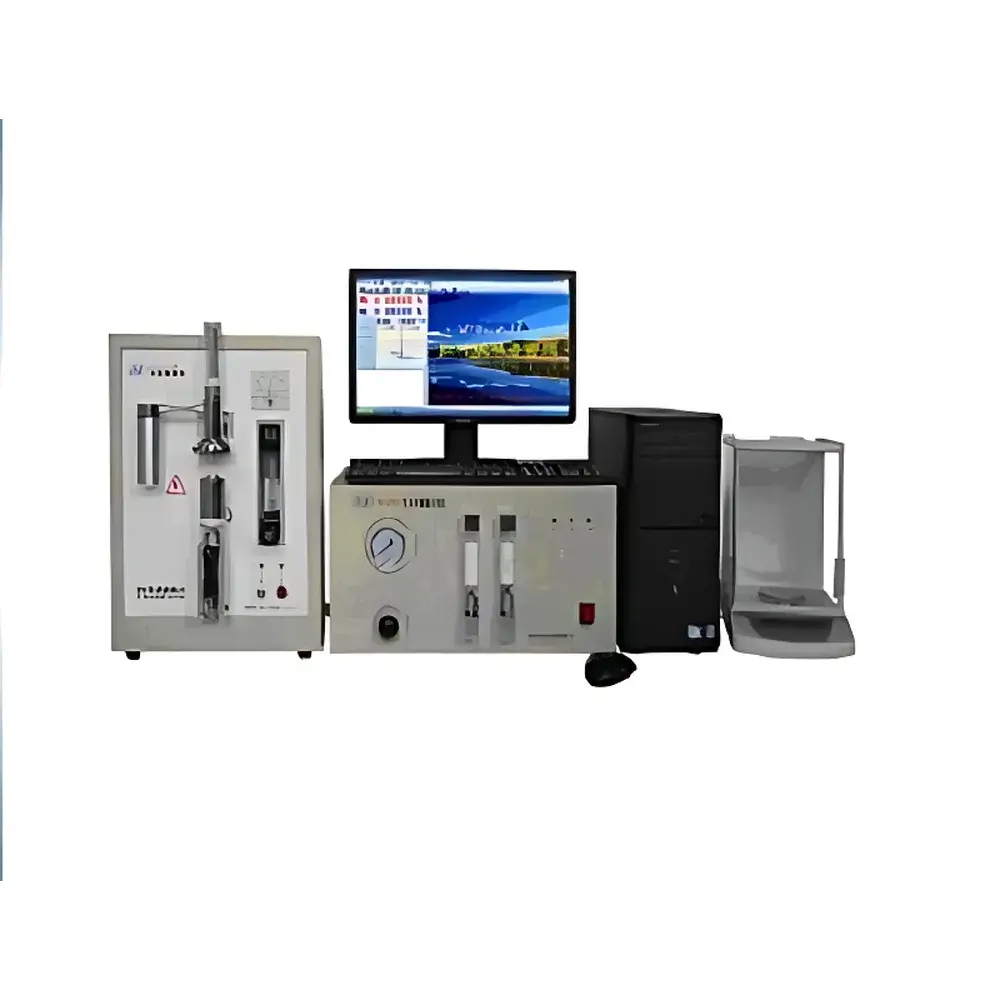
Kyoyuan KY-HW1A Arc Ignition Infrared Carbon-Sulfur Analyzer
| Brand | Kyoyuan |
|---|---|
| Model | KY-HW1A |
| Origin | Jiangsu, China |
| Manufacturer Type | Direct Manufacturer |
| Category | Domestic (China-Made) |
| Price Range | USD 7,000 – 14,000 (FOB China) |
| Measurement Principle | Arc Combustion Followed by Non-Dispersive Infrared (NDIR) Absorption |
| Elemental Coverage | Simultaneous C and S Quantification |
| Carbon Range | 0.005–6.0000 wt% (extendable to 99.999%) |
| Sulfur Range | 0.0005–0.3500 wt% (extendable to 99.999%) |
| Sample Mass (Solid Steel Reference) | 0.5 g ±20%, Continuous Weighing Mode |
| Analysis Precision | C meets or exceeds GB/T 223.69–2008 |
| Typical Analysis Time | 35 s (adjustable 20–60 s) |
| Operational Duty Cycle | 24/7 Continuous Operation |
| Detector | High-Stability Pyroelectric Infrared Sensor |
| Analysis Cell | Gold-Plated NDIR Cell |
| Light Source | Custom Platinum-Based IR Emitter |
| Power Supply | Taiwan-Made Switching Power Supply |
| Solenoid Valves | Airtac (Taiwan) Pneumatic Valves |
| Motor | Aerospace-Grade Synchronous Motor (100,000 hr MTBF) |
| Combustion Unit | KY-DRL1 Arc Furnace (2200 W Output) |
Overview
The Kyoyuan KY-HW1A Arc Ignition Infrared Carbon-Sulfur Analyzer is a dedicated elemental combustion analyzer engineered for precise, simultaneous quantification of total carbon (C) and sulfur (S) in solid metallic and non-metallic samples. It operates on the principle of high-energy arc combustion followed by non-dispersive infrared (NDIR) absorption spectroscopy — a method standardized under ISO 15350, ASTM E1019, and GB/T 223.68–1997 / GB/T 223.69–2008. The system couples with the KY-DRL1 arc furnace to achieve complete oxidation of refractory matrices at temperatures exceeding 3,500 °C, ensuring quantitative conversion of combined carbon and sulfur into CO2 and SO2, respectively. These gaseous products are then swept through a dual-channel, gold-plated NDIR cell where concentration-dependent absorbance at characteristic wavelengths (4.26 µm for CO2, 7.35 µm for SO2) is measured with high signal-to-noise ratio. The instrument’s architecture integrates PCI-bus-based real-time control and data acquisition, enabling deterministic timing, minimal thermal drift, and robust immunity to electromagnetic interference in industrial laboratory environments.
Key Features
- Simultaneous dual-element detection of carbon and sulfur within a single 35-second analysis cycle — no re-sampling or instrument reconfiguration required
- Extended dynamic range: certified 0.005–6.0000 wt% C and 0.0005–0.3500 wt% S, with documented linearity up to 99.999% for specialized calibration applications
- Continuous weighing mode supports 0.5 g ±20% sample mass without manual intervention — eliminates weighing errors and enables rapid throughput (≥60 samples/hour)
- Gold-plated infrared absorption cells ensure long-term optical stability, corrosion resistance against acidic SO2 condensates, and minimal baseline drift over extended operation
- Aerospace-grade synchronous motor (100,000-hour rated lifetime) drives the sample introduction mechanism, delivering repeatable positioning and thermal inertia management
- Industrial-grade components: Airtac (Taiwan) solenoid valves, custom platinum IR emitter with stable spectral output, and CE-certified switching power supply for voltage fluctuation tolerance
- 24/7 unattended operation capability validated under GLP-compliant environmental monitoring (20–30 °C, 30–80% RH, non-condensing)
Sample Compatibility & Compliance
The KY-HW1A is validated for use with ferrous alloys including low-, medium-, and high-carbon steels, stainless steels, cast irons, and tool steels. It also accommodates non-ferrous metals (e.g., Ni-base superalloys, cobalt-chrome), catalysts (e.g., petroleum hydrodesulfurization catalysts), ceramics, and geological silicates — provided samples are homogeneous, free of volatile halogens, and compatible with arc ignition. Method validation documentation aligns with ISO/IEC 17025 requirements for testing laboratories. Data integrity complies with FDA 21 CFR Part 11 principles via audit-trail-enabled software (see Software section). All hardware components meet IEC 61000-4 EMC standards and RoHS Directive 2011/65/EU material restrictions.
Software & Data Management
Control and analysis are managed via Kyoyuan’s proprietary Windows-based C/S software suite, supporting both local and network-deployed configurations. The interface provides real-time combustion profile visualization (O2 flow, pressure, IR signal decay), automatic baseline correction, multi-point linear/non-linear calibration curve fitting, and QC flagging per ASTM E29 criteria. All analytical events — including user login, calibration updates, result edits, and instrument diagnostics — are time-stamped and logged in an immutable audit trail. Raw spectra and processed results are exportable in CSV, XML, and LIMS-compatible ASTM E1382 format. Optional integration with enterprise LIMS systems is supported via ODBC and HL7 v2.5 interfaces. Software validation packages (IQ/OQ/PQ protocols) are available upon request for GMP-regulated environments.
Applications
- Quality control of incoming raw materials and finished steel billets in metallurgical production lines
- Verification of carbon equivalency (CE) and sulfur segregation limits per ASTM A6/A6M and EN 10027 specifications
- Trace sulfur monitoring in petrochemical catalysts to assess deactivation kinetics and regeneration cycles
- Research-grade quantification of interstitial carbon in martensitic phase transformations
- Compliance testing for automotive steel suppliers adhering to VDA 232-101 (sulfur ≤ 0.008 wt%) and IATF 16949 traceability requirements
- Environmental screening of slag and dust residues from electric arc furnace (EAF) operations
FAQ
What combustion method does the KY-HW1A employ, and why is arc ignition preferred for certain samples?
Arc ignition delivers localized energy densities exceeding those of induction or resistance furnaces, enabling complete oxidation of carbides (e.g., TiC, VC), sulfides (e.g., MnS), and graphitic carbon in high-alloy steels and cast irons without requiring flux additives.
Is the KY-HW1A compliant with international regulatory frameworks such as FDA 21 CFR Part 11?
Yes — when operated with enabled audit-trail logging, electronic signatures, and role-based access control, the system satisfies electronic record and signature requirements for regulated laboratories.
Can the instrument be integrated into an existing LIMS environment?
Yes — native ODBC drivers and configurable HL7 message templates support bidirectional data exchange with major LIMS platforms including Thermo Fisher SampleManager, LabVantage, and STARLIMS.
What maintenance intervals are recommended for routine operation?
Daily: desiccant replacement and O2 purifier check; Quarterly: IR cell cleaning and valve function verification; Annually: full optical alignment verification and detector sensitivity recalibration using NIST-traceable standards.
Does the system require external cooling water or compressed air?
No — the KY-HW1A operates with ambient air cooling and utilizes internal O2 generation or bottled oxygen; no external utility gases beyond 99.995% O2 are required.





