
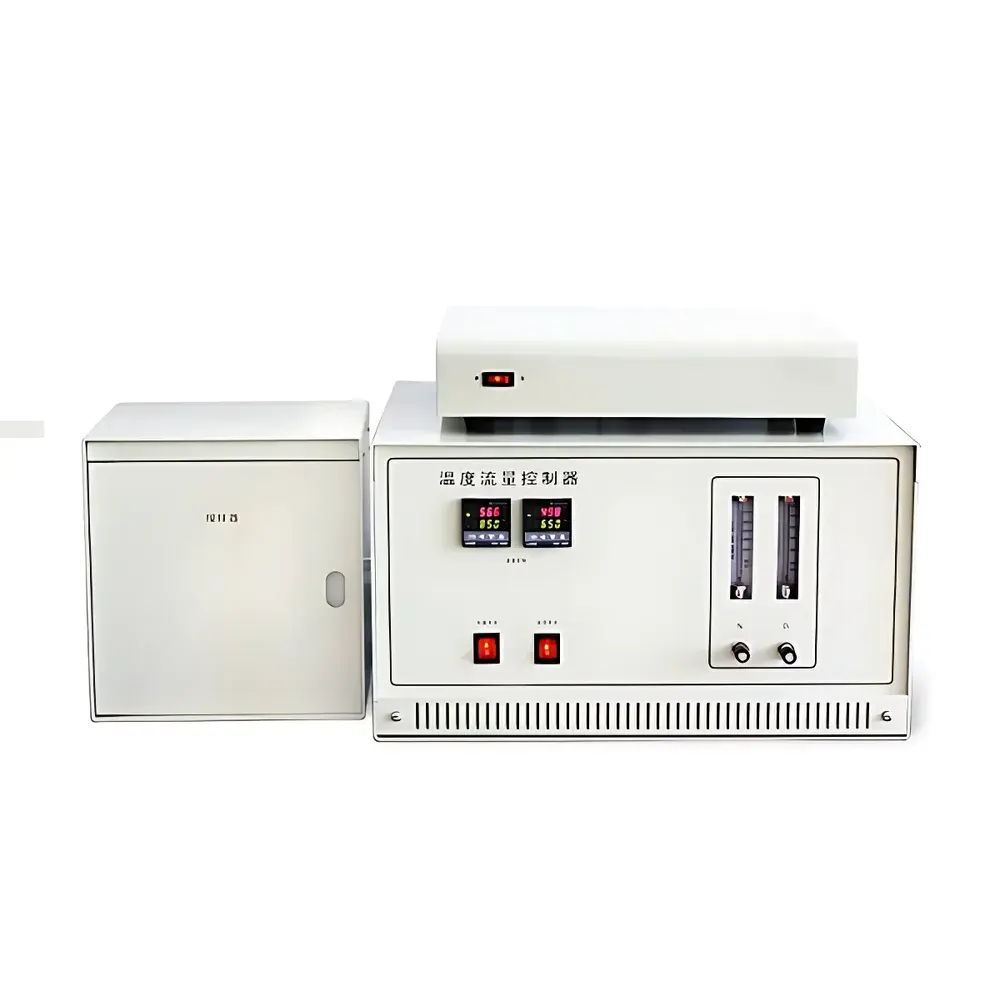
Kyoyuan WC-200 Microcoulometric Chlorine Analyzer
| Brand | Kyoyuan |
|---|---|
| Origin | Jiangsu, China |
| Manufacturer Type | Direct Manufacturer |
| Model | WC-200 |
| Detection Method | Coulometric Titration (Electrolytic Silver Generation) |
| Measurement Range | 1 ppm – 1 wt% Cl |
| Detection Limit | 1 ppm |
| Precision | ≤1 ppm (for 1–10 ppm Cl) |
| Sample Types | Solid, Liquid, or Viscous Petroleum Samples (with compatible autosampler or quartz boat system) |
| Temperature Control Range | Ambient to 1100 °C |
| Temperature Stability | ±1 °C |
| Gas Requirements | Industrial-grade O₂ and N₂ |
| Cooling System | Intelligent Fan-based Air Cooling |
| Compliance Standard | RIPP 64-90 (Refined Petroleum Products — Determination of Total Chlorine Content by Microcoulometry) |
| Power Rating | 1.5 kW |
Overview
The Kyoyuan WC-200 Microcoulometric Chlorine Analyzer is a dedicated electrochemical instrument engineered for precise, trace-level quantification of total chlorine in crude oil, heavy fuel oils, lubricants, and other complex hydrocarbon matrices. It operates on the fundamental principle of controlled-potential microcoulometric titration: samples are combusted under optimized oxidative conditions (O₂/N₂ carrier gas mixture) in a high-temperature quartz furnace (up to 1100 °C), converting organochlorine compounds into gaseous HCl. The liberated chloride ions are swept into a dual-electrode silver coulometric titration cell, where stoichiometric electrolytic generation of Ag⁺ ions occurs until all Cl⁻ is precipitated as AgCl. The total charge (coulombs) consumed during electrolysis is directly proportional to chlorine mass via Faraday’s law (1 mole Cl⁻ ≡ 96,485 C), enabling absolute quantification without external calibration standards.
Key Features
- True microcoulometric architecture with dual-working-electrode titration cell for high reproducibility and minimal electrode polarization effects.
- Digital signal processing core ensuring stable baseline, low noise, and accurate integration of current-time curves over extended analysis cycles.
- Automated temperature-programmable furnace with ±1 °C stability across ambient to 1100 °C—critical for complete pyrolysis of refractory chlorinated species in heavy fractions.
- Intelligent air-cooling system with thermostatically triggered fan control, eliminating water cooling infrastructure and reducing operational overhead.
- Integrated solid/liquid sample introduction capability via quartz boat and programmable solid sampler—compatible with ASTM D5808 and ISO 12913 adaptations for heterogeneous feedstocks.
- Real-time status monitoring, parameter logging, and result reporting via embedded industrial PC with Windows-based control software.
Sample Compatibility & Compliance
The WC-200 accommodates solid (e.g., catalysts, spent adsorbents), liquid (crude, distillates, jet fuels), and semi-solid (asphaltene-rich residues) samples after appropriate homogenization and weighing. Its combustion protocol meets the technical requirements of RIPP 64-90—the primary industry standard for chlorine determination in Chinese petroleum refineries—and is functionally aligned with ASTM D5808 (Standard Test Method for Chlorine in New and Used Petroleum Products by Microcoulometry) and ISO 12913 (Petroleum products — Determination of halogens by microcoulometry). All hardware and firmware components support GLP-compliant data integrity: audit trails, user access levels, electronic signatures, and raw current-time file export conform to FDA 21 CFR Part 11 expectations when deployed in regulated QC laboratories.
Software & Data Management
The proprietary Kyoyuan Analytical Suite provides full instrument control, real-time waveform visualization, automatic endpoint detection, and quantitative calculation using built-in Faraday constant correction algorithms. Each analysis generates a timestamped data package containing furnace thermogram, current-time profile, integrated charge value, calculated ppm/wt%, and operator ID. Reports are exportable in CSV, PDF, and XML formats; raw .DAT files retain unprocessed analog signals for retrospective reintegration. Database modules support batch tracking, trend analysis across shifts, and automated pass/fail flagging against configurable specification limits—enabling seamless integration into LIMS environments via ODBC or REST API interfaces.
Applications
- Monitoring chlorine ingress in refinery feedstocks to prevent catalyst poisoning (e.g., Pt/Re reforming catalysts, hydrodesulfurization units).
- Quality assurance of pipeline-spec crudes and marine bunker fuels per ISO 8217 Annex A (chlorine limit: ≤10 ppm).
- Verification of chlorine removal efficiency in solvent-refined lube base stocks and white oils.
- Regulatory compliance testing for EPA 40 CFR Part 63 Subpart GGGGG (petroleum refineries MACT) and EU REACH SVHC screening.
- Research applications in petrochemical reaction mechanism studies involving chlorinated intermediates or corrosion product characterization.
FAQ
What sample preparation is required prior to analysis?
Minimal preparation: liquids are injected directly; solids require precise weighing (±0.01 mg) into quartz cups and placement in the quartz boat. No derivatization or extraction is needed.
Can the WC-200 analyze organochlorine pesticides or PCBs in environmental samples?
Not without method adaptation and matrix-specific validation; its design targets petroleum matrices per RIPP 64-90. For environmental solids, EPA Method 1650 would require significant hardware modification and alternative combustion protocols.
Is the titration cell reusable, and what is its typical service life?
Yes—the Ag/AgCl dual-electrode cell is field-replaceable and maintains calibration stability for ≥500 injections under routine maintenance (electrolyte replacement every 30 days, periodic cell polishing).
Does the system support multi-point calibration verification?
While absolute quantification relies on Faraday’s law, optional certified reference materials (e.g., organochlorine standards traceable to NIST SRM 2723a) can be run periodically to verify system linearity and recovery across the 1 ppm–1% range.
How is data security ensured during long-term deployment in networked labs?
All data writes are journaled with SHA-256 hashing; user sessions enforce role-based permissions; and encrypted local storage complies with IEC 62443-3-3 SL2 requirements for industrial control systems.





