
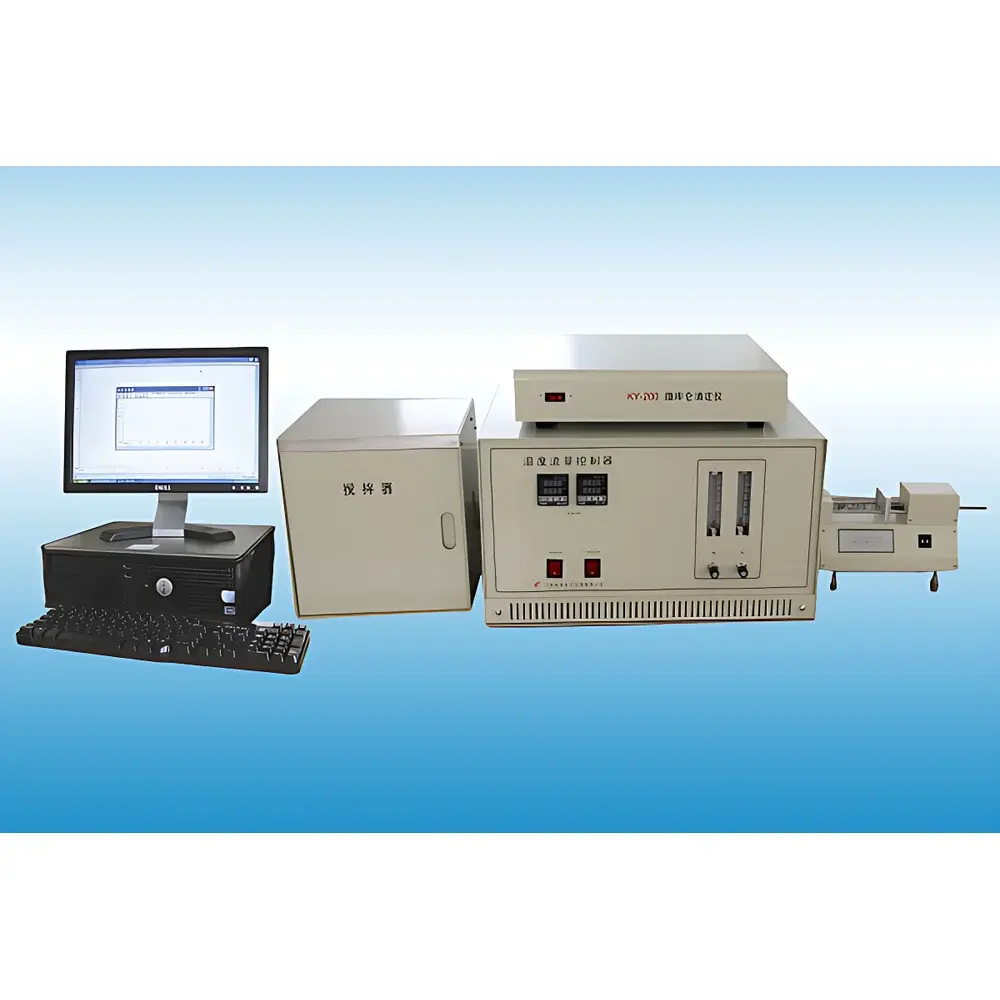
Kyuan KY-200 Microcoulometric Total Sulfur Analyzer
| Brand | Kyuan Instruments |
|---|---|
| Origin | Jiangsu, China |
| Manufacturer Type | Direct Manufacturer |
| Country of Origin | China |
| Model | KY-200 |
| Detection Target | Total Sulfur |
| Measurement Principle | Microcoulometric Titration (ASTM D3227, SH/T 0253, GB/T 11061.4, SH/T 0222) |
| Sample Forms | Liquid, Solid, Gas (with optional injectors) |
| Detection Range | 0.2–10,000 mg/L S |
| LOD | 0.2 mg/L S |
| Precision | CV ≤ 3% (for x > 10 mg/L S) |
| Temperature Control | Ambient to 1100 °C, ±1 °C |
| Power Requirement | 1500 W |
| Carrier Gases | Industrial-grade N₂ and O₂ |
| Cooling Method | Intelligent Fan-based Air Cooling |
| Compliance Standards | SH/T 0253, GB/T 11061.4, SH/T 0222 |
Overview
The Kyuan KY-200 Microcoulometric Total Sulfur Analyzer is a fully automated, benchtop analytical instrument engineered for precise quantification of total sulfur in petroleum products, refinery streams, natural gas condensates, LPG, and related hydrocarbon matrices. It operates on the fundamental principle of microcoulometric titration—where sulfur-containing compounds are thermally oxidized in a high-temperature quartz furnace under controlled N₂/O₂ atmosphere to generate SO₂. The gaseous SO₂ is swept into a dual-electrode titration cell, where it reacts stoichiometrically with electrogenerated iodine (I₂). The charge consumed during iodine regeneration is measured in real time and converted to sulfur mass via Faraday’s law (1 mole electrons ≡ 1/2 mole S ≡ 16.03 g S per 96,485 C). This method delivers trace-level sensitivity, inherent linearity, and minimal matrix interference—making it the reference technique for regulatory compliance testing in refining, custody transfer, and environmental monitoring.
Key Features
- Digital microcoulometric architecture with embedded PID temperature control and auto-calibrating electrolysis circuitry for long-term baseline stability
- Programmable high-temperature furnace (ambient to 1100 °C, ±1 °C accuracy) with rapid thermal ramping and inert-gas purged oxidation zone
- Integrated air-cooled cracking system featuring intelligent fan logic—fan activates only during high-temperature operation and deactivates automatically upon cooldown
- Modular sample introduction: compatible with liquid autosampler (standard), solid pyrolysis boat module, and gas sampling loop (optional)
- Real-time status monitoring via dedicated Windows-based control software—displays furnace temperature, titration current/voltage, coulombic efficiency, and reaction progress curves
- Compliance-ready data handling: audit-trail enabled logging, user-access levels, electronic signatures, and export formats aligned with GLP/GMP documentation requirements
Sample Compatibility & Compliance
The KY-200 accepts liquid fuels (gasoline, diesel, jet fuel, naphtha), liquefied petroleum gas (LPG), crude oil fractions, lubricants, and solid catalysts or residues when paired with appropriate sample preparation accessories. Its measurement methodology conforms rigorously to multiple internationally recognized standards: SH/T 0253 (light distillates), GB/T 11061.4 (natural gas), and SH/T 0222 (LPG)—all of which specify microcoulometric detection as the primary reference method for total sulfur. The instrument satisfies essential metrological criteria for routine QC laboratories, including repeatability per ISO 5725-2, detection limit verification per IUPAC guidelines, and operational validation per ASTM D7097 (standard practice for calibration of sulfur analyzers). No external certification is required for routine use in ISO/IEC 17025-accredited facilities when operated within validated parameters.
Software & Data Management
Kyuan’s proprietary KySulfur v3.2 software provides full instrument orchestration—from method setup and sequence definition to real-time curve visualization and report generation. All raw coulombic integrals, temperature profiles, and system diagnostics are timestamped and stored in encrypted binary archives. Users may generate customizable PDF reports compliant with internal QA templates or external regulatory submissions (e.g., EPA Method 1664B sulfur annex, EU EN 20846). Data export supports CSV, XML, and LIMS-compatible ASTM E1384 formats. Software features include method locking, calibration history tracking, drift compensation algorithms, and automatic dilution factor application for samples exceeding 5000 mg/L S. The system supports 21 CFR Part 11-compliant configuration when deployed with network authentication and Windows Active Directory integration.
Applications
- Refinery process control: monitoring sulfur removal efficiency across hydrotreaters and desulfurization units
- Custody transfer testing of pipeline-spec diesel and marine fuel (ISO 8217, ASTM D975, EN 590)
- Research and development of low-sulfur additives, catalysts, and alternative fuels
- Environmental compliance: verification of ultra-low-sulfur diesel (ULSD, ≤15 mg/kg) and Tier 3 gasoline specifications
- Quality assurance in petrochemical feedstock evaluation (e.g., ethylene cracker feed, reformate)
- Third-party inspection and customs clearance testing per national import regulations (e.g., China GB 17930, India IS 1460)
FAQ
What sample types can be analyzed without modification?
Liquid petroleum products—including gasoline, kerosene, diesel, and light naphthas—can be injected directly using the standard liquid autosampler. Solid and gaseous samples require optional hardware modules.
Is carrier gas purity critical for accurate results?
Yes. Industrial-grade nitrogen (99.99% pure) and oxygen (99.5% pure) are sufficient; ultra-high-purity gases are unnecessary and may cause over-oxidation artifacts.
How often must the titration cell be cleaned or refilled?
Under normal operation (≤20 injections/day), the electrolyte requires replenishment every 7–10 days; cell cleaning is recommended after every 50 analyses or when baseline noise exceeds 5 nA.
Can the KY-200 measure chlorine simultaneously with sulfur?
No. The KY-200 is optimized exclusively for sulfur detection. A separate KY-200Cl variant—configured with Ag⁺/Ag redox chemistry—is available for total chlorine analysis.
Does the system support remote diagnostics or service access?
Yes. Optional KyRemote Connect module enables secure, encrypted technician access for firmware updates, parameter validation, and troubleshooting—fully auditable and configurable per IT security policy.






