
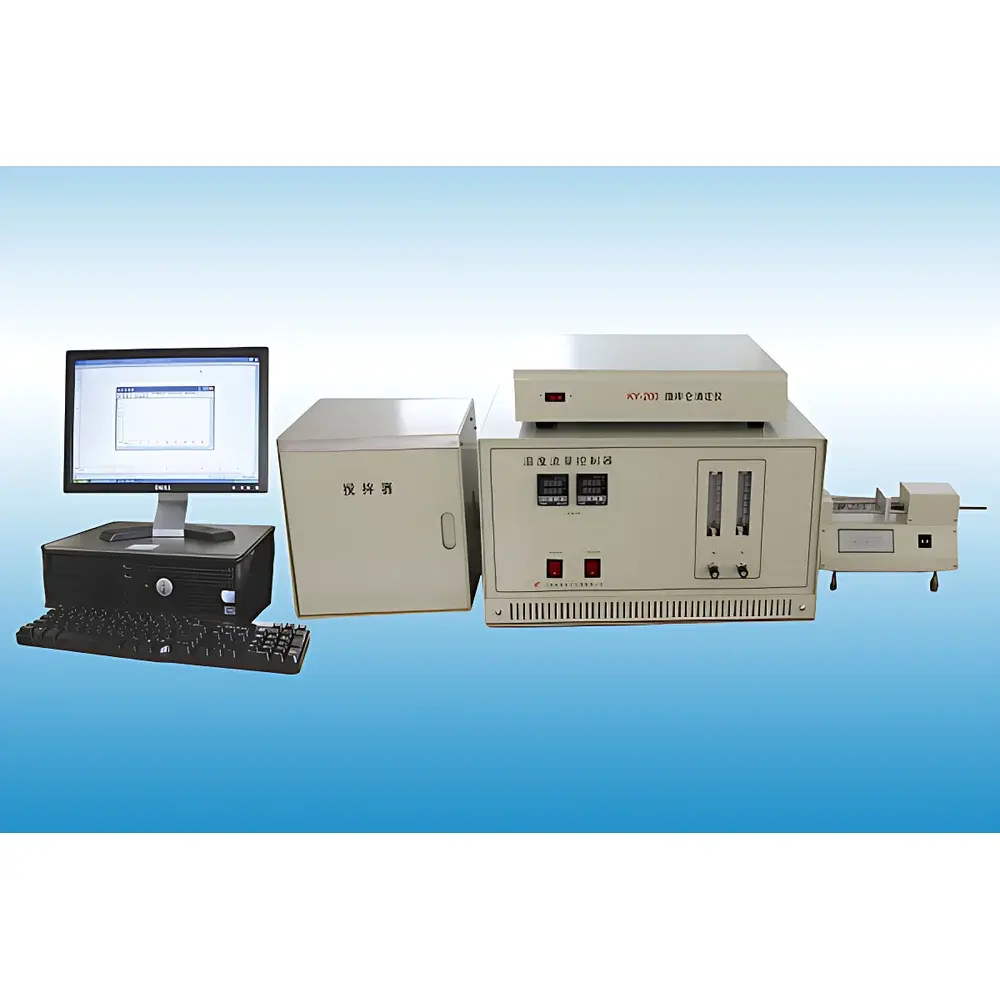
Kyuyuan KY-200 Microcoulometric Chlorine Analyzer
| Origin | Jiangsu, China |
|---|---|
| Manufacturer Type | Authorized Distributor |
| Origin Category | Domestic (PRC) |
| Model | KY-200 |
| Price Range | USD 4,200 – 7,000 (FOB) |
| Analyte Scope | Total Sulfur, Total Nitrogen, and Halides (Cl⁻, Br⁻, I⁻) |
| Measurement Principle | Microcoulometric Titration per ASTM D5808 & GB/T 18612 |
| Detection Range (Cl) | 0.05–10,000 mg/L |
| LOD (Cl) | 0.05 mg/L |
| Repeatability | ≤10% (≤1 mg/L), ≤8% (1–10 mg/L), ≤3% (>10 mg/L) |
| Sensitivity | 0.05 mg NaCl/L |
| Furnace Temp Control | Ambient to 1000 °C ±1 °C |
| Cooling Method | Intelligent Fan-Cooled |
| Analysis Time | ~3 min/sample (excluding sample prep) |
Overview
The Kyuyuan KY-200 Microcoulometric Chlorine Analyzer is a dedicated high-precision instrument engineered for the quantitative determination of total chlorine—alongside total sulfur and total nitrogen—in petroleum products, feedstocks, and refined hydrocarbons. It operates on the fundamental principle of microcoulometric titration: samples are combusted under controlled oxygen/nitrogen atmosphere at temperatures up to 1000 °C, converting all organic and inorganic chlorine species quantitatively into hydrogen chloride (HCl). The evolved HCl is carried by carrier gas into a dual-electrode microcoulometric titration cell, where electrogenerated silver ions (Ag⁺) react stoichiometrically with Cl⁻. The instrument measures the integrated charge (coulombs) consumed during electrolysis, applying Faraday’s law to compute chlorine concentration directly in mg/L or ppm. This method ensures trace-level sensitivity, excellent linearity across five orders of magnitude, and compliance with internationally recognized test methods including ASTM D5808-09 (Standard Test Method for Determination of Organic Chloride in Aromatic Hydrocarbons and Related Compounds by Microcoulometry) and GB/T 18612-2011 (Determination of Organic Chlorine Content in Crude Oil).
Key Features
- Fully automated analysis workflow: integrated autosampler enables unattended batch processing of up to 48 samples with programmable sequence control.
- Digital microcoulometric detection system with real-time charge integration, low-noise amplification, and adaptive baseline correction for enhanced signal stability.
- High-temperature quartz combustion furnace with PID-controlled heating (ambient to 1000 °C, ±1 °C accuracy) and intelligent fan-based cooling—fan activates automatically during cooldown and deactivates upon stabilization.
- Robust dual-electrode titration cell design using Ag/Ag⁺ reference and working electrodes; optimized electrolyte formulation ensures long-term cell lifetime and minimal drift.
- Embedded industrial-grade controller synchronized with PC-based acquisition software; supports dual-mode operation (standalone diagnostics or full PC-integrated control).
- Compliance-ready architecture: audit trail logging, user-access levels (admin/operator), electronic signature support, and data export formats compatible with LIMS integration.
Sample Compatibility & Compliance
The KY-200 accepts liquid hydrocarbon samples—including crude oil, naphtha, gasoline, diesel, jet fuel, lubricants, and reformate—without derivatization. Solid or viscous samples (e.g., bitumen, heavy fuel oil) require appropriate dilution in xylene or chlorinated solvents prior to injection. Sample introduction is via programmable liquid-phase syringe injection (1–100 µL range) or optional solid probe module. All analytical procedures adhere to quality assurance frameworks aligned with ISO/IEC 17025, ASTM D5808, GB/T 18612, and UOP 470. For regulated environments, the system supports 21 CFR Part 11-compliant data handling when deployed with validated software configurations and documented change control procedures.
Software & Data Management
KY-200 Control Suite is a Windows-based application delivering real-time monitoring of combustion temperature, cell voltage, electrolysis current, and coulombic integration curves. It provides customizable report templates (PDF/CSV/XLSX), calibration curve management (multi-point linear/nonlinear), QC flagging (e.g., out-of-range recovery, carryover alerts), and automatic recalibration prompts based on user-defined drift thresholds. Raw data files include timestamped metadata (operator ID, method ID, sample ID, instrument serial number), supporting GLP/GMP traceability. Audit logs record all parameter modifications, result approvals, and user logins—retained for ≥18 months unless archived externally per organizational policy.
Applications
- Monitoring organic chloride contamination in refinery feedstocks to prevent catalyst poisoning in hydrotreating and FCC units.
- Verifying compliance with ASTM D4294 (Sulfur) and D5808 specifications for pipeline-quality hydrocarbons and marine fuels.
- Supporting R&D studies on chlorine speciation in biofuels and synthetic crude blends.
- Quality control of aviation turbine fuels (Jet A/A-1) per DEF STAN 91-91 and NATO F-34 requirements.
- Environmental testing of wastewater effluents from petrochemical plants where halogenated organics must be quantified below regulatory thresholds (e.g., EPA Method 1650).
FAQ
What sample types are compatible with the KY-200?
Liquid petroleum fractions, distillates, and light crudes are directly injectable. High-boiling or asphaltic materials require solvent dilution (e.g., xylene) and homogenization prior to analysis.
Does the KY-200 meet ASTM D5808 requirements?
Yes—the instrument implements the core microcoulometric methodology, furnace temperature profile, titration cell configuration, and calibration protocol specified in ASTM D5808-09.
Can the same system analyze sulfur and nitrogen simultaneously?
No. While the KY-200 platform supports total sulfur and total nitrogen measurement via separate modules (requiring distinct electrolytes and detector configurations), chlorine analysis uses a dedicated Ag⁺/Cl⁻ titration cell. Multi-analyte capability necessitates hardware reconfiguration and method validation per analyte.
Is routine maintenance required for the combustion furnace?
Yes. Quartz liner inspection and cleaning every 200–300 analyses is recommended; thermocouple verification annually or after 500 h of operation. Full furnace calibration is advised following any physical impact or thermal shock event.
How is data integrity ensured during regulatory audits?
Through time-stamped audit trails, role-based access controls, electronic signatures, and immutable raw data storage—all configurable to align with FDA 21 CFR Part 11 and EU Annex 11 expectations when validated per site-specific SOPs.





