
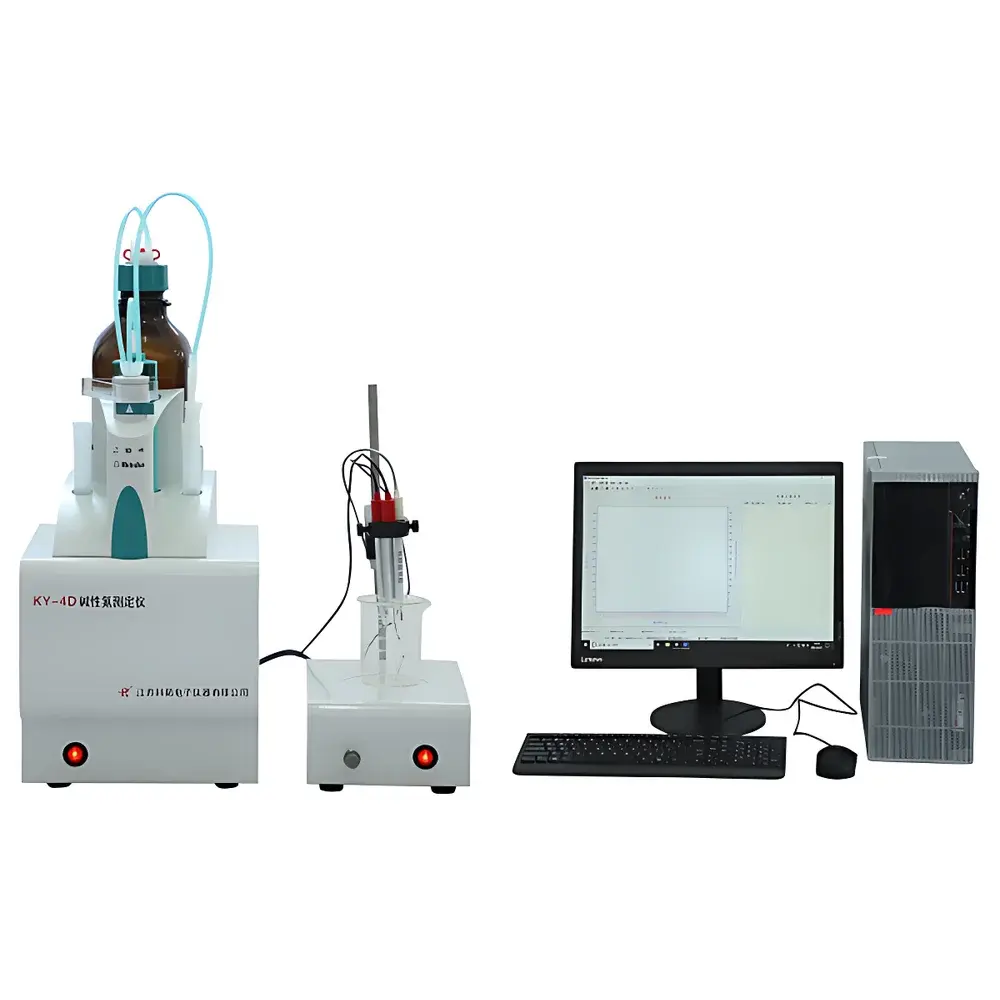
Kyuyuan KY-4D Alkaline Nitrogen Analyzer
| Origin | Jiangsu, China |
|---|---|
| Manufacturer Type | Distributor |
| Origin Category | Domestic |
| Model | KY-4D |
| Price Range | USD 4,200–7,000 |
| Detection Principle | Potentiometric Titration |
| Portability | Benchtop (Non-portable) |
| Analyte | Alkaline Nitrogen in Petroleum Products |
| Measurement Range | ≥3 µg/g |
| Analysis Time | <10 min |
| Detection Limit | ±0.1% F.S. |
| Indication Error | 0.1% F.S. ± 0.5 mV |
| Titration Resolution | 0.01 mL |
| Electrode Potential Range | 0 to ±1999.5 mV |
| Burette Accuracy | ±0.1% F.S. |
| Electronic Unit Basic Error | 0.1% of full scale ± 0.5 mV |
| Relative Error | ≤5% |
| Compliance Standard | SH/T 0162–1992 |
Overview
The Kyuyuan KY-4D Alkaline Nitrogen Analyzer is a benchtop potentiometric titration system engineered for the quantitative determination of alkaline nitrogen compounds in petroleum distillates, lubricating oils, crude fractions, and refinery intermediates. Unlike sulfur-specific analyzers, this instrument targets nitrogen-containing basic species—primarily quinolines, acridines, and substituted pyridines—that contribute to catalyst poisoning, corrosion, and instability in downstream refining processes. It operates on the principle of automated potentiometric titration using perchloric acid in glacial acetic acid as titrant, with real-time monitoring of electrode potential shifts to identify stoichiometric endpoints. The system conforms strictly to SH/T 0162–1992, the People’s Republic of China industry standard equivalent in scope and methodology to ASTM D2597 (for hydrocarbon analysis) and aligned with ISO 8217 Annex D guidance on nitrogen speciation in marine fuels. Designed for routine QC/QA environments, it delivers reproducible results under GLP-compliant workflows without requiring operator interpretation of colorimetric endpoints.
Key Features
- Full automation of titration sequence—including reagent delivery, endpoint detection, electrode rinsing, and blank correction—minimizing manual intervention and inter-operator variability.
- Imported Swiss-made titration module with low-noise precision stepper motor drive and ceramic syringe pump, ensuring long-term volumetric accuracy and mechanical durability over >10,000 titrations.
- Dual high-impedance input circuitry (≥1013 Ω) for stable reference and indicator electrode signal acquisition, reducing drift during extended measurements in low-conductivity organic media.
- Windows-based control software with intuitive graphical interface, supporting multi-step method programming, real-time titration curve visualization, and automatic baseline correction via Savitzky–Golay smoothing algorithms.
- Integrated data handling: auto-storage of raw potential vs. volume data, endpoint coordinates, sample ID, operator tag, timestamp, and audit trail metadata—all exportable in CSV or PDF format.
- Compliance-ready configuration: supports user-level access control, electronic signature prompts, and optional 21 CFR Part 11 add-ons for regulated laboratories operating under GMP or ISO/IEC 17025 frameworks.
Sample Compatibility & Compliance
The KY-4D accepts liquid petroleum samples within viscosity limits compatible with standard 1–5 mL volumetric dosing (e.g., naphthas, kerosenes, diesel fractions, and vacuum gas oils). Samples must be free of suspended solids and water content <0.05 wt%, per SH/T 0162–1992 pre-treatment requirements. It is not suitable for heavy residuals, bitumens, or solid-phase catalysts without prior solvent extraction. Instrument validation follows SH/T 0162–1992 procedural verification protocols—including repeatability testing (RSD ≤3.5% at 10 µg/g level), recovery assessment using certified reference materials (CRMs) such as NIST SRM 2721a (alkaline nitrogen in fuel oil), and linearity verification across 3–100 µg/g range. Calibration verification is performed daily using standardized HClO4/HOAc solutions traceable to national metrology institutes.
Software & Data Management
The embedded Windows application provides full method lifecycle management: from creation of sample batches and assignment of calibration curves to post-run statistical evaluation (mean, SD, RSD, confidence intervals). All raw electrode potential readings are logged at 100 ms intervals, enabling retrospective endpoint re-evaluation using first-derivative or Gran plot methods. Audit trails record every parameter change, result modification, or report generation event with immutable timestamps and user IDs. Data exports meet LIMS interoperability requirements via ODBC connectivity and support structured metadata tagging compliant with ASTM E1469 (Standard Practice for Laboratory Information Management Systems). Optional firmware upgrade enables encrypted local database storage and TLS 1.2–secured remote diagnostics.
Applications
- Refinery QC labs quantifying alkaline nitrogen in hydrotreater feedstocks to assess catalyst deactivation risk.
- Fuel specification compliance testing for marine distillate fuels per ISO 8217:2017 Table 2 limits (max 0.1 mg/kg for DMA grade).
- R&D screening of nitrogen removal efficiency during solvent extraction or adsorption studies.
- Correlation studies between alkaline nitrogen content and thermal stability indices (e.g., Ramsbottom carbon residue).
- Supporting ASTM D6443 (XRF sulfur) and ASTM D5453 (UVF sulfur) workflows where nitrogen interference correction is required.
FAQ
What sample preparation is required prior to analysis?
Samples must be homogenized and filtered through a 0.45 µm PTFE membrane; water content must be reduced to <0.05 wt% via azeotropic distillation or Karl Fischer drying.
Can the instrument be used for total nitrogen analysis?
No—this system is specifically validated for alkaline nitrogen only, as defined by SH/T 0162–1992. Total nitrogen requires chemiluminescence (ASTM D4294) or Kjeldahl digestion methods.
Is method transfer possible from legacy manual titration setups?
Yes—built-in method conversion tools allow direct import of classical titration parameters (e.g., titrant normality, sample mass, dilution factors) into automated sequences with endpoint tolerance adjustment.
How often does the measuring electrode require recalibration?
Electrode calibration is recommended before each analytical batch using two-point buffer verification (±500 mV and 0 mV in acetic acid medium); full system performance verification is required weekly.
Does the system support multi-language UI?
The base software interface is English-only; Chinese language localization is available upon request for domestic deployment, but all exported reports and metadata remain in English to ensure international traceability.





