
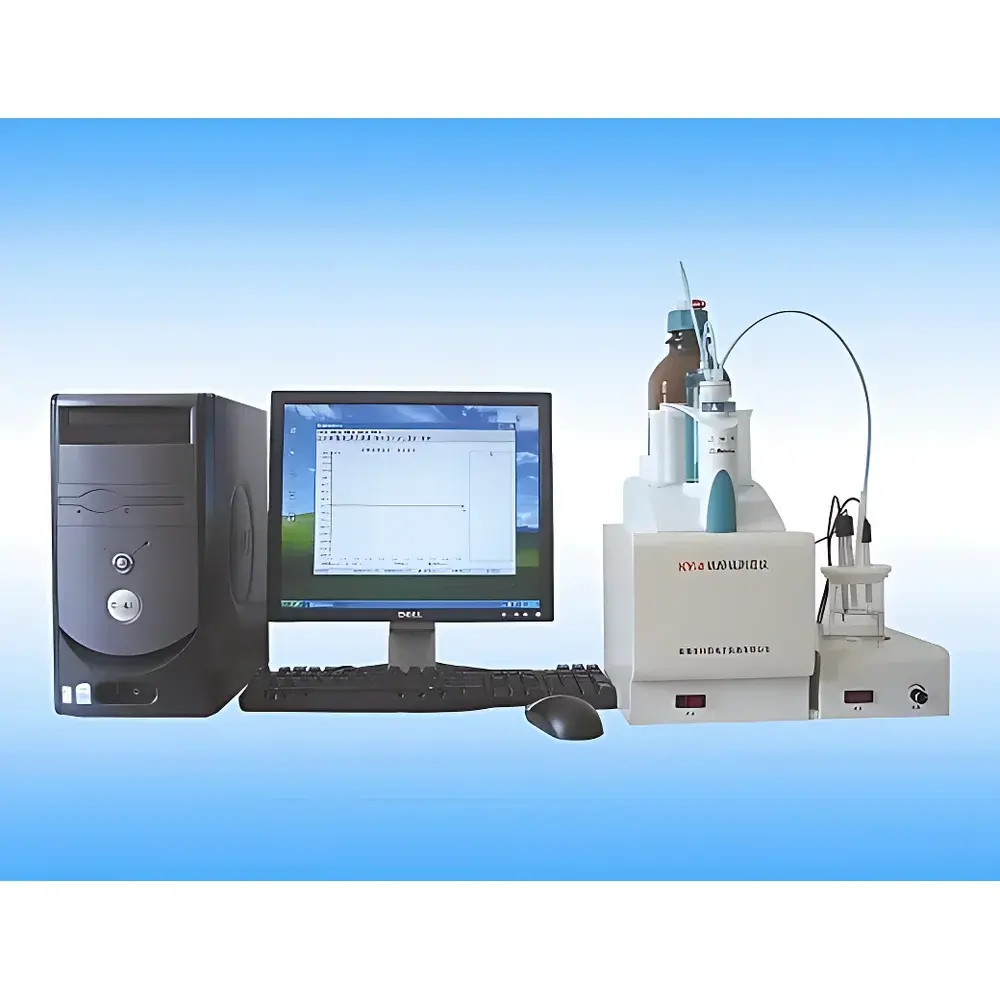
Kyuyuan KY-4S Mercaptan Sulfur Analyzer
| Origin | Jiangsu, China |
|---|---|
| Manufacturer Type | Authorized Distributor |
| Origin Category | Domestic (China) |
| Model | KY-4S |
| Pricing | Available Upon Request |
| Sample Type | Liquid |
| Analytical Method | Potentiometric Titration |
| Detection Limit | ≥3 µg/g |
| Minimum Titrant Dispense Volume | 0.01 mL |
| Electrode Potential Range | 0 to ±1999.5 mV |
| Burette Accuracy | ±0.1% F.S. |
| Electronic Unit Basic Error | ±0.1% of full scale + 0.5 mV |
| Relative Standard Deviation | ≤5% |
| Compliance Standard | GB/T 1792–1988 “Determination of Mercaptan Sulfur in Distillate Fuels” |
Overview
The Kyuyuan KY-4S Mercaptan Sulfur Analyzer is a dedicated potentiometric titration system engineered for the precise quantification of mercaptan sulfur (R–SH) in liquid petroleum distillates, including gasoline, kerosene, diesel, and jet fuel. It operates on the fundamental principle of selective electrochemical titration using silver nitrate (AgNO₃) as the titrant, where mercaptan anions form insoluble silver thiolate precipitates—generating a well-defined inflection point in the potential vs. volume curve. This endpoint is detected via dual high-impedance potentiometric electrodes, ensuring minimal current draw and stable baseline potential response. The instrument integrates a microprocessor-controlled burette drive, real-time potential acquisition at 10 Hz sampling rate, and adaptive endpoint recognition algorithms that apply Savitzky–Golay smoothing to raw titration curves—effectively suppressing noise while preserving inflection fidelity. Designed specifically to meet the procedural requirements of GB/T 1792–1988 (equivalent in scope to ASTM D3229 and IP 177), the KY-4S delivers trace-level sulfur speciation capability with documented repeatability under routine laboratory conditions.
Key Features
- Imported precision burette module with ceramic piston and PTFE-coated plunger, delivering consistent volumetric accuracy of ±0.1% F.S. across the full 10 mL dispensing range
- Dual high-input-impedance (>10¹² Ω) potentiometric amplifier circuitry, minimizing electrode polarization and enabling stable mV readings within ±0.5 mV baseline drift over 60-minute operation
- Automated fluid handling sequence: solvent priming, sample aspiration, reagent addition, titrant delivery, and post-titration rinse—all programmable via intuitive Windows-based interface
- Real-time titration curve visualization with dynamic endpoint recalculation; software applies first-derivative peak detection and second-derivative zero-crossing validation to confirm stoichiometric equivalence
- Integrated calibration verification protocol: built-in reference electrode check and Ag⁺ standard solution titration validation before each analytical batch
Sample Compatibility & Compliance
The KY-4S accepts clear, low-viscosity liquid hydrocarbon samples conforming to GB/T 1792–1988 specifications—including unstabilized gasoline fractions, hydrotreated naphthas, and aviation turbine fuels. Samples must be free of suspended solids, water emulsions, or excessive dissolved H₂S (which interferes stoichiometrically). The analyzer complies with national metrological verification regulation JJG 814–2015 for automatic potentiometric titrators and supports audit-ready documentation per GLP requirements. While not pre-certified for FDA 21 CFR Part 11, its software architecture permits configuration of user access levels, electronic signature fields, and full audit trail logging—including timestamped method parameters, raw potential data, and manual override records.
Software & Data Management
The KY-4S is operated via Kyuyuan TitraSoft v3.2—a standalone Windows application supporting method creation, sequence scheduling, and automated report generation in PDF or CSV format. Each analysis session saves raw mV vs. mL data points (≥200 points per titration), smoothed derivative curves, calculated endpoint volumes, and final sulfur mass concentration (µg/g) referenced to sample weight. Data files are stored in encrypted SQLite databases with SHA-256 hash integrity checks. Export modules support LIMS integration via ODBC drivers, and all reports include embedded metadata: analyst ID, instrument serial number, calibration date, ambient temperature/humidity logs, and GB/T 1792–1988 clause references.
Applications
- Quality control of refinery streams prior to mercaptan extraction or sweetening units
- Verification of sulfur removal efficiency in Merox® or caustic wash processes
- Regulatory compliance testing for ultra-low-sulfur diesel (ULSD) and Euro 5/6 fuel certification
- Research-grade speciation studies correlating mercaptan content with copper corrosion ratings (ASTM D130)
- Stability assessment of stored bio-blended fuels where oxidative mercaptan formation may occur
FAQ
Does the KY-4S support ASTM D3229 or IP 177 test protocols?
Yes—the hardware configuration, titrant chemistry, and endpoint detection logic fully align with the operational intent of ASTM D3229 and IP 177. Method templates for these standards are included in TitraSoft v3.2.
Can the system analyze viscous or wax-containing distillates?
No—GB/T 1792–1988 explicitly restricts applicability to samples with kinematic viscosity below 10 mm²/s at 20 °C. High-viscosity fuels require pre-dilution with xylene or toluene, validated per Annex B of the standard.
Is electrode maintenance documented in the software?
Yes—TitraSoft prompts users to log electrode cleaning cycles, reference electrolyte refills, and membrane replacement dates. These entries appear in the final report footer.
What is the minimum detectable sulfur concentration?
The validated lower limit of quantitation (LLOQ) is 3 µg/g, determined per ICH Q2(R2) guidelines using signal-to-noise ≥10 and within-run precision ≤5% RSD (n=6).
How is system suitability verified before daily use?
A certified 10 µg/g mercaptan standard (traceable to NIM, China) is analyzed; results must fall within ±5% of certified value, and endpoint RSD across triplicates must be ≤2.5%.






