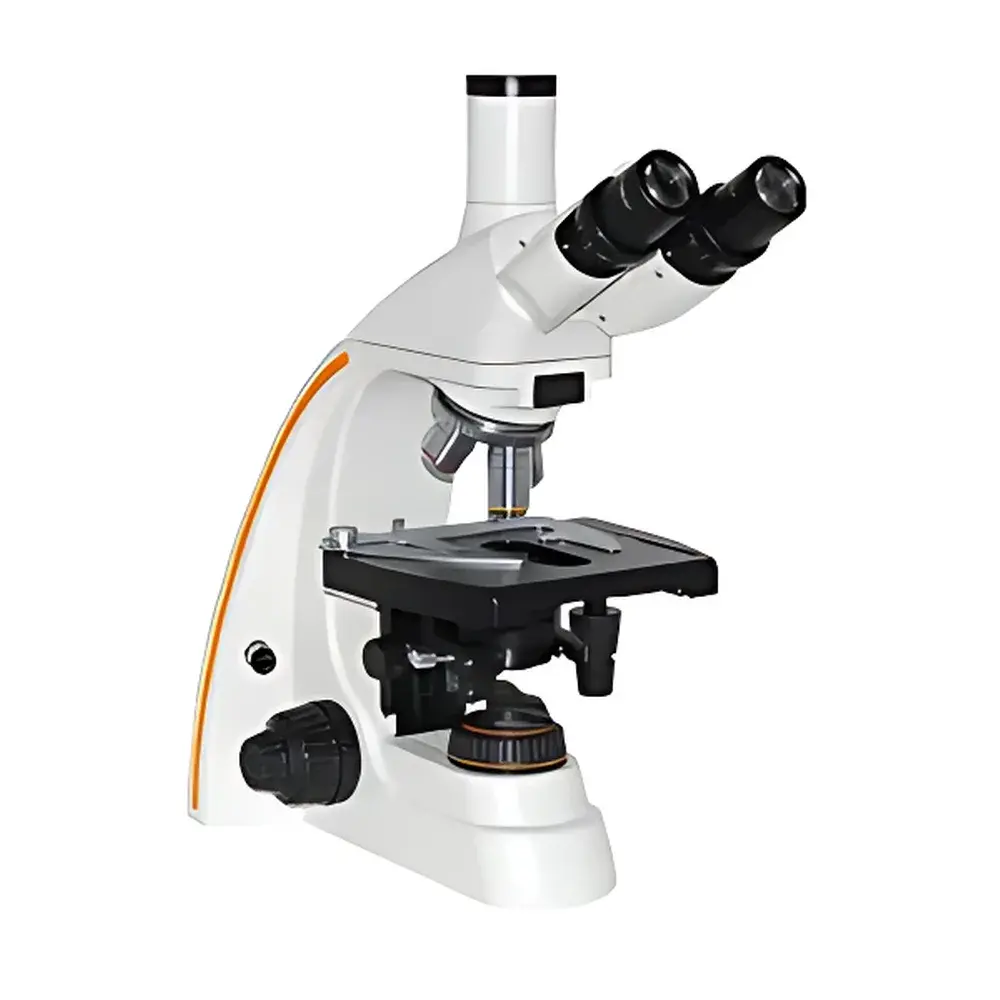
L2800 Research-Grade Biological Microscope
| Origin | Guangdong, China |
|---|---|
| Manufacturer Type | Authorized Distributor |
| Origin Category | Domestic (China) |
| Model | L2800 |
| Price | USD 1,200 (FOB Guangdong) |
| Optical System | Infinity-Corrected Achromatic Plan Objectives |
| Eyepieces | Widefield WF10X (Φ22 mm) |
| Objective Lenses | PL 4X/0.10 (WD 19.8 mm), PL 10X/0.25 (WD 5.0 mm), PL 40X/0.65 (Spring, WD 0.66 mm), PL 100X/1.25 (Spring, Oil Immersion, WD 0.36 mm) |
| Nosepiece | Four-Position Internal Ball-Bearing Turret |
| Stage | Dual-Layer Mechanical Stage (193 × 155 mm, 75 × 50 mm Travel) |
| Condenser | Abbe Condenser NA 1.25 with Vertical Adjustment |
| Filters | Blue Filter + Ground Glass |
| Illumination | High-Power Adjustable White LED (≥12,000 lux at specimen plane) |
| Focusing Mechanism | Coaxial Coarse/Fine Focus (Fine Focus Graduation: 2 µm, Locking & Upper/Lower Limit Stops) |
| Tube | Trinocular, 30° Inclined |
Overview
The L2800 Research-Grade Biological Microscope is an infinity-corrected, upright transmitted-light microscope engineered for high-fidelity brightfield observation in academic laboratories, clinical training facilities, and quality control environments. Its optical architecture employs plan achromatic objectives with full chromatic and spherical aberration correction across the visible spectrum (400–700 nm), ensuring flat, high-contrast imaging with minimal edge distortion—critical for quantitative morphological analysis of unstained or stained biological specimens. Designed to meet ISO 10934-1 (Microscopes — Nomenclature of parts and functions) and aligned with ASTM E2867-22 (Standard Guide for Selection and Use of Microscopes in Life Science Applications), the L2800 supports reproducible visual documentation and routine microscopy workflows where ergonomic sustainability and optical fidelity are non-negotiable.
Key Features
- Infinity-corrected plan achromatic objective suite (4×, 10×, 40×, 100× oil) delivering uniform resolution and consistent color fidelity across the entire field of view (FOV Φ22 mm).
- Trinocular head with 30° inclination and standardized C-mount interface (1× magnification path) for seamless integration with digital imaging systems compliant with USB 3.0, HDMI, or analog video standards.
- Dual-layer mechanical stage (193 × 155 mm footprint, 75 × 50 mm travel range) with engraved vernier scales and low-friction linear bearings—optimized for precise specimen repositioning during time-series or multi-region analysis.
- Coaxial coarse/fine focusing system with 2 µm fine-focus graduation, integrated upper/lower limit stops, and focus-locking mechanism—enabling stable Z-stack acquisition and operator fatigue reduction during extended sessions.
- Adjustable high-luminance white LED illumination (DC-driven, constant-current circuitry) with continuous intensity control (0–100%), thermal management, and >50,000-hour rated lifetime—eliminating halogen bulb replacement cycles and spectral drift.
- Abbe condenser (NA 1.25) with centering screws and vertical rack-and-pinion adjustment—supporting Köhler illumination setup per ISO 8578 and enabling optimal resolution matching for all objectives up to 100×.
Sample Compatibility & Compliance
The L2800 accommodates standard glass microscope slides (26 × 76 mm, ≤1.2 mm thickness) and coverslips (No. 1.5, 0.17 mm), including live-cell chambers (e.g., Lab-Tek II chambered coverglass) when used with optional long-working-distance accessories. It complies with IEC 61000-6-3 (EMC emission limits) and IEC 61010-1 (safety requirements for laboratory equipment). While not certified for GMP manufacturing environments, its mechanical stability, repeatable focus mechanics, and traceable optical calibration pathways support GLP-aligned documentation practices. Optional phase contrast and polarizing modules enable compliance with USP (Microscopy) for particulate analysis and ISO 13322-2 (Particle size analysis — Image analysis methods) validation protocols.
Software & Data Management
The microscope interfaces natively with third-party imaging software via UVC-compliant USB video class drivers (e.g., for DV-130/200/300 series cameras) or standard composite/S-Video inputs. Supported platforms include NIS-Elements (Nikon), ZEN Blue (Zeiss), and open-source tools such as Fiji/ImageJ—facilitating measurement annotation, multi-channel overlay, and batch export in TIFF, PNG, or OME-TIFF formats. All digital outputs retain embedded metadata (objective ID, magnification, exposure time, illumination level) for audit trail integrity. Optional CCD adapters (0.4×, 0.5×, 1×) preserve native sensor resolution and support FDA 21 CFR Part 11–compliant electronic signatures when deployed with validated software suites.
Applications
- Undergraduate and graduate histology instruction—including H&E, Gram, and Giemsa-stained tissue sections and bacterial smears.
- Clinical hematology screening (peripheral blood smear review, differential white cell counts) under CLIA-waived operational parameters.
- Plant morphology studies (stomatal density, trichome distribution, root hair development) using dry and immersion objectives.
- Industrial QC of pharmaceutical excipients, polymer blends, and microcapsule integrity via transmitted-light contrast assessment.
- Preparatory imaging for fluorescence add-ons (e.g., FITC/TRITC filter cubes mounted on optional slider), pending external light source integration.
FAQ
Is the L2800 compatible with DIC or fluorescence modules?
The base configuration does not include differential interference contrast (DIC) prisms or fluorescence epi-illumination; however, the trinocular port and standardized nosepiece threading support aftermarket DIC sliders and LED-based fluorescence illuminators (e.g., CoolLED pE-300white) with appropriate filter cubes.
What is the maximum usable magnification with the 100× oil objective?
With a 10× widefield eyepiece and 1× camera tube, total magnification is 1000×; resolution is limited by visible-light diffraction (~0.22 µm lateral, NA 1.25, λ = 550 nm), consistent with Rayleigh criterion expectations.
Does the LED illumination support Köhler alignment procedures?
Yes—the Abbe condenser includes centering screws and vertical travel, and the LED’s homogenized output enables full-field uniformity required for proper Köhler setup per ISO 8578 Annex B.
Can the L2800 be calibrated for measurement accuracy?
Calibration is performed using NIST-traceable stage micrometers (e.g., 0.01 mm division) and eyepiece reticles; scale factors are software-recorded per objective and preserved across imaging sessions.
Is service and spare parts support available outside mainland China?
Global technical support and consumables (e.g., immersion oil, blue/green filters, LED modules) are distributed through authorized regional partners with documented SLAs for lead times and firmware updates.
Related Products