
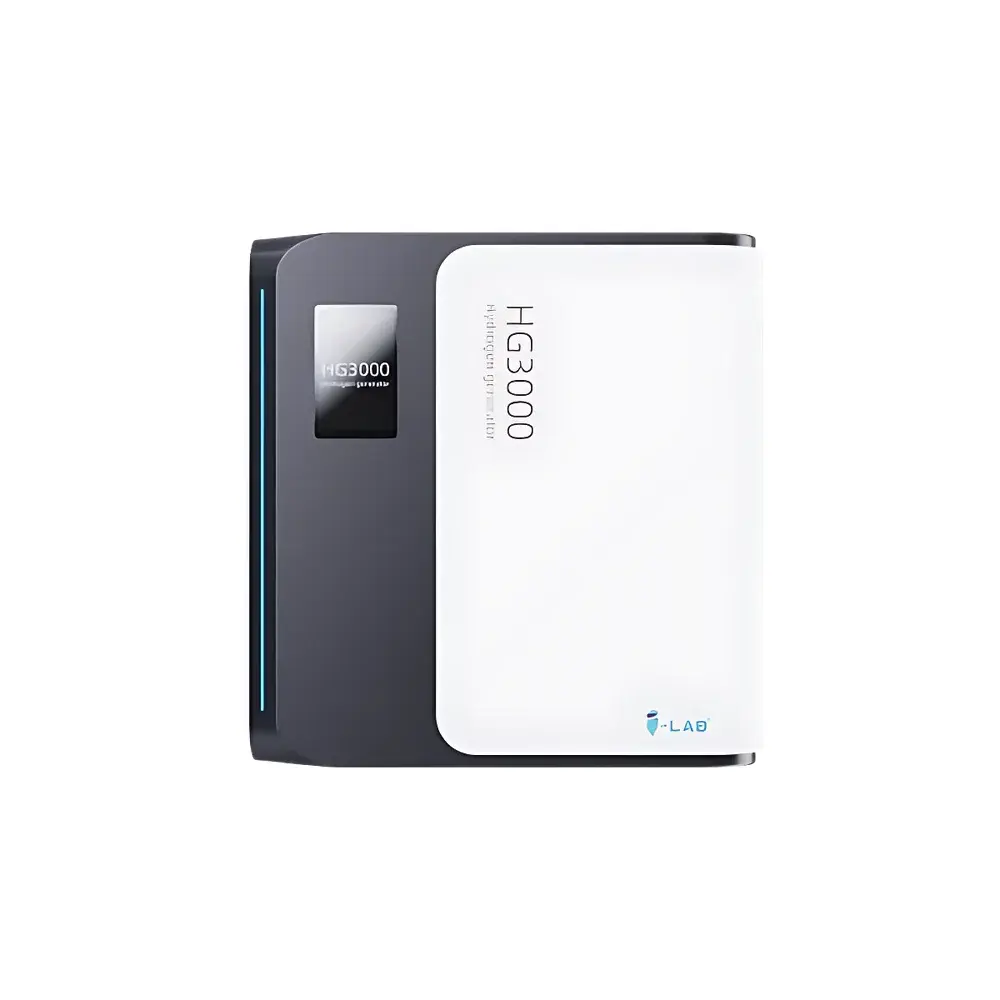
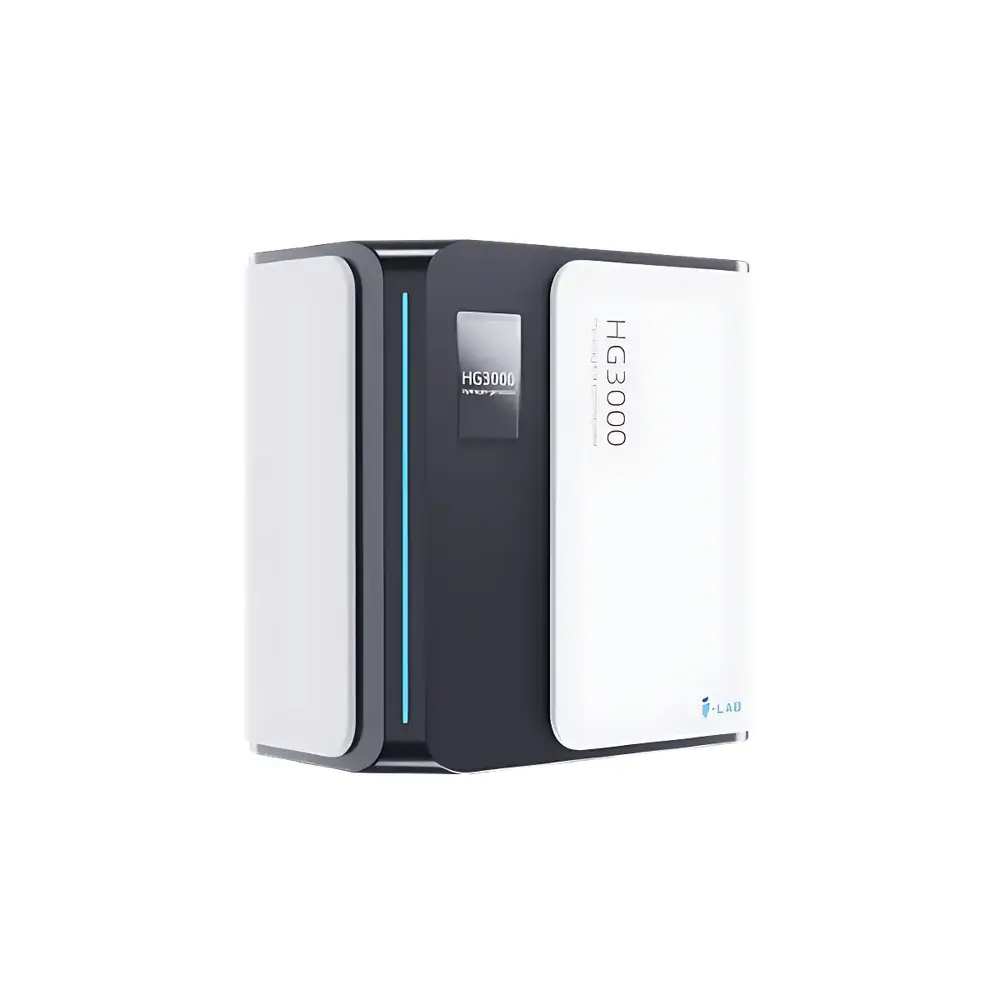
i-Lab HG3000 High-Flow Ultra-High-Purity Hydrogen Generator
| Brand | i-Lab |
|---|---|
| Origin | Shanghai, China |
| Manufacturer Type | Direct Manufacturer |
| Model | HG3000 |
| Hydrogen Generation Principle | SPE-PEM Solid Polymer Electrolyte Electrolysis |
| Output Flow Rate | 0–3000 mL/min |
| Output Pressure Options | 0–0.4 MPa / 0–0.7 MPa / 0–1.0 MPa / 0–1.5 MPa |
| Hydrogen Purity | ≥99.9995% (v/v) |
| Power Consumption | 1500 W |
Overview
The i-Lab HG3000 is an industrial-grade, high-flow ultra-high-purity hydrogen generator engineered for continuous, on-demand hydrogen supply in analytical laboratories, semiconductor process environments, and centralized gas distribution systems. It employs solid polymer electrolyte (SPE)-proton exchange membrane (PEM) electrolysis — a zero-alkaline, corrosion-free electrochemical process that dissociates deionized water into high-purity H₂ and O₂ without caustic electrolytes or metal catalyst degradation. Unlike traditional KOH-based systems, the HG3000 eliminates liquid electrolyte handling, pH drift, and electrode passivation risks, delivering consistent hydrogen purity ≥99.9995% (v/v) — meeting ASTM D7606-22 Grade 5 specifications and ISO 8573-1 Class 1 compressed gas quality requirements for analytical applications. Its modular architecture supports integration into multi-instrument labs via stainless steel 316L gas manifolds and complies with IEC 61000-6-3 EMC emission standards and UL/CSA 61010-1 safety directives.
Key Features
- SPE-PEM electrolysis stack with platinum-group-metal (PGM)-free anode/cathode coatings, rated for >20,000 hours of continuous operation under nominal load.
- Integrated catalytic oxygen removal module operating at ambient temperature; no thermal activation or periodic regeneration required.
- Two-stage pressure-swing adsorption (PSA) drying system using 4Å molecular sieve and activated alumina, achieving dew point ≤ –70°C at 1.5 MPa output pressure.
- Dual-mode control interface supporting both constant-pressure (±0.01 MPa regulation) and constant-flow (±10 mL/min accuracy) operation, compatible with Agilent, Thermo Fisher, Shimadzu, and PerkinElmer GC/GC-MS platforms via analog 0–10 V or RS-485 Modbus RTU protocols.
- Comprehensive safety suite: overpressure relief valve (set at 110% max rated pressure), level-sensing ultrasonic water reservoir monitoring, dry-run prevention circuitry, anti-backflow check valves, and real-time thermal runaway detection.
- Remote management via Ethernet/Wi-Fi with TLS 1.2-secured web interface; supports SNMP v3 alerts, Syslog event logging, and scheduled maintenance reminders aligned with GLP audit trails.
Sample Compatibility & Compliance
The HG3000 delivers hydrogen suitable for carrier gas in capillary GC (including low-bleed columns), FID/NPD/FPD detector fuel, and purge gas in inert-atmosphere gloveboxes. Its output meets USP and EP 2.5.27 requirements for pharmaceutical residual solvent analysis and satisfies ISO/IEC 17025 clause 6.4.7 instrument qualification criteria for gas purity verification. All wetted materials — including titanium electrolyzer plates, PTFE-coated diaphragms, and electropolished 316L stainless steel gas paths — are certified per ASTM A269 and ASME BPE-2022 standards. The unit carries SGS-certified CE marking (2014/30/EU EMC Directive, 2014/35/EU LVD Directive) and complies with FDA 21 CFR Part 11 for electronic record integrity when paired with validated data acquisition software.
Software & Data Management
The embedded i-Control™ firmware (v3.2.1) provides full traceability: all operational parameters — flow rate, pressure, cell voltage, coolant temperature, and cumulative runtime — are timestamped and stored locally for ≥12 months. Data export supports CSV and XML formats compliant with LabWare LIMS and Thermo Fisher Chromeleon CDS ingestion protocols. Audit logs record user login events, parameter changes, and alarm acknowledgments with SHA-256 hashing to prevent tampering. Optional IQ/OQ documentation packages include installation qualification checklists, operational qualification test scripts (per ASTM E2500), and calibration certificates traceable to NIST SRM 1650b.
Applications
- Primary carrier gas source for high-resolution gas chromatography (GC) and GC-MS systems requiring sub-ppb oxygen and moisture content.
- Fuel gas supply for flame ionization (FID), nitrogen-phosphorus (NPD), and flame photometric (FPD) detectors across environmental, petrochemical, and food safety testing labs.
- Process gas feedstock for low-pressure chemical vapor deposition (CVD) reactors and plasma-enhanced CVD (PECVD) tools in microelectronics R&D.
- Centralized hydrogen distribution hub for multi-station laboratories, replacing high-risk cylinder banks and eliminating delivery scheduling dependencies.
- Hydrogen blending support in fuel cell testing rigs and electrochemical impedance spectroscopy (EIS) setups requiring stable stoichiometric ratios.
FAQ
What water quality is required for optimal HG3000 performance?
Deionized water with resistivity ≥15 MΩ·cm (ASTM D1193 Type I) and total organic carbon (TOC) <10 ppb is mandatory. Integrated 0.2 µm pre-filtration prevents particulate fouling of the SPE membrane.
Can the HG3000 be integrated into existing lab gas networks?
Yes — it features dual 1/4″ NPT male outlets with integrated back-pressure regulators and optional manifold kits for parallel connection to up to eight GC instruments.
Is routine maintenance required for the PSA dryer system?
No consumable replacement is needed within the first 12 months of operation; desiccant life is extended by automatic regeneration cycles triggered by dew point sensor feedback.
How does the HG3000 handle power interruptions?
Upon grid loss, the system executes a controlled shutdown sequence: electrolyzer current ramp-down, pressure venting via solenoid relief valve, and non-volatile memory retention of last operational state for seamless recovery.
Does the unit support regulatory compliance for GMP environments?
Yes — firmware supports 21 CFR Part 11-compliant electronic signatures, audit trail export, and role-based access control (RBAC) with configurable password policies and session timeouts.



