
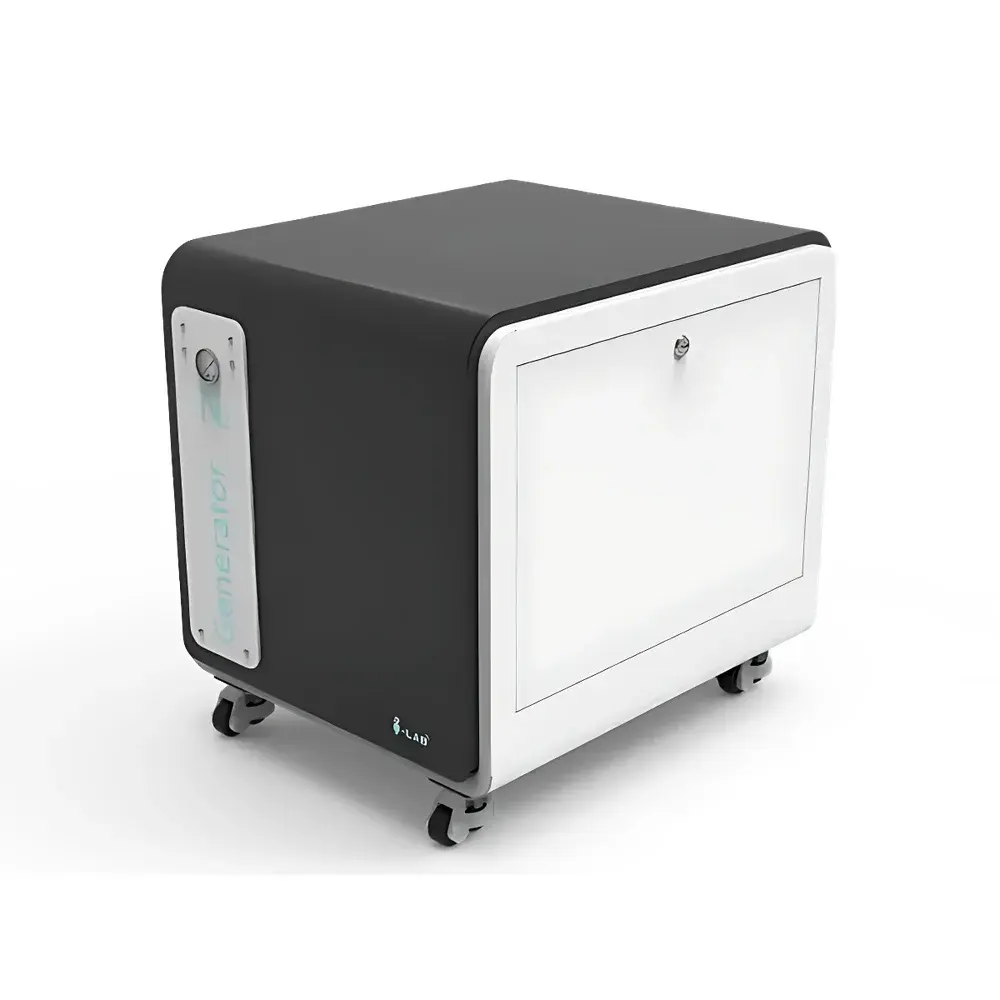
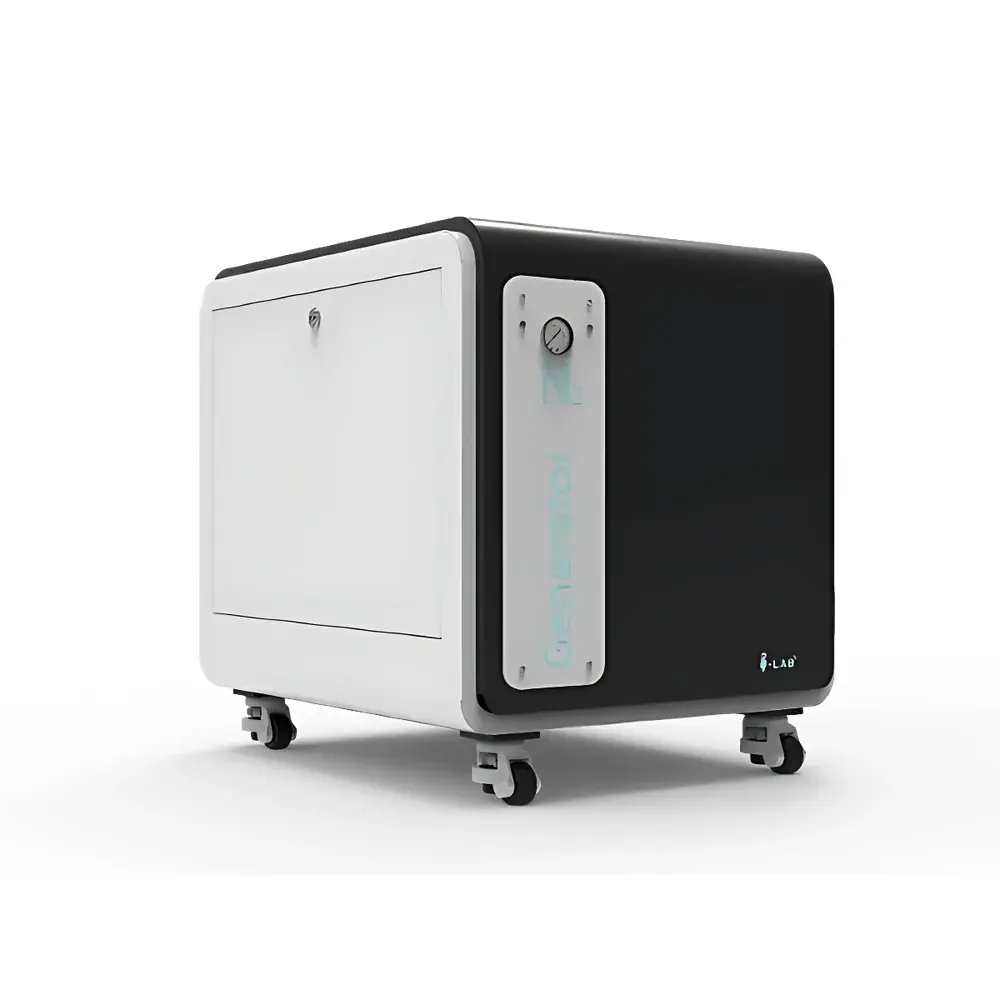
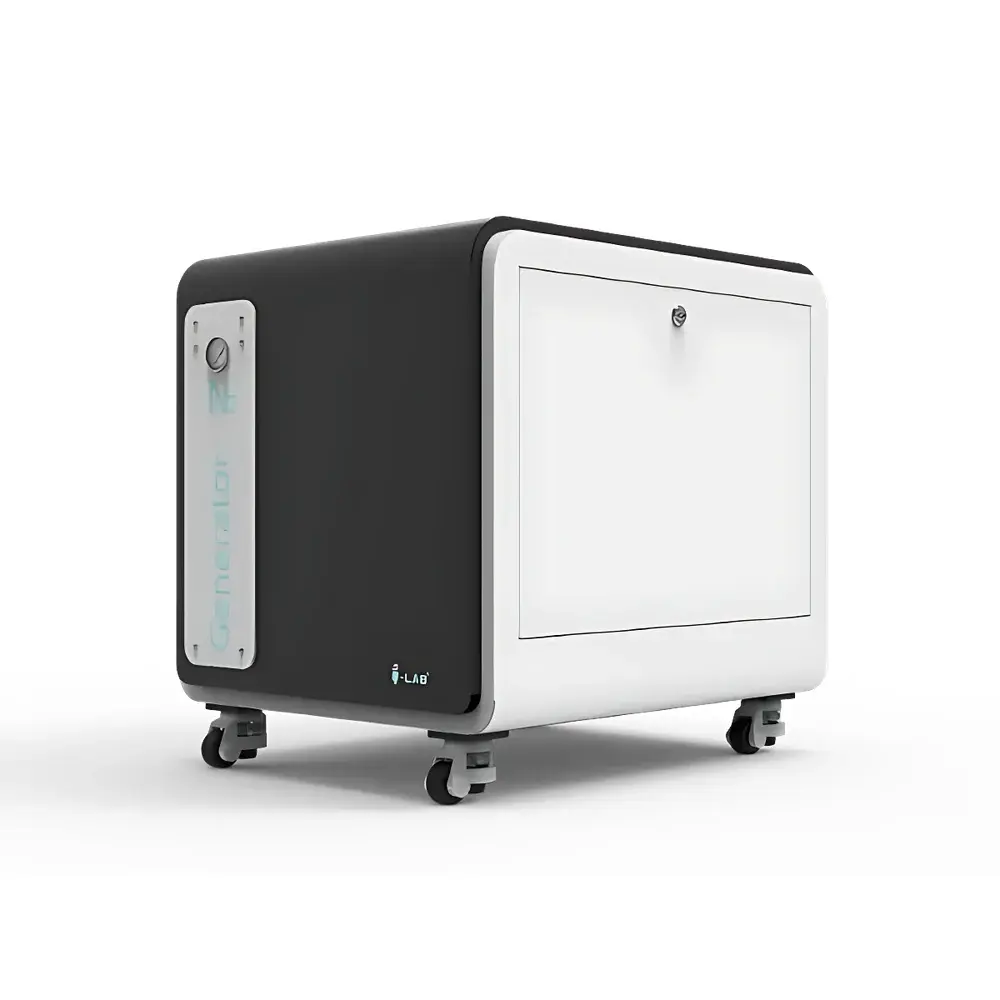
i-Lab KL42-1 Nitrogen Generator
| Brand | i-Lab |
|---|---|
| Origin | Shanghai, China |
| Manufacturer Type | Direct Manufacturer |
| Region of Origin | Domestic (China) |
| Model | KL42-1 |
| Instrument Type | Nitrogen Generator |
| Nitrogen Generation Principle | Imported High-Flow Hollow-Fiber Membrane Technology |
| Output Flow Rate | 19 L/min |
| Output Pressure Range | 0–7 bar |
| Nitrogen Purity | 99.9% |
| Gas Outputs | Nitrogen + Zero-Air (Dried & Hydrocarbon-Free) |
| Integrated Components | Built-in Oil-Free Air Compressor, Dual Buffer Tanks (N₂ & Air), Pressure Protection System, Intelligent Standby Control |
| Filtration Stages | Coalescing Pre-Filter, Desiccant Dryer, Hydrocarbon Adsorber, Particulate Final Filter |
| Noise Level | <55 dB(A) |
| Mobility | Heavy-Duty Swivel Casters with Locking Brakes |
Overview
The i-Lab KL42-1 Nitrogen Generator is an engineered gas supply solution designed specifically for high-sensitivity analytical instrumentation—particularly SCIEX liquid chromatography–mass spectrometry (LC-MS) systems requiring continuous, stable delivery of ≥99.9% pure nitrogen and zero-grade air. It employs a proven hollow-fiber membrane separation process: compressed ambient air is fed into a bundle of semi-permeable polymeric fibers where oxygen, water vapor, carbon dioxide, and trace hydrocarbons diffuse preferentially through the membrane wall, leaving a nitrogen-enriched stream at the outlet. This principle—rooted in selective permeability and differential gas solubility—enables consistent, maintenance-light operation without consumables such as catalysts or PSA beds. Unlike pressure swing adsorption (PSA) systems, the KL42-1 delivers inherently stable flow and purity across its full operating range (0–19 L/min), with no cycling-induced pressure fluctuations or purity dips during transient demand.
Key Features
- Imported high-flux hollow-fiber membrane module engineered for long-term stability and minimal performance drift under continuous 24/7 operation.
- Integrated oil-free scroll air compressor delivering clean, pulsation-dampened feed air—eliminating risk of hydrocarbon contamination to downstream instrumentation.
- Multi-stage gas conditioning: coalescing pre-filter (removes >99.9% of particles ≥0.01 µm), desiccant dryer (dew point ≤ –40 °C), catalytic hydrocarbon scrubber, and sub-micron final particulate filter.
- Dual independent buffer tanks—one for nitrogen, one for zero-air—ensuring uninterrupted gas delivery during compressor off-cycles and mitigating pressure transients.
- Intelligent standby control logic automatically reduces compressor duty cycle once system pressure reaches setpoint, reducing energy consumption by up to 40% and extending component service life.
- Acoustic enclosure with vibration-damping mounts achieves <55 dB(A) at 1 m distance—compatible with shared laboratory environments where low ambient noise is critical.
- Modular chassis with reinforced steel frame and heavy-duty locking casters enables secure repositioning and space-efficient placement adjacent to LC-MS workstations.
Sample Compatibility & Compliance
The KL42-1 meets essential gas quality requirements for SCIEX TripleTOF®, QTRAP®, and X500B LC-MS platforms, supporting compliance with instrument manufacturer specifications for nebulizer, curtain, and collision gases. Its output satisfies ASTM D6352–22 (Standard Guide for Gas Purity in Mass Spectrometry) for nitrogen used in ion source applications. All filtration media are certified non-shedding and compatible with ISO 8573-1:2010 Class 2:2:2 (solid particles, water, oil) for compressed air quality. The system supports GLP/GMP-aligned operation through configurable event logging (pressure, flow, runtime, standby cycles) and optional analog/digital I/O for integration into centralized lab monitoring networks.
Software & Data Management
While the KL42-1 operates as a stand-alone hardware platform without embedded touchscreen or cloud connectivity, it provides real-time analog outputs (4–20 mA) for nitrogen pressure and flow, enabling seamless integration with building management systems (BMS) or SCADA platforms. Optional RS-485 Modbus RTU interface allows remote status polling—including compressor state, buffer tank pressure, filter saturation indicators, and cumulative runtime—for preventive maintenance scheduling. All operational parameters are logged internally with timestamped records retained for ≥12 months, satisfying FDA 21 CFR Part 11 audit trail prerequisites when paired with validated third-party data acquisition software.
Applications
- Nebulizer and desolvation gas for electrospray ionization (ESI) and atmospheric pressure chemical ionization (APCI) sources in SCIEX LC-MS systems.
- Curtain gas and collision gas (CID) in triple quadrupole and QTOF mass analyzers requiring stable, hydrocarbon-free nitrogen streams.
- Zero-air supply for detector purge, auxiliary gas lines, and vacuum pump backing where moisture and organic contaminants must be excluded.
- Gas support for nitrogen-purged optical enclosures, glove boxes, and sample preparation stations requiring inert atmosphere integrity.
- Backup or primary nitrogen source in regulated QC/QA labs performing USP , ICH Q2(R2), or EPA Method 8270D analyses.
FAQ
What is the typical lifetime of the hollow-fiber membrane module?
Under continuous operation at rated flow and inlet air quality meeting ISO 8573-1 Class 4:4:4, the membrane module maintains ≥99.9% purity for ≥15,000 hours before scheduled replacement.
Does the KL42-1 require external cooling or ventilation?
No—its thermally optimized heat exchanger and low-power compressor design allow safe operation in standard laboratory ambient conditions (15–30 °C, ≤80% RH) without dedicated HVAC ducting.
Can the nitrogen and zero-air outputs be used simultaneously at full rated flow?
Yes—the dual-buffer architecture and independent pressure regulation ensure simultaneous delivery of 19 L/min nitrogen and 12 L/min zero-air without cross-contamination or pressure drop.
Is calibration traceable to NIST standards?
Gas purity verification is performed using on-board electrochemical O₂ sensors calibrated against NIST-traceable reference gases; full factory calibration reports are provided with each unit.
How often do filters need replacement?
Pre-filter and particulate final filter: every 6 months under typical lab air conditions; desiccant and hydrocarbon adsorber: every 12 months—scheduled via internal runtime counter and visual indicator.



