
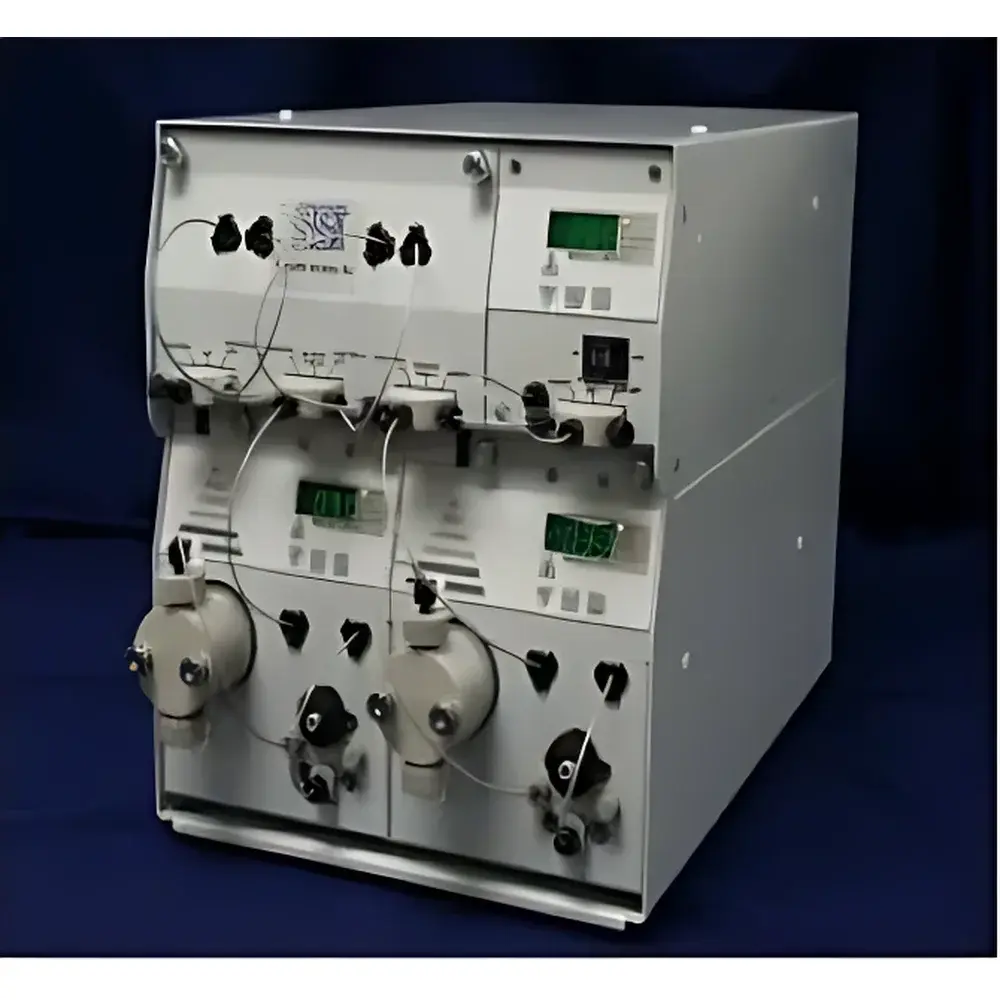
Laballiance Post-Column Derivatization System (Model: Laballiance PCDS)
| Brand | Laballiance |
|---|---|
| Origin | USA |
| Manufacturer Type | Authorized Distributor |
| Import Status | Imported |
| Model | Laballiance PCDS |
| Price | Upon Request |
| Pump Flow Rate | 0.01–2.5 mL/min |
| Maximum Pressure | 2500 psi |
| Flow Precision | ±0.5% RSD |
| Flow Accuracy | ±2% |
| Flow Path Material | Full PEEK |
| Temperature Control Range | Ambient +10 °C to 150 °C |
| Temperature Accuracy | ±2 °C |
| Temperature Repeatability | ±1 °C |
| Safety Cutoff Temperature | 160 °C |
| Reactor Volume Accuracy | ±5% |
| Warm-up Time to 150 °C | ≤30 min |
| Communication Interface | RS232 |
Overview
The Laballiance Post-Column Derivatization System (PCDS) is an engineered solution for enhancing detection sensitivity and selectivity in high-performance liquid chromatography (HPLC) and ultra-high-performance liquid chromatography (UHPLC) workflows. Designed around the principle of post-separation chemical derivatization, this system introduces reactive reagents into the eluent stream immediately after column exit but prior to detector entry—enabling real-time conversion of non-chromophoric or weakly fluorescent analytes into stable, highly detectable derivatives. Its architecture integrates precision dual-syringe pump technology, thermally controlled reaction modules with modular PEEK-based flow paths, and embedded process monitoring—all aligned with GLP-compliant laboratory practices. The system supports both isocratic and gradient-compatible derivatization protocols without compromising chromatographic resolution or peak integrity.
Key Features
- Modular dual-pump configuration: Supports independent delivery of up to two derivatization reagents at precisely controlled flow rates (0.01–2.5 mL/min), each with ±0.5% RSD flow precision and ±2% absolute accuracy.
- Thermally stabilized reaction manifold: Features interchangeable PEEK reaction coils with volume accuracy within ±5%, enabling method-specific optimization of residence time and reaction efficiency.
- Intelligent temperature control: Digital PID regulation maintains setpoints from ambient +10 °C to 150 °C with ±1 °C repeatability and ±2 °C absolute accuracy; automatic thermal cutoff at 160 °C ensures hardware protection.
- Front-panel operational interface: Real-time display of reagent flow rates, line pressure, setpoint/actual temperature, and system status—fully configurable via tactile controls or RS232 serial communication.
- Integrated pulse dampening: Built-in flow stabilizer minimizes pressure transients from syringe actuation, preserving baseline stability and reducing detector noise.
- Leak-resistant fluidic design: All fittings located on the front panel; standardized 1/16″ PEEK tubing connections with zero-dead-volume unions ensure rapid setup and long-term seal integrity.
- Self-cleaning pump cycle: Programmable flush routines extend syringe seal life and maintain consistent delivery performance across extended operation cycles.
Sample Compatibility & Compliance
The Laballiance PCDS is validated for use with common derivatization chemistries including ortho-phthalaldehyde (OPA), ninhydrin, iodine-based oxidation, and other nucleophile-targeting reagents. It accommodates aqueous, organic-aqueous, and mildly acidic/basic mobile phases compatible with standard reversed-phase and HILIC columns. The full-PEEK wetted path resists corrosion from aggressive reagents such as sodium cyanide (in OPA protocols) or potassium iodide solutions (for aflatoxin analysis). System firmware supports audit-trail logging per FDA 21 CFR Part 11 requirements when integrated with compliant LIMS or CDS platforms. Method parameters—including flow rate limits, temperature thresholds, and standby timeout—are user-definable and stored in non-volatile memory to support ISO/IEC 17025 and ASTM D7594-compliant validation documentation.
Software & Data Management
Remote operation and parameter synchronization are enabled via RS232 serial interface, supporting integration with third-party chromatography data systems (CDS) such as Thermo Chromeleon, Waters Empower, or Agilent OpenLAB. The system does not include proprietary acquisition software but provides ASCII-formatted status polling responses (e.g., “TEMP=125.3°C”, “PRESSURE=1842 psi”) for custom script-based monitoring. All critical operational events—including temperature excursions, pressure alarms, and pump error states—are timestamped and logged internally for traceability during regulatory audits. Configuration files can be exported/imported using terminal emulation tools, facilitating method transfer between instruments in multi-lab environments.
Applications
- Amino acid quantification in clinical serum and food matrices using OPA or ninhydrin derivatization.
- Residue analysis of carbamate pesticides in agricultural commodities per AOAC Official Method 2007.01.
- Determination of aflatoxins B1, B2, G1, and G2 in cereals and nuts following iodine-mediated derivatization (AOAC 994.10).
- Quantitation of taurine in dairy and infant formula products under USP chromatographic suitability criteria.
- Glycerophospholipid metabolite profiling in biological fluids using optimized OPA-HPLC-FLD workflows.
- Herbicide residue screening (e.g., glyphosate, glufosinate) in environmental water samples per EPA Method 547.1.
FAQ
What derivatization reagents are compatible with the Laballiance PCDS?
The system supports a broad range of reagents including OPA, ninhydrin, iodine, o-phthaldialdehyde–sodium cyanide, and chloramine-T, provided they are soluble in miscible solvents and compatible with PEEK surfaces.
Can the PCDS be used with UHPLC systems operating above 1000 bar?
Yes—the flow path is rated to 2500 psi (≈172 bar); however, backpressure contribution from the reactor coil must be included in total system pressure calculations.
Is temperature calibration traceable to NIST standards?
The internal Pt100 sensor is factory-calibrated; users may perform field verification using certified reference thermometers per ISO/IEC 17025 Section 6.5.
How often should the reaction coil be replaced?
Under normal use with clean reagents, PEEK coils exhibit service lifetimes exceeding 12 months; replacement is recommended if peak broadening or increased backpressure is observed.
Does the system support gradient elution during derivatization?
Yes—flow rate and temperature parameters remain stable across solvent composition changes, provided the derivatization reaction kinetics are not adversely affected by mobile phase polarity shifts.




