
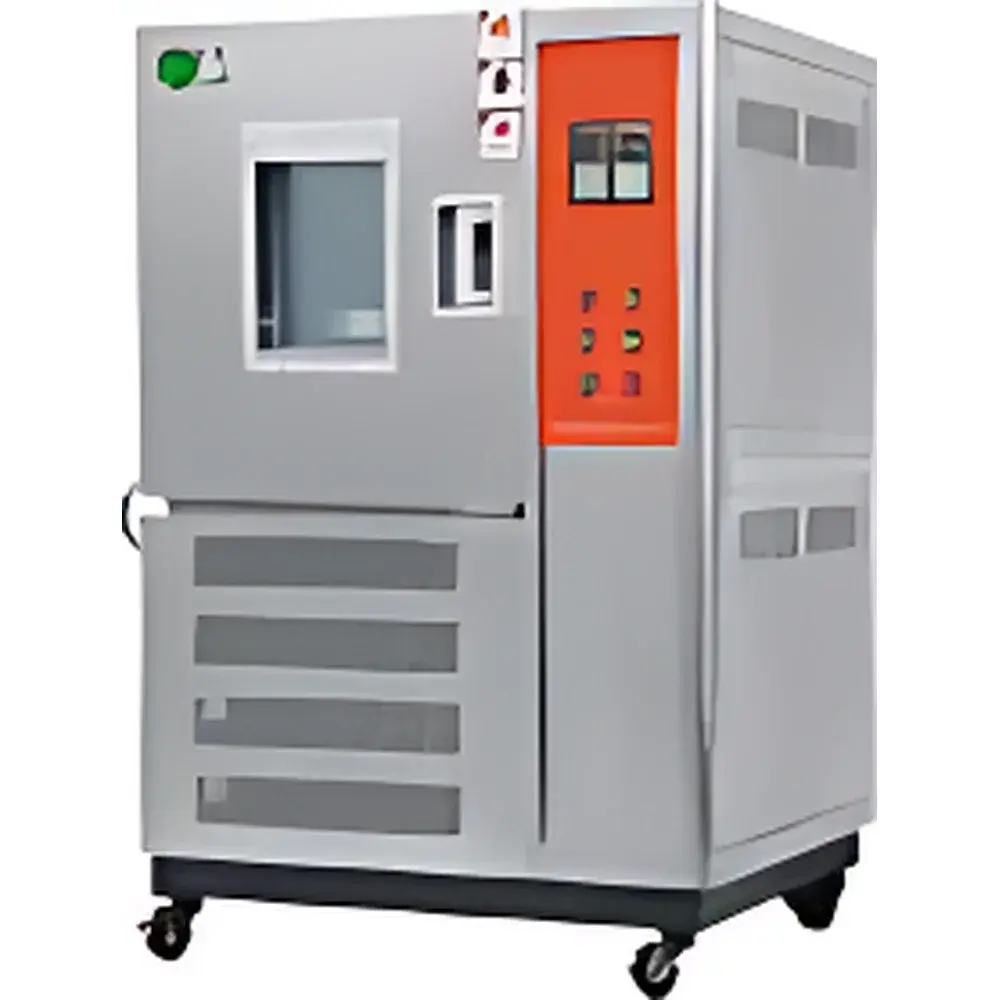
LabCompanion UP-150 Temperature and Humidity Controlled Environmental Test Chamber
| Brand | LabCompanion |
|---|---|
| Origin | Guangdong, China |
| Manufacturer Type | OEM Manufacturer |
| Country of Origin | China |
| Model | UP-150 |
| Pricing | Available Upon Request |
| Temperature Range (Standard Config) | –40°C to +100°C (Optional: –70°C to +150°C) |
| Humidity Range | 30–98% RH |
| Temperature Uniformity | ≤2°C |
| Temperature Fluctuation | ±0.5°C |
| Humidity Fluctuation | ±2–3% RH |
| Heating/Cooling Rate | 0.7–1°C/min (Optional: 3/5/10°C/min) |
| Internal Chamber Dimensions (W×D×H) | 500×600×500 mm |
| External Dimensions (Approx. W×D×H) | 960×1610×980 mm |
| Refrigeration System | Dual-stage cascade refrigeration |
| Compressor | HERMETIC TECUMSEH (France) |
| Humidification Method | Electric steam generator + saturated chamber humidification |
| Control System | TEMI 990 programmable controller (Korean) / SHIMADEN (Japan) / Honeywell (USA) optional |
| Sensor | PT100 platinum resistance thermometer |
| Safety Protections | Over-temperature cut-off, leakage current protection, high-pressure compressor shutdown, fast-acting fuse |
| Standard Accessories | Double-layer tempered glass observation window (220×180 mm), Ø50 mm test port, two stainless steel sample shelves, LED interior lighting |
| Power Supply | 220 V AC / 380 V AC, 50 Hz |
Overview
The LabCompanion UP-150 Temperature and Humidity Controlled Environmental Test Chamber is an engineered solution for accelerated environmental stress testing under precisely regulated thermal and hygrothermal conditions. Designed in accordance with the fundamental principles of thermodynamic equilibrium and psychrometric control, the system maintains stable, repeatable temperature and relative humidity profiles across its working volume using a dual-stage cascade refrigeration architecture and electrically driven steam generation. Its core function is to replicate real-world climatic exposure—such as tropical high-humidity storage, cold-chain logistics validation, or diurnal thermal cycling—for reliability assessment of electronic components, automotive modules, medical devices, and packaging materials. The chamber operates within a defined specification envelope aligned with international environmental test standards, enabling compliance-driven qualification protocols in R&D, quality assurance, and regulatory submission workflows.
Key Features
- Robust dual-stage cascade refrigeration system utilizing a hermetically sealed TECUMSEH (France) compressor, delivering stable low-temperature performance down to –40°C (optionally –70°C) without reliance on liquid nitrogen or external chillers.
- Integrated dual-mode humidification: electric steam generator for rapid RH ramp-up and saturated chamber (water-jacketed) humidification for high-stability maintenance at 30–98% RH, minimizing condensation artifacts during dynamic transitions.
- High-efficiency air circulation architecture featuring extended-shaft stainless steel centrifugal impellers and optimized duct geometry, ensuring uniform airflow distribution and meeting ≤2°C temperature uniformity per IEC 60068-3-5.
- Programmable TEMI 990 controller (Korea) with intuitive touch interface, supporting up to 99 segments, 999 cycles, and real-time graphical display of setpoints, actual values, and deviation trends; optional SHIMADEN (Japan) or Honeywell (USA) controllers available for legacy integration.
- Structural integrity optimized for long-term stability: inner chamber constructed from mirror-finish SUS304 stainless steel; outer enclosure fabricated via CNC bending and powder-coated cold-rolled steel; reinforced insulation using polyurethane foam (≥100 mm thickness) and fiberglass composite layers.
- Comprehensive safety architecture including independent over-temperature cutoff, compressor high-pressure interlock, earth leakage circuit breaker (ELCB), and fast-acting thermal fuses—fully documented in the factory-installed safety manual per ISO 13857 requirements.
Sample Compatibility & Compliance
The UP-150 accommodates standard industrial samples up to 30 kg total load, with adjustable stainless steel shelves supporting PCB assemblies, molded plastic housings, lithium-ion battery packs, and sealed medical device enclosures. Its internal dimensions (500 × 600 × 500 mm) permit concurrent multi-point sensor placement for spatial mapping per ASTM E2234. The system conforms to GB/T 10586–2014 (Chinese national standard for environmental test chambers), GB/T 2423.1–2022 (cold testing), GB/T 2423.2–2022 (dry heat), GB/T 2423.3–2016 (damp heat, cyclic), and ISO 16750-4 (road vehicles—environmental conditions). Optional calibration certificates traceable to NIM (National Institute of Metrology, China) are available upon request. All control software logs meet GLP/GMP audit trail requirements—including user ID, timestamp, parameter change history, and alarm event records—as required under FDA 21 CFR Part 11 when configured with password-protected access and electronic signature modules.
Software & Data Management
The embedded TEMI 990 controller supports USB data export (CSV format) of time-stamped temperature/humidity readings at user-defined intervals (1 s to 60 min resolution). Optional LabCompanion DataBridge™ PC software enables remote monitoring, real-time graphing, automated report generation (PDF/Excel), and alarm email/SMS notification via Ethernet or RS485 Modbus RTU. All recorded data files include metadata headers indicating chamber ID, operator login, test program name, and calibration status. Raw log files are write-protected after completion and support SHA-256 hash verification for integrity auditing. Historical data retention is configurable up to 18 months on internal 4 GB flash memory or external NAS via SMB protocol.
Applications
- Electronics reliability testing: thermal cycling of PCBs, solder joint fatigue analysis, and moisture sensitivity level (MSL) preconditioning per JEDEC J-STD-020.
- Automotive component validation: climate endurance of infotainment displays, ADAS sensors, and EV battery management systems under combined thermal shock and humidity soak conditions.
- Pharmaceutical packaging evaluation: accelerated aging studies of blister packs and HDPE containers per ICH Q1A(R2) guidelines.
- Aerospace material qualification: outgassing behavior of composites and adhesives under low-RH, high-temperature vacuum pre-conditioning sequences.
- Quality control laboratories: incoming inspection of raw polymers, elastomers, and coated metals for dimensional stability and surface delamination risk assessment.
FAQ
What is the standard temperature and humidity range for the UP-150 model?
The base configuration supports –40°C to +100°C and 30–98% RH. Extended low-temperature variants (–70°C) and high-temperature options (+150°C) are available as factory-configured options.
Does the chamber support automated test sequencing?
Yes—the TEMI 990 controller supports fully programmable multi-segment profiles, including ramp-soak-hold cycles, humidity-only phases, and conditional branching based on elapsed time or sensor thresholds.
Is third-party calibration documentation included?
Factory calibration is performed using NIST-traceable reference instruments. A Certificate of Conformance is supplied standard; ISO/IEC 17025-accredited calibration reports are available as an add-on service.
Can the UP-150 be integrated into a central lab monitoring network?
Yes—Ethernet and RS485 interfaces support integration with SCADA platforms, LIMS, or MES systems using Modbus TCP/RTU or OPC UA protocols (driver package provided).
What maintenance is required for long-term operational reliability?
Recommended quarterly tasks include cleaning the condenser coil, inspecting humidifier water reservoir for mineral deposits, verifying door gasket integrity, and validating sensor drift against a portable reference hygrometer and dry-well calibrator.
Related Products



