
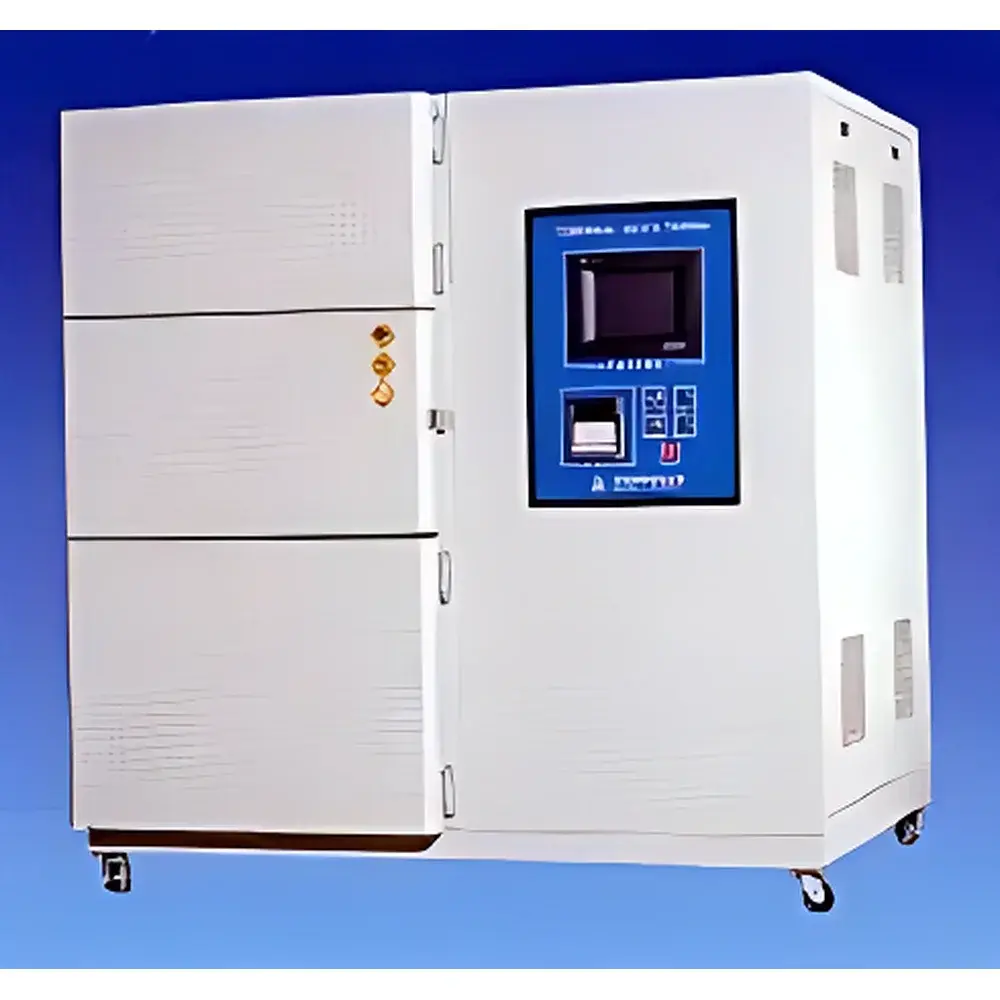
LabCompanion A1 Series Thermal Shock Test Chamber
| Brand | LabCompanion |
|---|---|
| Model | A1 Series |
| Chamber Configuration | 2-Zone or 3-Zone |
| Control Interface | Touchscreen HMI with Programmable Logic Controller (PLC) |
| Language Support | English & Chinese UI |
| Door Actuation | Dual-pneumatic high-durability air damper mechanism |
| Startup Mode | Selectable high-temperature-first or low-temperature-first cycle initiation |
| Defrost Function | Automatic periodic defrost |
| Refrigerant | Eco-friendly dual-refrigeration system (R404A/R23 cascade or equivalent) |
| Data Logging | Integrated single-channel temperature recorder |
| Connectivity | Optional RS485/RS232 interface for PC integration and software expansion |
| Construction | Heavy-duty steel enclosure with powder-coated finish |
| Origin | Guangdong, China |
| Manufacturer Type | Direct OEM manufacturer |
Overview
The LabCompanion A1 Series Thermal Shock Test Chamber is an engineered environmental stress screening (ESS) system designed to evaluate material and component reliability under rapid, extreme temperature transitions. Operating on the principle of accelerated thermal cycling—where specimens remain stationary while alternating exposure to independently controlled high-temperature and low-temperature zones—the A1 Series enables precise simulation of real-world thermal shock conditions encountered during transportation, storage, and operational use. Unlike single-chamber ramp-and-soak systems, the A1’s 2-zone or optional 3-zone architecture eliminates thermal inertia delays, delivering transition times as fast as 10–15 seconds between extremes (e.g., −65 °C ↔ +150 °C), in compliance with test standards including MIL-STD-810H Method 503.5, IEC 60068-2-14, and JESD22-A104. Its fixed-sample configuration ensures mechanical stability and repeatability across thousands of cycles, making it especially suitable for qualification testing of PCB assemblies, semiconductor packages, automotive ECUs, and aerospace structural composites.
Key Features
- Robust structural design featuring high-rigidity cold-rolled steel housing with electrostatic powder coating for corrosion resistance and long-term dimensional stability.
- Intuitive touchscreen human-machine interface (HMI) integrated with industrial-grade programmable logic controller (PLC), supporting both English and Chinese operational menus without language switching latency.
- Patented dual-pneumatic air damper mechanism ensures consistent, wear-resistant zone isolation—critical for maintaining thermal separation integrity over ≥50,000 operational cycles.
- Selectably configurable thermal shock protocol: users may initiate sequences from either the hot or cold zone, accommodating pre-conditioning requirements defined in ASTM F1879 or JEDEC JESD22-A106B.
- Dual-refrigeration cascade system utilizing environmentally compliant refrigerants (R404A/R23 or R507/R23 alternatives), meeting EU F-Gas Regulation (EU) No 517/2014 and EPA SNAP program criteria.
- Built-in single-channel temperature data logger with non-volatile memory, capable of time-stamped recording at user-defined intervals (1 s to 60 min resolution) for audit-ready traceability.
Sample Compatibility & Compliance
The A1 Series accommodates test specimens up to 300 mm × 300 mm × 300 mm (customizable chamber volumes available upon request), with uniformity maintained per IEC 60068-3-5 (±2 °C within working volume). It supports standardized mounting fixtures—including DUT trays with thermocouple access ports—and integrates seamlessly into GLP/GMP-aligned validation workflows. All firmware and control logic are structured to support IQ/OQ/PQ documentation, and optional 21 CFR Part 11-compliant software modules provide electronic signatures, audit trails, and user role-based access control for regulated environments.
Software & Data Management
While the base unit operates autonomously via embedded PLC, optional PC connectivity (RS485/RS232 or Ethernet) enables integration with LabCompanion’s TC-Link™ software suite. This platform supports real-time remote monitoring, multi-chamber synchronization, automated report generation (PDF/CSV), and deviation alerting via email/SNMP. Raw log files comply with ISO/IEC 17025 clause 7.5.2 for measurement traceability, and calibration certificates are issued with NIST-traceable reference sensors (Class A PT100).
Applications
- Qualification of solder joint integrity in surface-mount electronics under JEDEC J-STD-020D.1 reflow simulation.
- Validation of adhesive bond strength in polymer-metal hybrid automotive components per SAE J2334.
- Accelerated life testing of optical sensor housings exposed to diurnal desert climates (−40 °C to +85 °C cycling).
- Reliability screening of medical device enclosures subjected to sterilization–cool-down thermal transients (ISO 13485 Annex C).
- Material phase-transition analysis in shape-memory alloys and piezoelectric ceramics.
FAQ
What is the typical temperature transition time between zones?
Transition time depends on configured setpoints and load mass; standard performance achieves ≤15 seconds for −65 °C ↔ +150 °C with empty chamber per IEC 60068-2-14 Clause 6.2.
Does the system support custom test profiles beyond standard thermal shock cycles?
Yes—up to 99 programmable steps per profile, including dwell time, ramp rate (0.5–10 °C/min), and conditional branching based on real-time sensor feedback.
Is calibration certification included with delivery?
Each unit ships with factory calibration report (traceable to national metrology institutes); on-site accredited calibration services are available under separate service agreement.
Can the chamber be validated for GMP compliance?
Yes—validation protocols (IQ/OQ/PQ), URS templates, and 21 CFR Part 11 add-on modules are available to support FDA-regulated manufacturing environments.



