
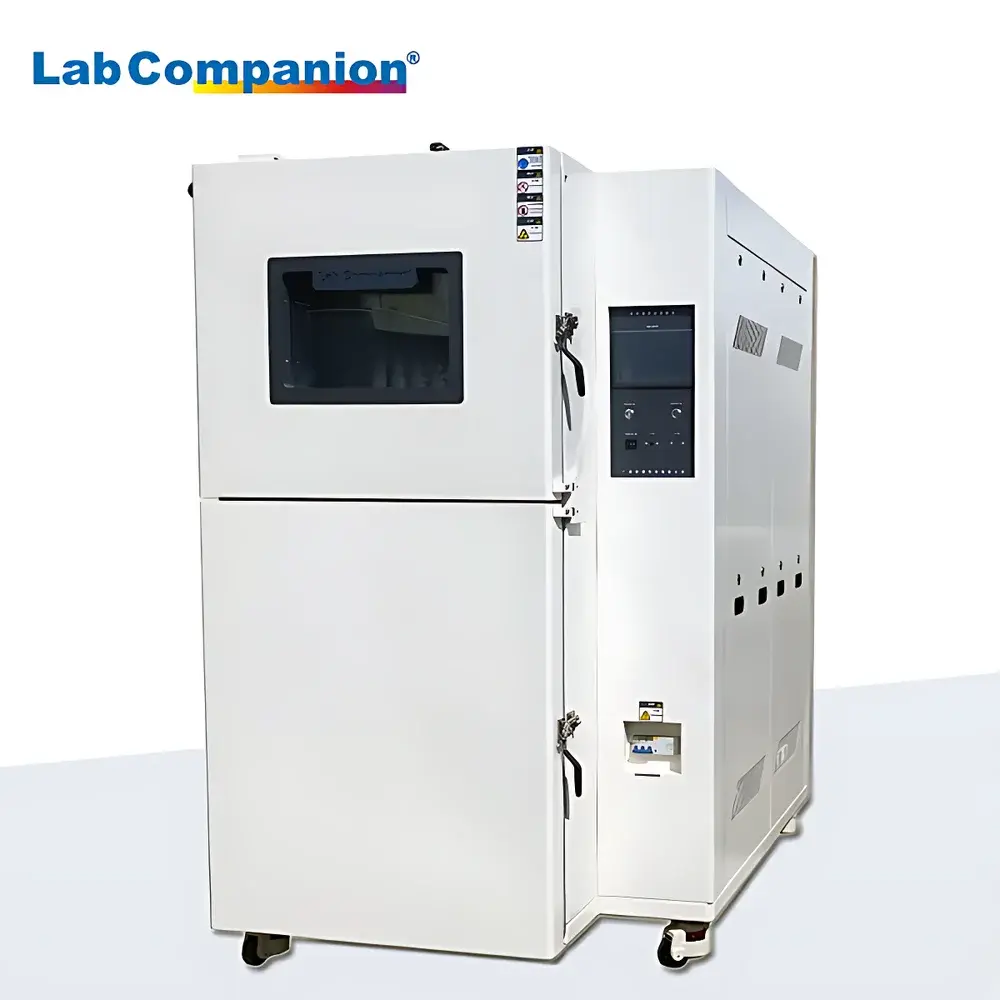
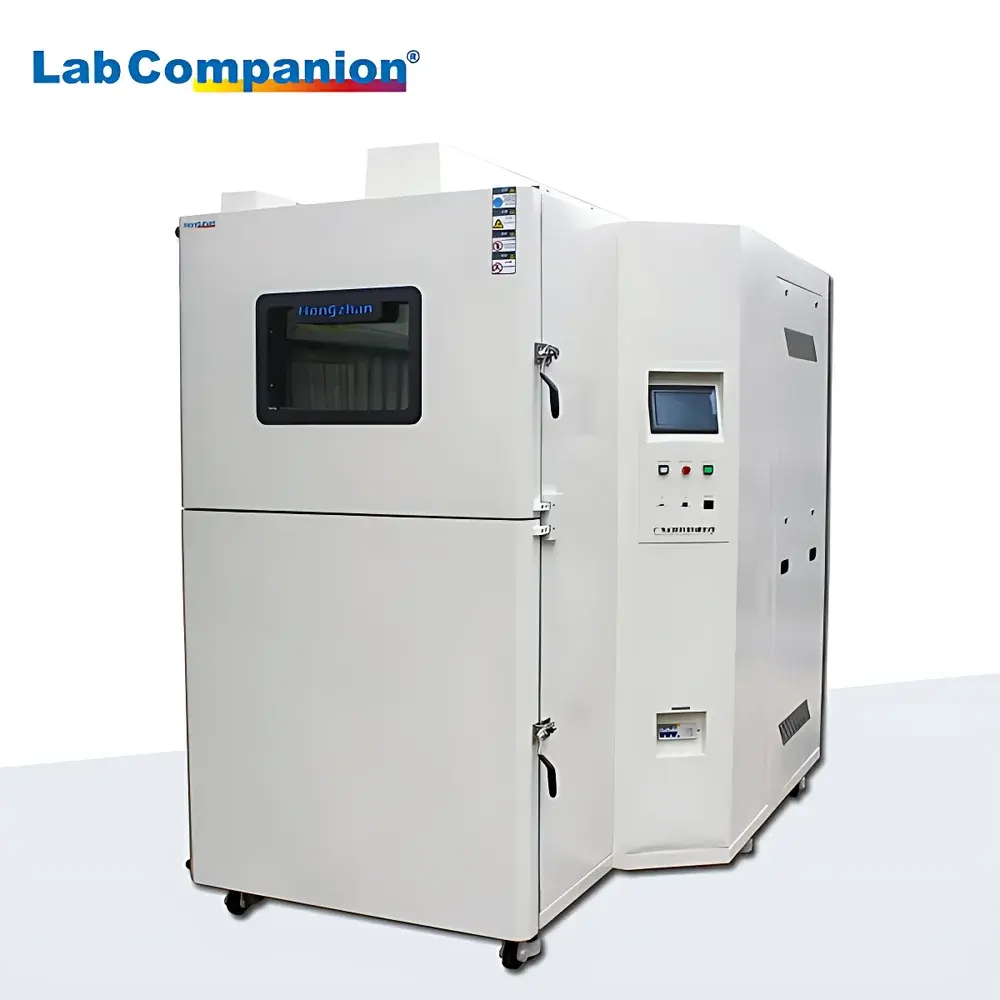
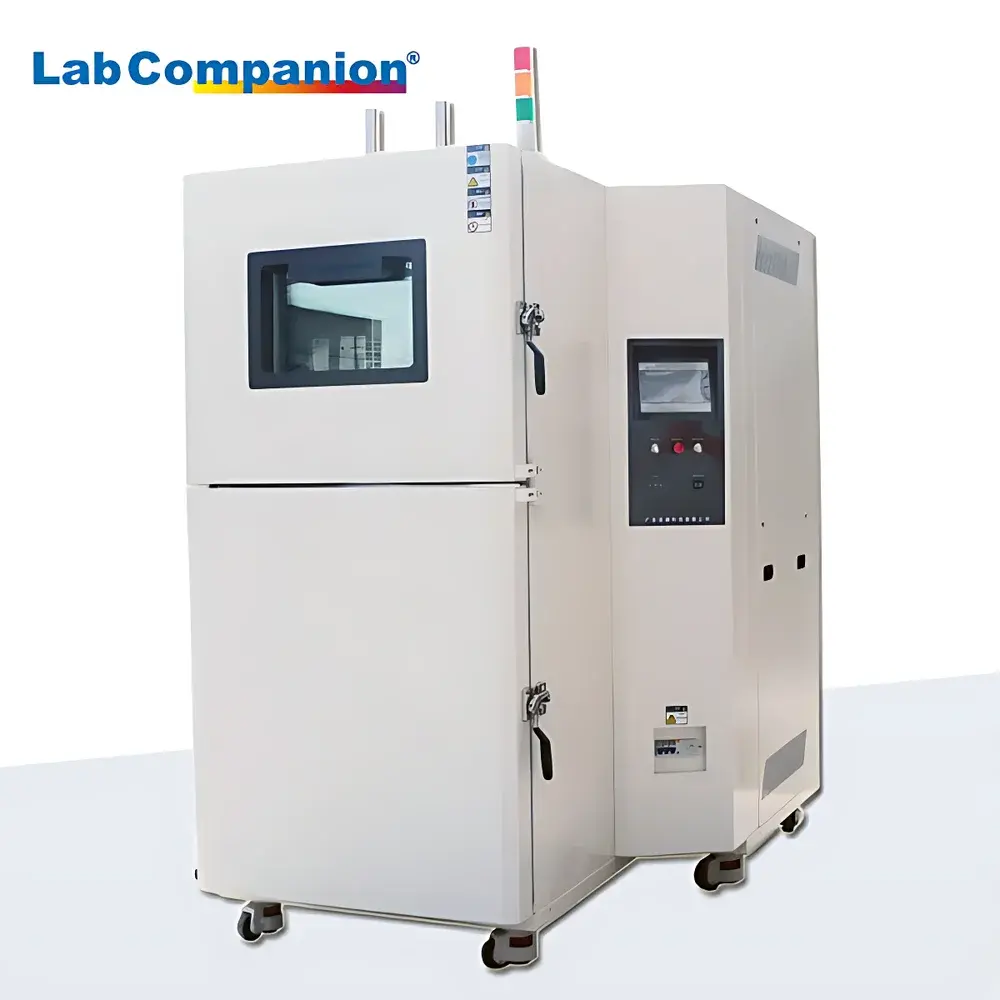
LabCompanion CTS-120W Thermal Shock Test Chamber
| Brand | LabCompanion |
|---|---|
| Origin | Guangdong, China |
| Manufacturer Type | Direct Manufacturer |
| Model | CTS-120W |
| High-Temperature Range | +60 °C to +200 °C |
| Low-Temperature Range | 0 °C to −70 °C |
| Thermal Shock Range | −65 °C to +150 °C |
| Temperature Stability | ±2 °C |
| Heating Rate | R.T. → +200 °C in ~40 min |
| Cooling Rate | R.T. → −70 °C in ~60 min |
| Transfer Time | ≤5 s |
| Temperature Recovery Time | ≤5 min |
| Internal Dimensions (W×H×D) | 500×610×400 mm |
| External Dimensions (W×H×D) | 2720×1050×1950 mm |
| Construction | Cold-Rolled Steel Outer Shell (Ivory White Powder-Coated) + #304 Mirror-Finish Stainless Steel Inner Chamber (1.2 mm) |
| Insulation | Eco-Friendly Glass Fiber (Non-Hazardous Waste Class) |
| Refrigeration | Air-Cooled (A) or Water-Cooled (W) System with Imported Compressor |
| Temperature Sensor | Armored Platinum RTD (Pt100) |
| Controller | Siemens PLC Module + Embedded PlatinumV1.0 Control Software + 7″ Color TFT Touchscreen Interface |
| Data Logging | USB Storage Port (CSV format |
| Power Supply | AC 380 V, 50 Hz, 3-Phase + PE |
| Compliance | GJB 150.3–150.5, GB/T 2423.1–2423.2 |
Overview
The LabCompanion CTS-120W Thermal Shock Test Chamber is an industrial-grade environmental stress screening (ESS) system engineered for rapid, repeatable thermal cycling between extreme high- and low-temperature zones. It operates on the two-chamber static air thermal shock principle—featuring physically isolated hot and cold compartments with a vertically actuated transfer basket that moves test specimens between them within ≤5 seconds. This architecture eliminates thermal inertia from chamber air mass, enabling precise exposure control and minimizing dwell-time uncertainty. Designed for reliability-critical validation in aerospace, automotive electronics, semiconductor packaging, and military-grade component qualification, the CTS-120W delivers a certified operational range of −65 °C to +150 °C across the specimen zone, with temperature deviation maintained within ±2 °C across the full span per GB/T 2423.1–2423.2 and GJB 150.3–150.5 requirements.
Key Features
- Independent dual-zone design: Hot chamber (+60 °C to +200 °C) and cold chamber (0 °C to −70 °C), each with dedicated refrigeration and heating circuits
- High-speed pneumatic transfer mechanism with ≤5 s basket movement time and ≤5 min temperature recovery post-transfer
- Robust thermal insulation using non-hazardous, low-conductivity glass fiber (λ ≤ 0.038 W/m·K), compliant with RoHS and REACH material restrictions
- Siemens S7-1200 PLC-based controller with embedded PlatinumV1.0 firmware, supporting programmable ramp/soak profiles, multi-step cycles, and alarm-triggered emergency shutdown
- 7-inch high-resolution color touchscreen interface with intuitive drag-and-drop sequencing, real-time graphing, and multilingual UI (English, Chinese, Spanish)
- Structural integrity assured by 1.2 mm mirror-finish AISI 304 stainless steel inner chamber and powder-coated cold-rolled steel outer enclosure
- Modular refrigeration: configurable air-cooled (A) or water-cooled (W) condensing system with dual-stage imported compressors and electronic expansion valves
Sample Compatibility & Compliance
The CTS-120W accommodates standard test specimens up to 400 mm × 400 mm × 300 mm (W×H×D) on its stainless-steel transfer basket, with optional custom fixtures available for PCB arrays, molded connectors, and hermetic packages. Its thermal performance is validated per MIL-STD-810H Method 503.5 (Temperature Shock), IEC 60068-2-14, and JESD22-A104D. The chamber’s ±2 °C temperature uniformity and ≤1 °C fluctuation (per GB/T 5170.2–1996) meet GLP audit requirements for traceable environmental testing. All electrical and safety systems conform to IEC 61000-6-2 (EMC immunity) and IEC 61010-1 (Safety of Electrical Equipment for Measurement).
Software & Data Management
Data acquisition and reporting are governed by the PlatinumV1.0 embedded software suite. Operational parameters—including setpoints, actual chamber temperatures, cycle count, transfer timing, and alarm logs—are recorded at user-configurable intervals (1–60 s) and exported via USB to CSV files. These files are natively compatible with LabCompanion’s PlatinumView desktop application for statistical process control (SPC), trend analysis, and automated PDF report generation. For networked environments, the RJ45 TCP/IP interface enables integration into centralized test management systems under FDA 21 CFR Part 11-compliant configurations—supporting electronic signatures, audit trails, and role-based access control when deployed with PlatinumV1.0 Supervisory Edition. Up to 32 chambers may be monitored simultaneously from a single server node.
Applications
- Qualification testing of avionics modules per DO-160 Section 4 (Temperature Shock)
- Reliability screening of solder joints and wire-bond interconnects in power electronics
- Validation of encapsulant adhesion and delamination resistance in MEMS and optoelectronic devices
- Accelerated aging of polymer-based gaskets, seals, and potting compounds
- Pre-conditioning of lithium-ion battery cells prior to mechanical abuse testing
- Verification of thermal expansion mismatch in multi-material assemblies (e.g., ceramic substrates bonded to copper leadframes)
FAQ
What standards does the CTS-120W comply with for military applications?
The chamber meets GJB 150.3 (High Temperature), GJB 150.4 (Low Temperature), and GJB 150.5 (Temperature Shock) requirements, including specified dwell times, transition rates, and temperature tolerance bands.
Can the unit be integrated into an existing factory MES or LIMS?
Yes—via its native TCP/IP interface and PlatinumV1.0 Supervisory Software, the CTS-120W supports OPC UA and Modbus TCP protocols for bidirectional data exchange with enterprise-level manufacturing execution and laboratory information systems.
Is the USB data export function compatible with third-party analysis tools?
All CSV exports follow ISO 8601 timestamp formatting and contain column headers aligned with IEEE 1139-2008 metadata conventions, enabling direct import into MATLAB, Python (pandas), JMP, and Minitab without preprocessing.
What maintenance intervals are recommended for the refrigeration system?
Compressor oil and filter-drier replacement is advised every 18 months under continuous operation; annual calibration of Pt100 sensors against NIST-traceable references is required for ISO/IEC 17025 accreditation.
Does the chamber support remote monitoring during unattended operation?
Yes—when connected to a local network, the built-in web server allows secure HTTPS access to real-time chamber status, historical trends, and alarm history via any modern browser, with configurable email/SMS alerts for critical events.



