
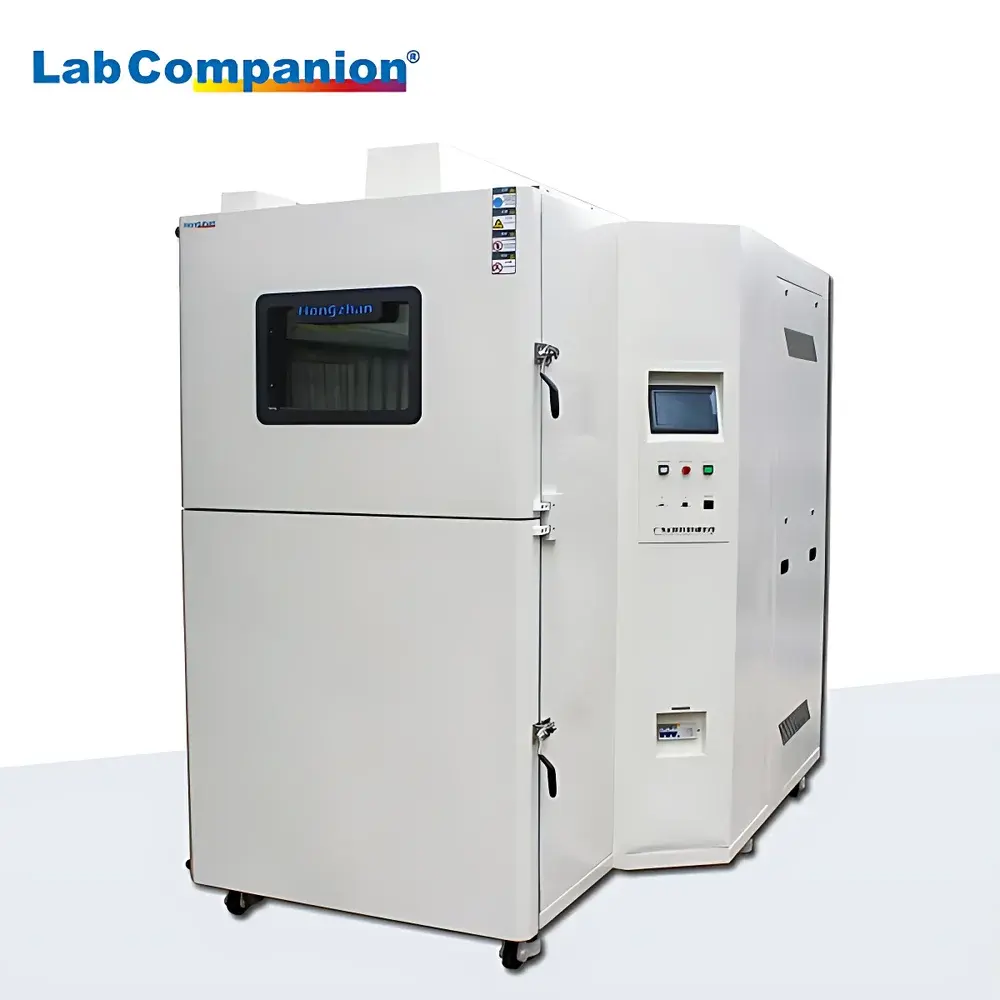
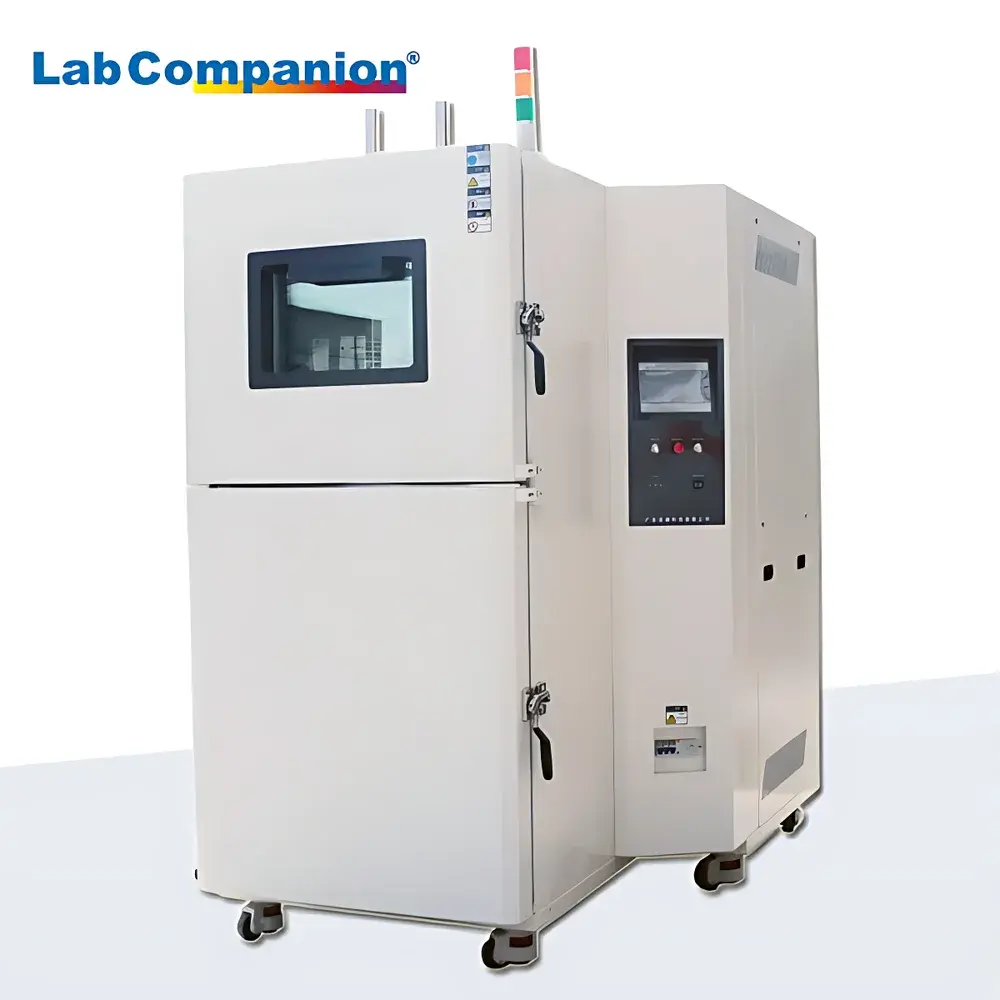
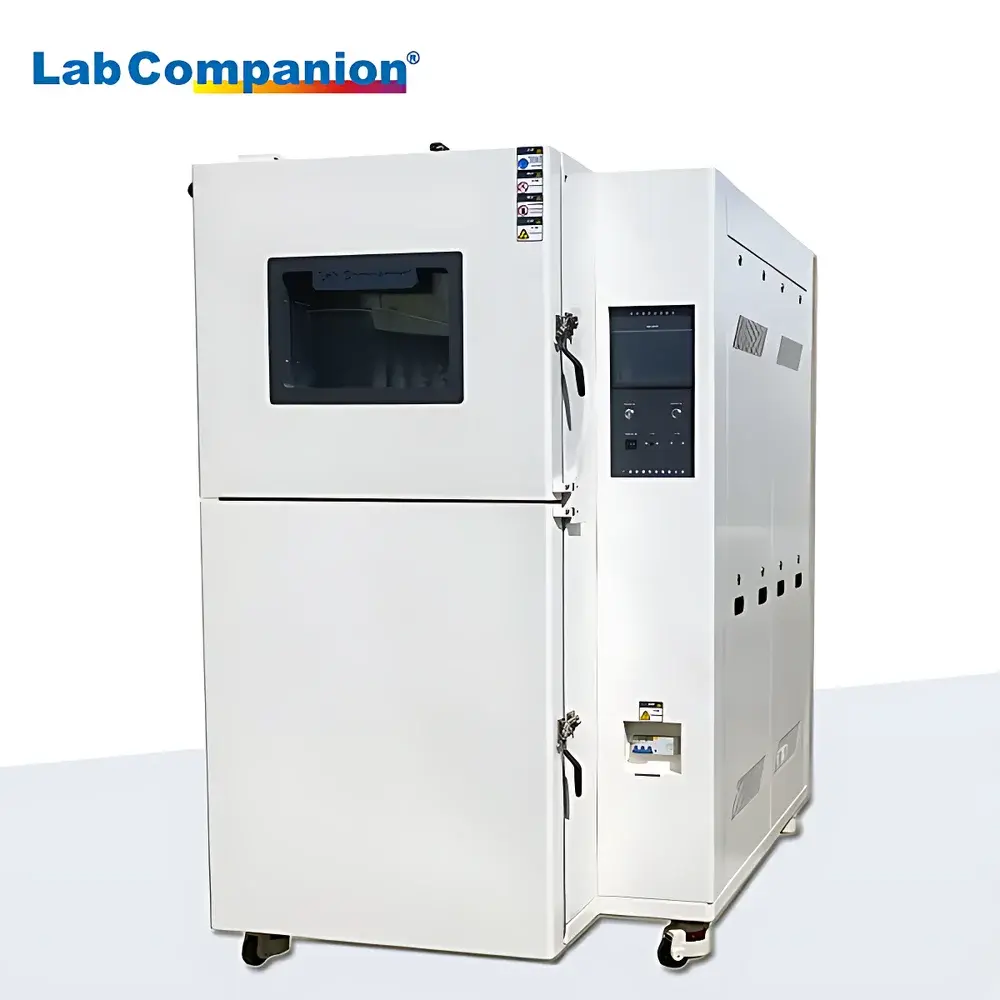
LabCompanion CTU-50A Thermal Shock Test Chamber
| Brand | LabCompanion |
|---|---|
| Origin | Guangdong, China |
| Manufacturer Type | Direct Manufacturer |
| Model | CTU-50A |
| High-Temperature Range | +60 °C to +200 °C |
| Low-Temperature Range | 0 °C to −70 °C |
| Thermal Shock Range | −55 °C to +150 °C |
| Temperature Stability | ±2 °C |
| Heating Rate | R.T. → +200 °C in ~40 min |
| Cooling Rate | R.T. → −70 °C in ~60 min |
| Transfer Time | ≤5 s |
| Temperature Recovery Time | ≤5 min |
| Internal Dimensions (W×H×D) | 300×460×350 mm |
| External Dimensions (W×H×D) | 2250×1200×1950 mm |
| Construction | Cold-Rolled Steel Outer Shell (Ivory White Powder-Coated) + #304 Mirror-Finish Stainless Steel Inner Chamber (1.2 mm) |
| Insulation | Eco-Friendly Glass Fiber (Non-Hazardous Waste Class) |
| Refrigeration | Air-Cooled or Water-Cooled Options |
| Compressor | Imported Hermetic Scroll Compressor |
| Temperature Sensor | Armored Pt100 Platinum Resistance Thermometer |
| Controller | Siemens S7-1200 PLC + Embedded PlatinumV1.0 Control Software |
| Display | 7″ Color TFT Touchscreen Interface |
| Data Storage | USB Port (CSV Format, Non-Hot-Swappable |
| Communication | RJ45 Ethernet Port (Supports PlatinumV1.0 Supervisory Software |
| Power Supply | AC 380 V, 50 Hz, 3-Phase + PE |
| Total Installed Capacity | 19.7 kVA |
| Compliance Standards | MIL-STD-810G Method 503.5 (Thermal Shock), GJB 150.3A–2009, GJB 150.4A–2009, GJB 150.5A–2009, GB/T 2423.1–2023 (Cold), GB/T 2423.2–2023 (Dry Heat), IEC 60068-2-14 |
Overview
The LabCompanion CTU-50A Thermal Shock Test Chamber is an engineered environmental test system designed for rapid, repeatable evaluation of material and component reliability under extreme temperature transitions. It operates on the two-chamber static air thermal shock principle—comprising independent high-temperature and low-temperature zones—with a horizontally moving specimen carrier (basket-type transfer mechanism) that enables precise, sub-5-second transitions between thermal extremes. This architecture eliminates chamber air mixing and ensures strict isolation of thermal zones, supporting high-fidelity simulation of real-world thermal cycling stresses encountered in aerospace electronics, automotive ECUs, semiconductor packaging, and military-grade avionics. The system adheres to the physical test methodology defined in MIL-STD-810G Method 503.5 and aligns with the procedural rigor of GJB 150.3A–2009 (high-temperature exposure), GJB 150.4A–2009 (low-temperature exposure), and GJB 150.5A–2009 (temperature shock). Its calibrated temperature range (−55 °C to +150 °C) and stability (±2 °C over full operating span) meet the metrological requirements for qualification-level testing under ISO/IEC 17025-accredited laboratories.
Key Features
- Independent dual-zone design with sealed high-temperature (+60 °C to +200 °C) and low-temperature (0 °C to −70 °C) chambers, minimizing cross-contamination and thermal lag
- Horizontal basket transfer mechanism with ≤5 s dwell-free transition time and ≤5 min temperature recovery post-transfer, verified per GB/T 2423.22–2012 Annex A
- High-efficiency refrigeration system using imported hermetic scroll compressors and eco-certified non-ozone-depleting refrigerant (R404A/R23 cascade configuration)
- Robust thermal insulation using non-hazardous glass fiber (density ≥48 kg/m³), achieving ≤0.8 W/m²·K thermal transmittance at ambient conditions
- Siemens S7-1200 PLC-based control architecture with embedded PlatinumV1.0 firmware, enabling deterministic real-time loop execution at 100 ms cycle time
- 7-inch industrial-grade TFT touchscreen interface with multi-language support (English, Chinese, Russian), password-protected parameter access levels, and audit trail logging
- Integrated data acquisition: continuous recording of chamber setpoints, actual temperatures (3-point sensor averaging), runtime, and alarm history in CSV format via dedicated USB port
Sample Compatibility & Compliance
The CTU-50A accommodates specimens up to 300 mm (W) × 460 mm (H) × 350 mm (D) within its stainless steel interior chamber. Its #304 mirror-finish inner walls resist oxidation and facilitate cleaning under cleanroom-compatible protocols. All internal surfaces are free of organic adhesives or outgassing elastomers—critical for optical component and vacuum-compatible device testing. The unit conforms to electromagnetic compatibility (EMC) requirements per GB/T 18268.1–2010 and safety standards per GB 4793.1–2007 (IEC 61010-1). It supports GLP/GMP-aligned validation through optional IQ/OQ documentation packages and meets traceability requirements for ISO 9001:2015 and AS9100D quality systems. Calibration certificates are issued against NIST-traceable reference standards, with uncertainty budgets reported per ISO/IEC 17025:2017 Clause 7.6.3.
Software & Data Management
The embedded PlatinumV1.0 control software provides closed-loop PID tuning, programmable multi-step thermal profiles (up to 99 segments), and real-time deviation monitoring with configurable alarm thresholds. Data export via USB generates timestamped CSV files containing setpoint, measured temperature (T1–T3), elapsed time, and system status flags—formatted for direct import into MATLAB, Python pandas, or JMP for statistical process control (SPC) analysis. Optional Ethernet connectivity enables integration with enterprise laboratory information management systems (LIMS) via TCP/IP. The supervisory PlatinumV1.0 PC software supports remote monitoring, batch report generation (PDF/Excel), electronic signature compliance per FDA 21 CFR Part 11 (when deployed with Windows domain authentication), and centralized fleet management of up to 32 chambers across distributed test sites.
Applications
- Qualification testing of printed circuit board assemblies (PCBAs) per IPC-9701A for solder joint fatigue under thermal cycling
- Reliability screening of MEMS sensors, power modules, and ceramic capacitors used in electric vehicle battery management systems (BMS)
- Environmental stress screening (ESS) of avionics hardware per RTCA/DO-160 Section 4.3 (Temperature Shock)
- Material characterization of polymer composites, thermal interface materials (TIMs), and conformal coatings under accelerated aging protocols
- Validation of hermetic seal integrity in medical implant housings and microfluidic cartridges via leak-induced thermal response anomalies
- Pre-compliance testing for CE marking under EN 60068-2-14 and automotive OEM specifications (e.g., GM W3177, Ford ES-XW7T-1A278-AC)
FAQ
What is the maximum specimen weight the CTU-50A basket can support?
The horizontal transfer basket is rated for a static load capacity of 25 kg, with dynamic load limits adjusted per IEC 60068-2-14 Annex B guidance to ensure mechanical stability during rapid acceleration.
Does the system support custom thermal shock profiles with dwell times below 1 minute?
Yes—profile programming allows dwell durations from 10 seconds to 999 minutes per segment, with ramp rate constraints enforced by real-time thermal inertia modeling in the PLC firmware.
Is the USB data port compatible with FAT32-formatted drives only?
Yes—the controller recognizes only FAT32 file systems; exFAT and NTFS volumes will not mount. A minimum 4 GB capacity is recommended for extended test logging.
Can the CTU-50A be validated for use in a regulated pharmaceutical QC lab?
When equipped with optional 21 CFR Part 11-compliant audit trail, electronic signature, and user role management modules—and operated under documented SOPs—it satisfies baseline requirements for equipment qualification in USP and EU Annex 15 environments.
What maintenance intervals are specified for the refrigeration system?
Compressor oil and filter dryer replacement is required every 24 months or 4,000 operational hours, whichever occurs first; quarterly inspection of condenser coil cleanliness and refrigerant charge verification is recommended per ASHRAE Guideline 3-2021.



