
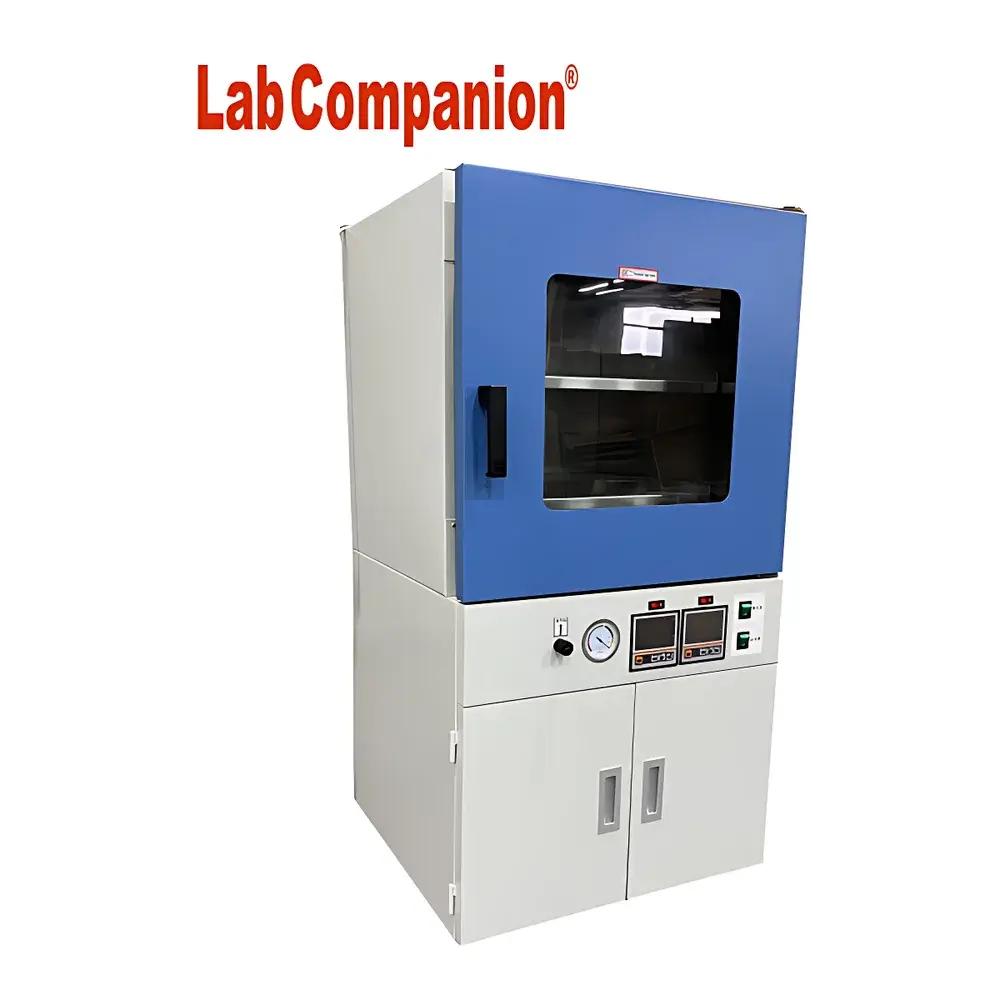
LabCompanion DHG-9000 620L Forced-Air Constant-Temperature Drying Oven
| Brand | LabCompanion |
|---|---|
| Origin | Guangdong, China |
| Manufacturer Type | Direct Manufacturer |
| Origin Category | Domestic (China) |
| Model | DHG-9000 |
| Instrument Type | General-Purpose Forced-Air Oven |
| Temperature Range | RT + 10 °C to 300 °C |
| Temperature Uniformity | ±0.5 °C |
| External Dimensions (W×D×H) | 1195 × 890 × 2060 mm |
| Internal Chamber Dimensions (W×D×H) | 940 × 700 × 1400 mm |
| Chamber Material | Stainless Steel (AISI 304 equivalent, 1Cr18Ni9Ti) or Galvanized Steel |
| Heating Method | Forced-air convection with axial fan circulation and auxiliary oil-heating option |
| Power Supply | Internal heating: AC 220 V, 50 Hz |
| External heating | AC 380 V, 50 Hz |
| Temperature Resolution | 0.1 °C |
| Temperature Stability | ±0.5 °C at setpoint |
| Timer Range | 1–9999 min/h |
| Optional Controller | “D”-series programmable LCD controller with multi-step ramp-soak profiles |
Overview
The LabCompanion DHG-9000 is a high-capacity, forced-air convection drying oven engineered for precision thermal processing in research laboratories, quality control environments, and industrial R&D facilities. Designed around the principle of uniform convective heat transfer, it employs a rear-mounted axial fan and optimized baffle system to ensure laminar airflow distribution across the entire 620 L chamber volume. This architecture minimizes thermal gradients—achieving ±0.5 °C temperature uniformity at steady state—critical for applications requiring reproducible moisture removal, pre-conditioning of polymeric substrates, or thermal aging per ASTM D3045 and ISO 293. The unit operates within a calibrated range from ambient +10 °C up to 300 °C, with independent verification traceable to NIST-traceable reference thermometers. Its robust stainless steel (1Cr18Ni9Ti) chamber—electropolished and fully welded—resists oxidation and corrosion during prolonged exposure to elevated temperatures and low-humidity conditions.
Key Features
- 620 L usable chamber volume (940 × 700 × 1400 mm), accommodating large sample batches or oversized components such as printed circuit board assemblies, composite panels, or pharmaceutical trays.
- Forced-air convection system with adjustable-speed axial fan and internal air baffles ensures consistent airflow velocity (≥0.5 m/s at chamber center) and eliminates cold spots per IEC 60068-2-2 test methodology.
- Dual heating configuration: primary electric heating elements integrated into the chamber walls, plus optional external导热油 (thermal oil) heating loop for enhanced thermal inertia and reduced overshoot during ramping.
- Precision PID temperature controller with 0.1 °C resolution and auto-tuning capability; optional “D-series” programmable LCD controller supports up to 30 segments of ramp/soak profiles with real-time deviation alarms.
- Double-layer insulated chamber door with silicone gasket and magnetic seal maintains thermal integrity and reduces surface temperature rise (<45 °C at 300 °C operation).
- Comprehensive safety architecture including over-temperature cut-off (mechanical backup thermostat), door-open interlock, and grounded chassis compliant with IEC 61010-1.
Sample Compatibility & Compliance
The DHG-9000 accommodates diverse sample formats—including glassware, metal fixtures, ceramic crucibles, polymer films, and coated substrates—without risk of contamination or cross-reactivity. Chamber material (1Cr18Ni9Ti stainless steel) meets ASTM A240 requirements for high-temperature corrosion resistance and is compatible with common laboratory solvents and residual volatiles. The oven complies with GB/T 5170.2–2017 (Chinese national standard for temperature uniformity testing of drying ovens) and conforms to electromagnetic compatibility (EMC) requirements per GB/T 18268.1–2010. When equipped with the optional D-series controller and audit trail module, the system supports GLP/GMP workflows by logging timestamped temperature records, operator IDs, and parameter changes—meeting foundational data integrity expectations aligned with FDA 21 CFR Part 11 Annex 11 principles.
Software & Data Management
The standard analog controller provides local setpoint adjustment and real-time display. For digital integration, the optional D-series controller features RS485 Modbus RTU output, enabling bidirectional communication with SCADA systems or LIMS platforms. Logged data includes chamber temperature (every 10 s), setpoint history, alarm events, and timer status—exportable via USB flash drive in CSV format. Firmware supports user-defined calibration offsets per DIN EN 60751 Class B Pt100 sensor specification. No cloud dependency or proprietary software installation is required; configuration remains accessible via intuitive front-panel navigation.
Applications
- Moisture content determination in pharmaceutical excipients (USP <921>), food powders, and ceramic green bodies.
- Thermal stabilization of lithium-ion battery electrode coatings prior to calendaring.
- Aging studies of elastomers and adhesives per ISO 188 and ASTM D573.
- Bake-out of vacuum chamber components and optical mounts in cleanroom assembly lines.
- Curing of epoxy-based encapsulants and conformal coatings in electronics manufacturing.
- Pre-drying of filter media and chromatography columns before solvent conditioning.
FAQ
What is the maximum safe operating temperature for continuous use?
The DHG-9000 is rated for continuous operation at 300 °C; however, sustained use above 250 °C requires periodic verification of sensor drift and door gasket integrity.
Can the oven be validated for IQ/OQ/PQ protocols?
Yes—the unit’s mechanical design, sensor layout, and controller architecture support full qualification per GAMP5 guidelines; validation templates and factory calibration certificates are available upon request.
Is external thermal oil heating mandatory for 300 °C operation?
No; the standard electric heating system achieves 300 °C. Oil heating is an optional upgrade for improved thermal stability during extended dwell cycles.
Does the oven meet CE marking requirements?
It complies with relevant parts of the EU Low Voltage Directive (2014/35/EU) and EMC Directive (2014/30/EU); CE marking is applied only upon completion of EU-based notified body assessment.
How is temperature uniformity verified across the working volume?
Uniformity is measured using nine calibrated Pt100 sensors placed at standardized locations (center, six faces, and four corners) per GB/T 5170.2–2017; reports include deviation maps and statistical confidence intervals.



