
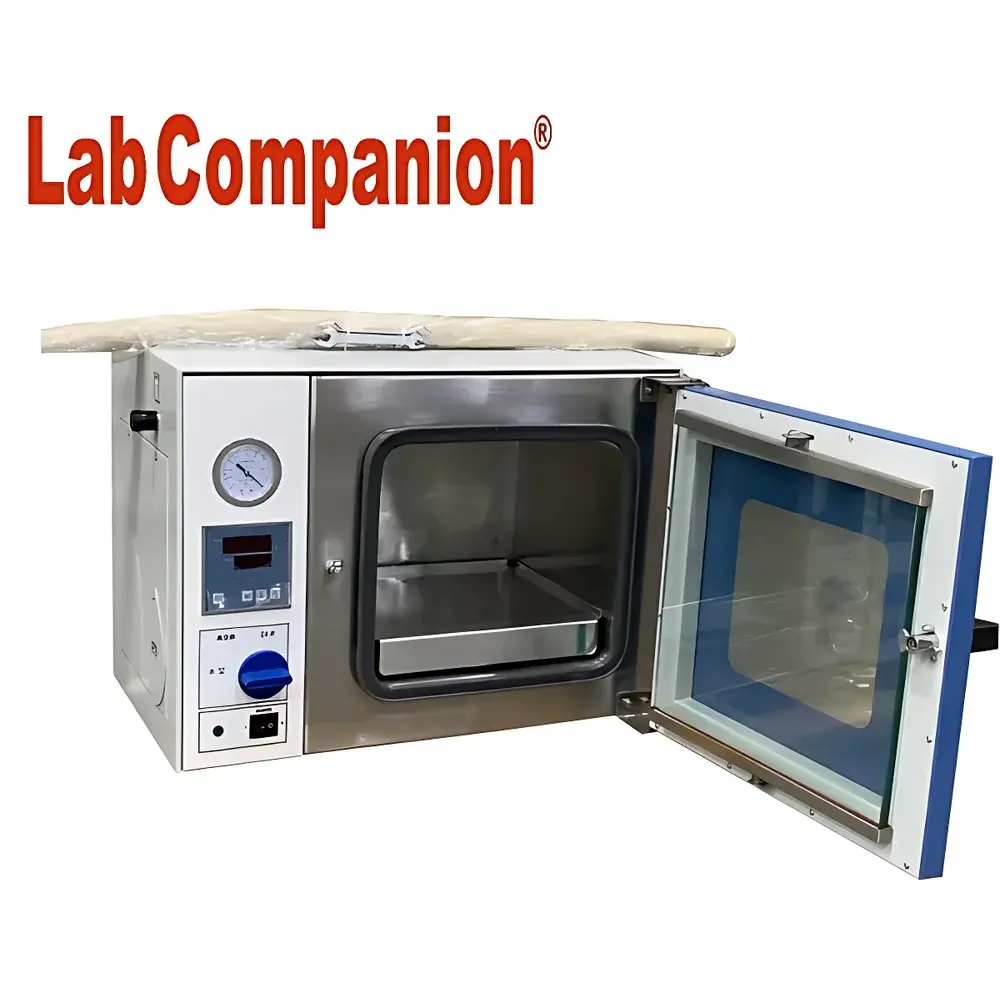
LabCompanion DHG-9005 Advanced Forced-Air Drying Oven
| Brand | LabCompanion |
|---|---|
| Origin | Guangdong, China |
| Manufacturer Type | Direct Manufacturer |
| Product Category | Domestic |
| Model | DHG-9005 |
| Instrument Type | General-Purpose Drying Oven |
| Temperature Range | RT + 10°C to 300°C |
| Temperature Uniformity | ±0.5°C |
| External Dimensions (W×D×H) | 1195 × 890 × 2060 mm |
| Internal Chamber Dimensions (W×D×H) | 940 × 700 × 1400 mm |
| Interior Material | Stainless Steel (1Cr18Ni9Ti) or Galvanized Steel |
| Heating Method | Forced-Air Convection with Optional Thermal Oil Heating |
| Power Supply | AC 220 V, 50 Hz (Internal Heating) |
| Temperature Resolution | 0.1°C |
| Temperature Stability | ±0.5°C |
| Timer Range | 1–9999 min/h |
| Programmable Controller Option | “D” Series LCD Microprocessor-Based Controller |
Overview
The LabCompanion DHG-9005 is a high-capacity, microprocessor-controlled forced-air drying oven engineered for precision thermal processing in academic, industrial, and quality control laboratories. Designed around the principle of uniform convective heat transfer, it employs a robust axial fan system that circulates heated air across calibrated ducts and perforated stainless steel shelves—ensuring consistent temperature distribution throughout its 420 L working chamber. Unlike natural convection ovens, this model eliminates thermal stratification through dynamic airflow management, enabling reliable moisture removal, pre-drying of samples prior to gravimetric analysis, thermal aging of polymers, and controlled curing of coatings. Its operational envelope spans from ambient +10°C up to 300°C, making it suitable for applications requiring elevated but non-combustible thermal treatment—such as residual solvent evaporation, desiccation of ceramic precursors, and stabilization of pharmaceutical excipients under ISO 17025-compliant conditions.
Key Features
- 420 L ultra-large internal volume (940 × 700 × 1400 mm) optimized for batch processing of voluminous or multiple sample sets
- High-precision digital PID temperature controller with 0.1°C resolution and ±0.5°C uniformity across the entire chamber
- Dual heating configuration support: standard electric resistance heating (AC 220 V) and optional external thermal oil circulation (AC 380 V) for enhanced thermal inertia and reduced overshoot
- Corrosion-resistant interior constructed from 1Cr18Ni9Ti austenitic stainless steel—mechanically polished and passivated for long-term resistance to acidic vapors and oxidation
- Intelligent programmable logic controller (PLC) available in “D-series” variants, supporting multi-step ramp-soak profiles, data logging via RS485/Modbus, and password-protected parameter locking
- Triple-layer insulated double-wall construction with mineral wool insulation (≥80 mm thickness) minimizes surface temperature rise and improves energy efficiency
- Over-temperature cut-off protection, door-open alarm, and real-time fault diagnostics compliant with IEC 61000-6-2 EMC immunity standards
Sample Compatibility & Compliance
The DHG-9005 accommodates a broad spectrum of sample types—including glassware, metal substrates, polymer films, granular powders, filter papers, and ceramic crucibles—without risk of cross-contamination or material degradation. Its stainless steel chamber resists chloride-induced pitting and withstands repeated exposure to low-concentration organic solvents and aqueous salt solutions. The unit conforms to key international safety and performance benchmarks: UL 61010-1 (2nd Ed.), CE marking per Directive 2014/30/EU (EMC) and 2014/35/EU (LVD), and GB/T 5170.2–2017 (Chinese national standard for temperature testing equipment). When equipped with audit-trail-enabled “D-series” controllers, it supports GLP/GMP workflows by recording operator ID, setpoint changes, deviation events, and runtime logs—fully traceable for FDA 21 CFR Part 11 readiness.
Software & Data Management
While the base DHG-9005 operates via front-panel keypad interface, optional LabCompanion SmartLink software enables remote monitoring and configuration via Ethernet or USB-to-RS485 adapter. This Windows-based application facilitates real-time graphing of chamber temperature vs. time, export of CSV-formatted datasets for statistical process control (SPC), and automated report generation aligned with ISO/IEC 17025 documentation requirements. All logged data are timestamped, digitally signed, and stored in non-volatile memory with configurable retention periods—ensuring integrity during regulatory audits. Firmware updates are delivered via secure HTTPS download and validated using SHA-256 checksum verification.
Applications
- Moisture content determination per ASTM D2297, ISO 758, and USP
- Pre-conditioning of test specimens prior to tensile, impact, or hardness evaluation (ASTM D638, ISO 527)
- Thermal stabilization of reference standards used in calibration laboratories
- Drying of filter media post-gravimetric particulate matter collection (EPA Method 201A)
- Curing of epoxy-coated electrical components under controlled ramp profiles
- Accelerated aging studies for packaging materials per ASTM F1980
- Residual solvent removal from API intermediates in non-GMP pilot-scale synthesis
FAQ
What is the maximum recommended operating temperature for continuous use?
The DHG-9005 is rated for continuous operation at 300°C; however, sustained use above 250°C may reduce heater element service life and requires periodic verification of thermal uniformity per ISO 17025 Clause 6.4.3.
Can the oven be integrated into a LIMS or MES environment?
Yes—via optional Modbus RTU over RS485, the “D-series” controller supports bi-directional communication with laboratory information management systems for automated job dispatch and result ingestion.
Is the stainless steel interior electropolished or mechanically finished?
The standard interior features a #4 brushed mechanical finish (Ra ≤ 0.8 µm); electropolishing is available as a factory-configurable option for ultra-high-purity applications.
Does the unit include validation documentation?
Factory-installed IQ/OQ documentation packages—including as-built drawings, calibration certificates traceable to NIM (China National Institute of Metrology), and installation checklists—are provided upon request.
What maintenance intervals are recommended for optimal performance?
Fan motor lubrication every 12 months, air filter cleaning every 3 months, and annual recalibration of the PT100 sensor using a NIST-traceable dry-block calibrator.



