
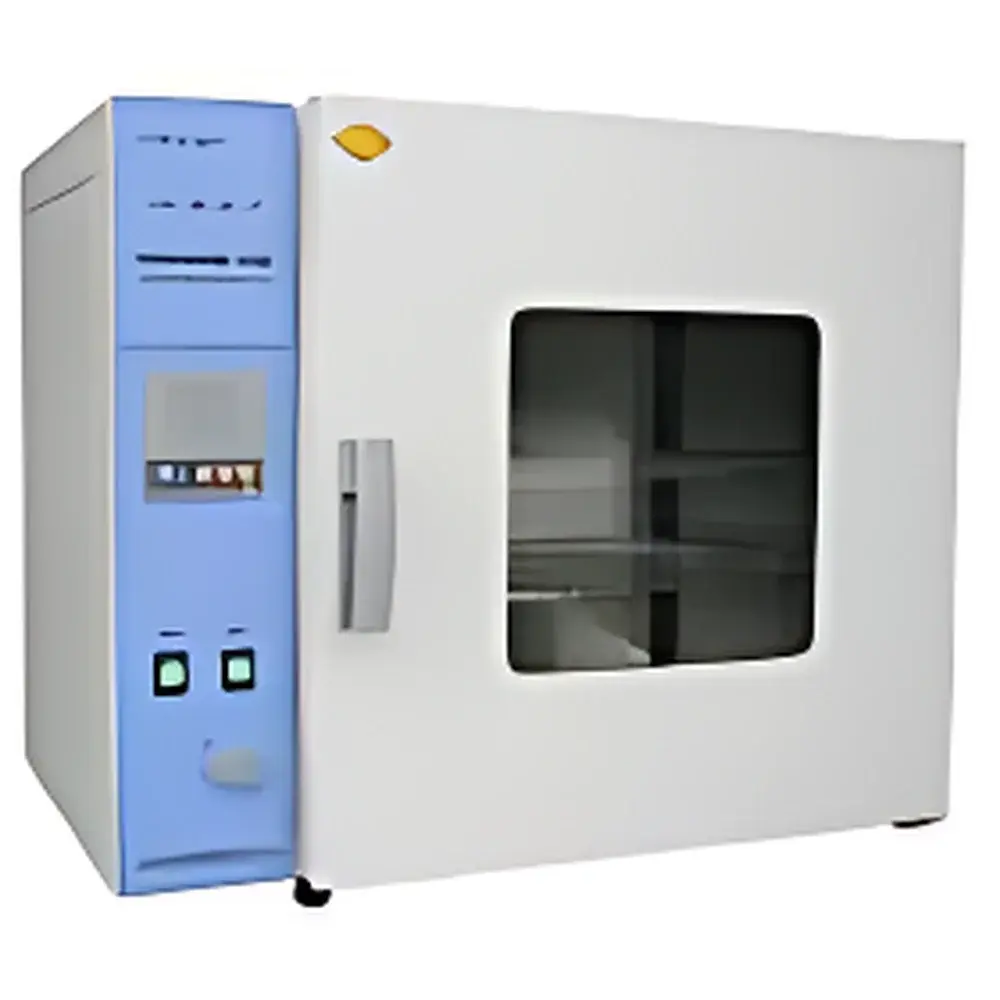
LabCompanion GZX1 High-Temperature Drying Oven
| Brand | LabCompanion |
|---|---|
| Origin | Guangdong, China |
| Manufacturer Type | Direct Manufacturer |
| Model | GZX1 |
| Power Options | 3.0 kW / 4.0 kW / 6.0 kW |
| Temperature Range | RT+10°C to 300°C or RT+20°C to 450°C |
| Temperature Uniformity | ±2.5% |
| Temperature Fluctuation | ±0.5°C |
| Heating Rate | ≤70 min (RT+10→300°C), ≤80 min (RT+20→450°C) |
| Air Exchange Rate | 5–200 cycles/hour |
| Internal Dimensions (W×D×H, cm) | 50×60×75 |
| External Dimensions (W×D×H, cm) | 67×106×96 |
| Control System | Microprocessor-based PID controller with auto-tuning |
| Temperature Sensor | Industrial-grade PT100 platinum resistance thermometer |
| Display | LED digital display for both setpoint and actual temperature |
| Timer Range | 0–999 minutes |
| Insulation | High-density polyurethane foam + glass fiber |
| Door Seal | Environmentally compliant silicone rubber gasket |
| Heating Element | Ni-Cr alloy wire heater |
| Safety Features | Independent over-temperature protection, thermal cutoff fuse, over-current circuit breaker |
| Standard Compliance | JB/T 5520–1991 Technical Specifications for Drying Ovens |
| Optional Accessories | Programmable temperature controller, RS232/RS485 communication port, chart recorder, additional shelves, observation window, Φ50 cable feedthrough |
Overview
The LabCompanion GZX1 High-Temperature Drying Oven is an engineered laboratory-grade thermal processing system designed for precise, repeatable, and stable heat treatment of non-flammable and non-explosive materials. Operating on the principle of forced-air convection, the oven maintains uniform thermal distribution across its working chamber via a high-efficiency axial fan and optimized internal airflow ducting. Its dual-range capability—RT+10°C to 300°C and RT+20°C to 450°C—supports diverse applications including component aging, moisture removal, pre-baking of substrates, post-curing of coatings, and accelerated stability testing. The unit meets JB/T 5520–1991, the Chinese national standard governing drying oven performance, and is constructed to support GLP-aligned workflows in R&D, quality control, and production environments.
Key Features
- Robust thermal architecture featuring double-layer insulation: high-density polyurethane foam core combined with glass fiber lining for minimized heat loss and enhanced energy efficiency.
- Corrosion-resistant interior chamber options: SUS304 stainless steel (BN variant) or high-quality cold-rolled steel with high-temp silver paint finish (N variant), ensuring long-term integrity under repeated thermal cycling.
- Microprocessor-based PID temperature controller with self-tuning algorithm, enabling adaptive response to load variations and maintaining ±0.5°C temperature fluctuation under steady-state conditions.
- Dual-display LED interface showing real-time measured temperature and user-defined setpoint simultaneously; intuitive up/down key input for parameter entry without menu navigation.
- Independent over-temperature safety circuit—electrically isolated from the main controller—triggers automatic power cutoff if chamber temperature exceeds user-defined or factory-set limits.
- Four-point adjustable leveling feet with locking casters facilitate safe repositioning within shared lab spaces while ensuring mechanical stability during operation.
- Modular structural design allows for field serviceability and simplifies component replacement, reducing downtime during preventive maintenance cycles.
Sample Compatibility & Compliance
The GZX1 accommodates a broad spectrum of sample forms—including wafers, PCB assemblies, ceramic substrates, polymer films, pharmaceutical excipients, and bulk chemical powders—provided they are non-volatile, non-combustible, and thermally stable within the selected operating range. Its chamber geometry supports standardized shelf configurations (2 standard shelves included; additional shelves available as accessories) and optional Φ50 mm cable feedthroughs for in-situ sensor integration. The oven complies with JB/T 5520–1991 for temperature uniformity (±2.5%), heating rate, and construction requirements. While not certified to IEC 61000 or UL standards out-of-the-box, its electrical architecture (AC220 V ±10%, 50 Hz ±0.5 Hz) and safety interlocks align with foundational requirements for Class II laboratory equipment under ISO/IEC 17025-conducive environments.
Software & Data Management
The base configuration includes a stand-alone microcontroller interface with local data logging capability (timer-based hold function, elapsed time tracking, and temperature deviation alerts). For traceable, auditable operations, optional RS232 or RS485 serial ports enable integration with external SCADA systems or LIMS platforms. When paired with a programmable temperature controller (optional accessory), the unit supports multi-step ramp-soak profiles and exports timestamped CSV logs compatible with FDA 21 CFR Part 11–compliant validation frameworks—subject to customer-configured electronic signature and audit trail implementation on the host system. All firmware revisions undergo version-controlled release documentation per internal engineering change management protocols.
Applications
- Electronics manufacturing: Aging of LEDs, LCD modules, quartz crystals, resistors, and capacitors under controlled thermal stress to verify long-term reliability and screen latent defects.
- Materials science: Pre-drying of metal oxide precursors, binder burnout in ceramic green bodies, and thermal conditioning of composite laminates prior to mechanical testing.
- Pharmaceutical development: Moisture content reduction in active pharmaceutical ingredients (APIs), excipient drying, and stability-indicating thermal exposure studies aligned with ICH Q1 guidelines.
- Academic research: Kinetic studies of solvent evaporation, polymer crosslinking kinetics, and catalyst activation protocols requiring precise isothermal holds at elevated temperatures.
- Quality assurance labs: Calibration verification of thermocouples and RTDs using NIST-traceable reference standards placed within the validated uniformity zone.
FAQ
What is the maximum allowable operating temperature for the GZX1 series?
The GZX1 offers two standard configurations: one rated for RT+10°C to 300°C, and another engineered for RT+20°C to 450°C. Selection depends on chamber material specification (SUS304 vs. high-temp coated steel) and heating element derating.
Does the oven support validation protocols required for regulated industries?
Yes—when equipped with optional programmable controller and serial interface, it enables generation of IQ/OQ documentation packages. Temperature uniformity mapping and alarm event logs meet baseline expectations for GMP-relevant thermal process validation.
Can the chamber be customized with additional access ports or viewing windows?
Yes. Optional accessories include an observation window with heat-resistant borosilicate glass and a Φ50 mm cable feedthrough port, both installed during factory assembly to preserve structural integrity and thermal seal performance.
Is third-party calibration certification available?
LabCompanion provides factory calibration certificates traceable to national metrology institutes. On-site calibration services and 21 CFR Part 11–compliant calibration management support are available through authorized regional partners.
How is airflow uniformity verified across the working volume?
Per JB/T 5520–1991, uniformity is assessed using nine PT100 probe placements (center + eight corners) during stabilized operation. Measured deviations are reported as percentage of setpoint temperature and must remain within ±2.5% across all tested zones.



