
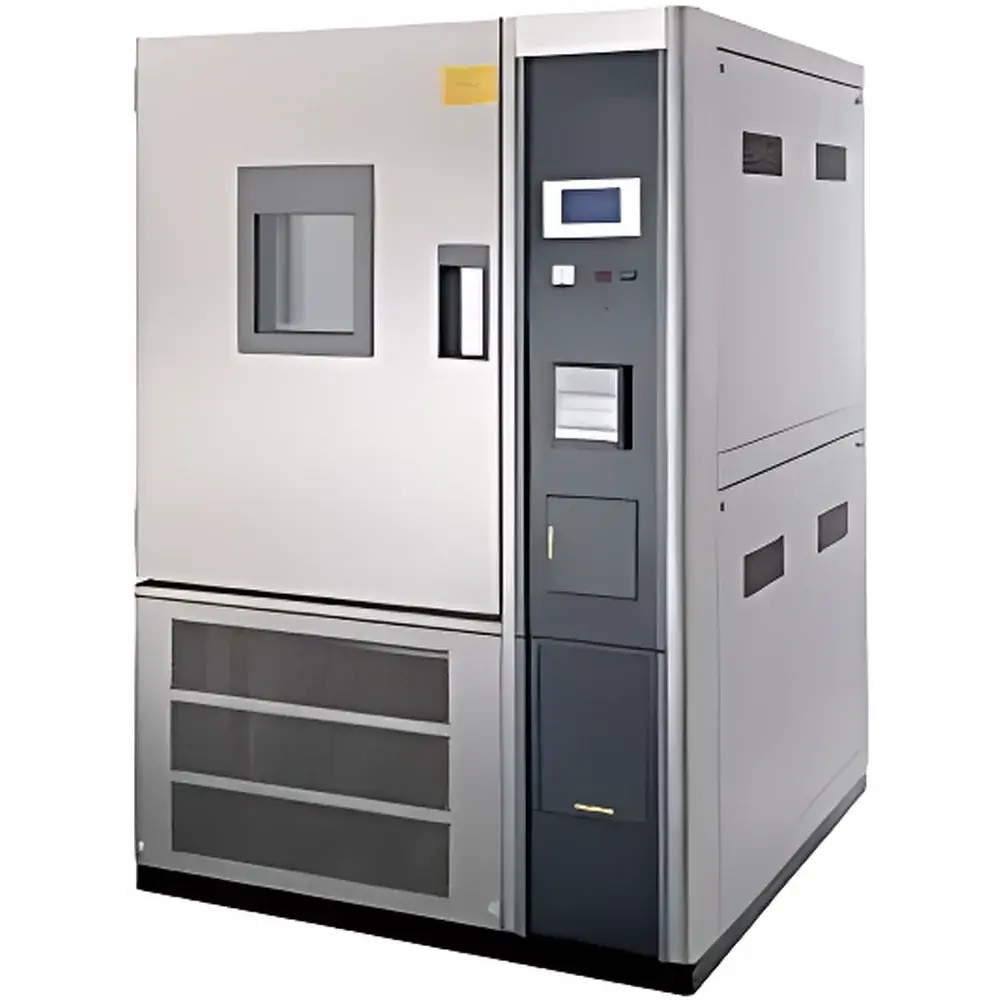
LabCompanion HC-80 High-Low Temperature Alternating Environmental Test Chamber
| Brand | LabCompanion |
|---|---|
| Origin | Guangdong, China |
| Manufacturer Type | Direct Manufacturer |
| Country of Origin | China |
| Model | HC-80 |
| Price | Upon Request |
| Internal Volume | 80 L |
| Interior Dimensions (W×H×D) | 400 × 500 × 400 mm |
| Temperature Range | 0 to +150 °C |
| Temperature Uniformity | ≤ ±2.0 °C |
| Temperature Fluctuation | ±0.5 °C |
| Heating Rate | 0 → +150 °C in ≤20 min (~3 °C/min) |
| Cooling Rate | +20 → 0 °C in ≤20 min (~1 °C/min) |
| Refrigerant | R507 (HFC-based, ozone-friendly) |
| Control System | VT9620 Fixed-Setpoint PID Controller (Taiwan-made, LED display, 0.1 °C resolution) |
| Construction | SUS304 stainless steel interior & exterior with powder-coated finish |
| Insulation | High-density polyurethane foam + fiberglass |
| Cooling Method | Single-stage or cascade mechanical compression refrigeration (air-cooled condenser) |
| Safety Protections | Independent overtemperature cutoff, low-water alarm, compressor overload/overcurrent protection, high-pressure refrigerant switch, earth leakage circuit breaker, phase failure detection |
Overview
The LabCompanion HC-80 High-Low Temperature Alternating Environmental Test Chamber is an engineered solution for evaluating the thermal stability, operational integrity, and long-term reliability of electronic components, optoelectronic devices, printed circuit boards (PCBs), lithium-ion batteries, LCD modules, and fiber-optic assemblies under controlled extreme temperature conditions. Designed according to fundamental thermodynamic principles and validated against international environmental testing standards, the HC-80 employs a dual-mode thermal regulation architecture—combining independent heating and cooling circuits with Balanced Temperature and Humidity Control (BTHC) logic—to achieve precise, repeatable, and stable thermal profiles. Its chamber core operates on convection-driven air circulation, utilizing a centrifugal blower system with optimized duct geometry to eliminate thermal stratification and ensure spatial temperature uniformity within ±2.0 °C across the full 80 L working volume. The unit is not a general-purpose oven or incubator; rather, it functions as a deterministic stress-testing platform for accelerated life-cycle validation, qualification testing, and pre-compliance screening in R&D labs and quality assurance departments.
Key Features
- Robust thermal architecture featuring a hermetically sealed, low-noise rotary compressor (imported from Europe or North America) paired with R507 refrigerant—a zero-ozone-depletion-potential (ODP = 0) HFC blend compliant with current EU F-Gas Regulation and EPA SNAP requirements.
- SUS304 stainless steel chamber interior and structural frame, combined with electrostatically applied powder coating on external surfaces, delivering corrosion resistance suitable for continuous operation in industrial laboratory environments.
- High-efficiency insulation system comprising rigid polyurethane foam (≥80 mm thickness) laminated with fiberglass layers, minimizing thermal bridging and reducing energy consumption by up to 30% relative to conventional chambers of comparable capacity.
- VT9620 fixed-setpoint temperature controller (Taiwan-manufactured), offering LED-based real-time monitoring, 0.1 °C setpoint resolution, auto-tuning PID algorithms, and selectable forward/reverse control action for seamless integration into legacy test protocols.
- Dual independent thermal actuation: Ni-Cr alloy heating elements and a fast-response refrigerant metering system (FastAIT™ technology) enabling dynamic load compensation and maintaining thermal stability even during frequent setpoint transitions.
- Full-spectrum safety redundancy including independent overtemperature cutout (mechanical backup), refrigerant high-pressure switch, water-level sensor, motor overcurrent protection, and earth leakage detection—all conforming to IEC 61000-6-2/6-4 immunity and emission limits.
Sample Compatibility & Compliance
The HC-80 accommodates standard industrial samples up to 350 mm (W) × 450 mm (H) × 350 mm (D), with two adjustable stainless-steel shelves included as standard. A centrally located Φ50 mm cable port (with removable gasketed cover) permits external signal routing for in-situ electrical parameter monitoring during thermal cycling. The chamber satisfies mandatory compliance requirements for environmental stress screening per GB/T 10589–1989 (Low-Temperature Test Chambers), GB/T 10592–1989 (Climate Test Chambers), GB/T 2423.1–2021 (Test A: Cold), GB/T 2423.2–2021 (Test B: Dry Heat), and MIL-STD-810G Method 502.5 (Low Temperature) and Method 507.5 (Temperature Shock). While not certified to IEC 60068-2 series out-of-the-box, its performance envelope aligns with Clause 2.1 (Temperature Stabilization Tolerance) and Clause 3.2 (Uniformity Requirements) when operated under calibrated, no-load conditions at ambient 20 °C.
Software & Data Management
The HC-80 operates in fixed-setpoint mode using the VT9620 hardware controller, which logs internal chamber temperature at 1-second intervals and retains the last 32 hours of runtime data internally. For extended traceability and regulatory alignment, optional RS-485/Modbus RTU or Ethernet/IP interfaces support connection to third-party SCADA systems or LIMS platforms. When integrated with compliant software (e.g., LabVIEW-based DAQ or custom Python scripts), the chamber supports audit-trail generation, electronic signature capture, and 21 CFR Part 11–ready data export—enabling GLP/GMP-aligned test documentation for medical device or automotive electronics validation. Firmware updates are performed via USB, with version history and checksum verification embedded in the controller’s boot loader.
Applications
- Thermal cycling validation of automotive ECUs prior to AEC-Q200 qualification
- Pre-conditioning of lithium-ion pouch cells before formation cycling or impedance spectroscopy
- Reliability assessment of optical transceivers operating in outdoor telecom infrastructure
- Stress screening of solder joints in HDI PCBs per IPC-9701A guidelines
- Material coefficient-of-thermal-expansion (CTE) correlation studies for polymer encapsulants
- Process window definition for reflow soldering profile development
FAQ
What is the maximum sample weight the HC-80 can accommodate without compromising thermal uniformity?
The chamber is rated for static loads up to 30 kg distributed evenly across both shelves. Exceeding this limit may impede airflow and degrade temperature uniformity beyond ±2.0 °C.
Can the HC-80 perform temperature ramp-and-soak profiles?
No—the standard VT9620 controller supports only fixed-setpoint operation. Ramp-and-soak functionality requires the optional programmable controller upgrade (model VT9850 or equivalent).
Is the R507 refrigerant compatible with existing facility recovery systems?
Yes—R507 is a zeotropic blend (R125/R23) classified under ASHRAE Standard 34 as A1 (low toxicity, non-flammable) and is fully recoverable using standard HVAC-grade reclaim equipment.
Does the unit include calibration certification?
A factory-assembled NIST-traceable temperature calibration report (per ISO/IEC 17025) is available upon request at additional cost; default delivery includes only a functional verification log.
What maintenance intervals are recommended for optimal compressor longevity?
Compressor oil analysis and refrigerant circuit integrity checks are advised every 2,000 operational hours or biannually—whichever occurs first—using OEM-recommended service kits and diagnostic procedures.



