
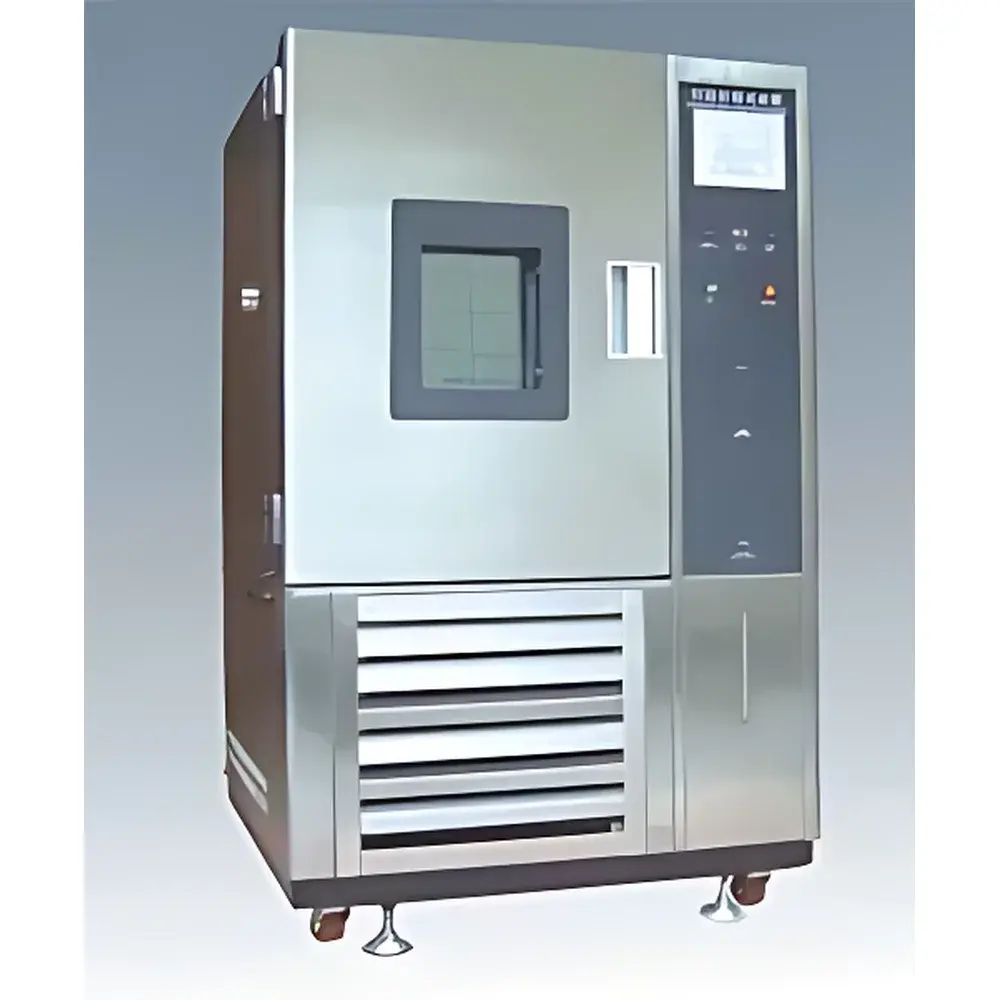
LabCompanion HLT/HA36 Temperature and Humidity Environmental Test Chamber
| Brand | LabCompanion |
|---|---|
| Origin | Guangdong, China |
| Manufacturer Type | Direct Manufacturer |
| Model | HLT/HA36 |
| Temperature Range | −20 °C to +125 °C (optional −40 °C / −70 °C) |
| Humidity Range | 25–98 %RH |
| Interior Dimensions (W×D×H) | 400 × 300 × 300 mm |
| Exterior Dimensions (W×D×H) | 600 × 670 × 1280 mm |
| Door Style | Top-opening lid |
| Inner Chamber Material | Stainless steel sheet |
| Outer Shell Material | Cold-rolled steel with powder coating (stainless steel optional) |
| Heating Rate | ≤40 min (room temp → +125 °C) |
| Cooling Rate | ≤15 min (room temp → −40 °C) |
| Temperature Uniformity | ≤2 °C |
| Temperature Stability | ≤±0.5 °C |
| Temperature Accuracy | ≤±2 °C |
| Humidity Accuracy | ±3.0 %RH (>75 %RH), ±5.0 %RH (≤75 %RH) |
| Humidification Method | Surface vaporization or pressure jetting |
| Refrigeration System | Air-cooled dual-stage cascade |
| Power Supply | 220 V / 50 Hz / 10 A |
| Compliance | GB 10586–1989, GB 10592–1989, IEC 60068-2, ISO 16750-4, ASTM D4332, MIL-STD-810G (environmental conditioning sections) |
Overview
The LabCompanion HLT/HA36 Temperature and Humidity Environmental Test Chamber is an engineered solution for accelerated environmental stress testing under controlled thermal and hygrothermal conditions. Designed in accordance with international standards for reliability validation—including IEC 60068-2, ISO 16750-4, and ASTM D4332—the chamber delivers precise, repeatable exposure profiles required for qualification testing across aerospace, automotive electronics, medical device packaging, and industrial instrumentation sectors. Its dual-stage air-cooled cascade refrigeration system enables stable operation from −20 °C to +125 °C, with optional extended low-temperature configurations (−40 °C and −70 °C) available upon request. The humidity control subsystem—based on surface vaporization or pressure-jet humidification—maintains 25–98 %RH with traceable accuracy per ISO 17025-aligned calibration protocols. All thermal and moisture cycles are governed by a programmable controller featuring PID regulation, real-time deviation monitoring, and automatic load compensation to minimize energy consumption without compromising test fidelity.
Key Features
- Compact footprint (600 × 670 × 1280 mm) with integrated casters for lab-floor mobility and repositioning
- Top-opening lid design minimizes heat/humidity loss during sample loading and visual inspection
- Stainless steel inner chamber ensures corrosion resistance, ease of cleaning, and long-term dimensional stability
- Intelligent thermal management: self-detecting internal heat load triggers adaptive compressor staging to reduce power draw and acoustic emissions
- Temperature uniformity ≤2 °C and stability ≤±0.5 °C across the full working volume, verified per GB/T 2423.1–2012 Annex B
- Low-noise operation (<65 dB(A) at 1 m) suitable for shared laboratory environments and GLP-compliant facilities
- Independent safety interlocks: over-temperature cutoff, phase-loss detection, ground-fault protection, water-flow monitoring (for water-cooled variants), and overload circuit breakers
Sample Compatibility & Compliance
The HLT/HA36 accommodates specimens up to 400 × 300 × 300 mm (W×D×H) within its stainless steel chamber. It supports standardized test sequences defined in MIL-STD-810G Method 502.6 (low temperature), Method 501.6 (high temperature), and Method 507.6 (humidity). The chamber meets the environmental conditioning requirements of IEC 60601-1 (medical electrical equipment), AEC-Q200 (automotive passive components), and IPC-J-STD-020 (moisture sensitivity level classification). Optional low-humidity configuration (5–98 %RH) enables evaluation of desiccant-based packaging and MEMS device hermeticity. All units undergo factory verification per ISO/IEC 17025 traceable procedures, with as-delivered calibration certificates documenting temperature and humidity performance at multiple setpoints.
Software & Data Management
Standard configuration includes a microprocessor-based digital controller with intuitive keypad interface and LED display. Optional upgrade to the IPC500 LCD touch-screen controller adds Ethernet connectivity, USB data export (CSV), and real-time graphing of chamber parameters. The controller logs timestamped temperature/humidity values at user-defined intervals (1–600 seconds), stores ≥10,000 data points internally, and supports audit-trail functionality compliant with FDA 21 CFR Part 11 when paired with LabCompanion’s optional secure authentication module. Remote monitoring via Modbus RTU or TCP/IP allows integration into centralized facility SCADA systems. Data files are compatible with common statistical process control (SPC) platforms and can be imported directly into JMP, Minitab, or Python-based analysis workflows.
Applications
- Accelerated life testing of PCB assemblies exposed to thermal cycling and condensation
- Validation of polymer seal integrity in pharmaceutical primary packaging under high-humidity storage conditions
- Thermal shock screening of avionics enclosures prior to flight qualification
- Environmental stress screening (ESS) of semiconductor devices per JESD22-A104
- Material compatibility testing of lubricants and elastomers at extreme temperature-humidity combinations
- Stability assessment of diagnostic reagents and biologics under ICH Q1A(R3) recommended storage conditions
FAQ
What is the standard temperature and humidity accuracy specification?
Temperature accuracy is ≤±2 °C; humidity accuracy is ±3.0 %RH above 75 %RH and ±5.0 %RH at or below 75 %RH, measured at chamber center per GB/T 2423.3–2016.
Can this chamber operate continuously at −70 °C?
Yes—the HLT/HA36 supports continuous operation at −70 °C when equipped with the extended low-temperature option and water-cooled cascade condenser (requires external chilled water supply at 10–25 °C).
Is the chamber compliant with GLP or GMP documentation requirements?
With the IPC500 controller and optional audit-trail license, the system provides electronic records meeting ALCOA+ principles and supports 21 CFR Part 11 compliance through role-based access control and electronic signature capability.
What maintenance intervals are recommended for the refrigeration system?
Compressor oil and filter replacement every 24 months; refrigerant charge verification annually; condenser coil cleaning quarterly in typical lab environments.
Are custom chamber dimensions or materials available?
Yes—LabCompanion offers OEM engineering services for non-standard interior volumes, alternative chamber linings (e.g., electropolished stainless), and specialized door mechanisms (e.g., pneumatic lift, double-glazed observation windows with anti-fog heating).



