
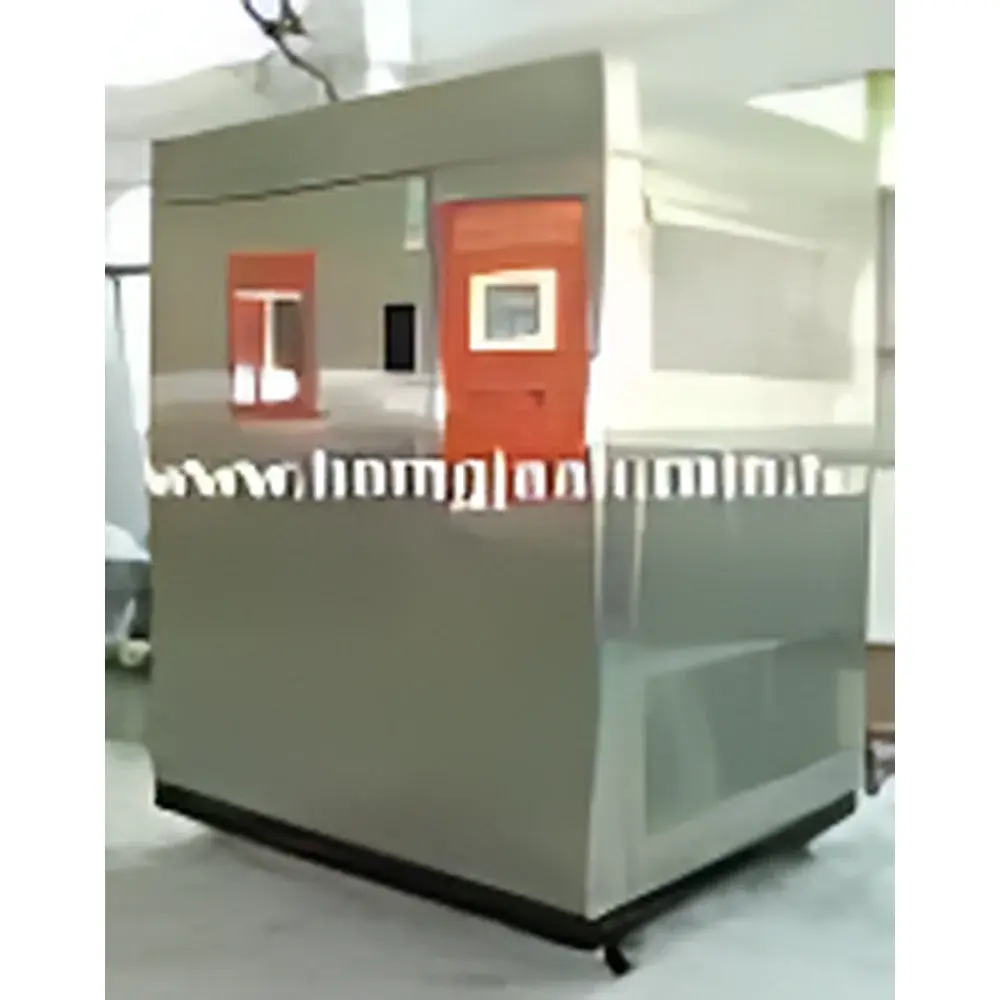
LabCompanion LTS-252-3PA Three-Zone Thermal Shock Test Chamber
| Brand | LabCompanion |
|---|---|
| Origin | Guangdong, China |
| Manufacturer Type | Direct Manufacturer |
| Model | LTS-252-3PA |
| Temperature Range (High Zone) | +60 °C to +200 °C |
| Temperature Range (Low Zone) | −65 °C to −10 °C |
| Internal Chamber Dimensions | 80 × 80 × 75 cm |
| Temperature Resolution | ±0.1 °C |
| Control System | PID with ETAC830 Touchscreen Controller (10.4″ TFT, Multi-language UI) |
| Program Storage | 1000 programs / 2500 segments |
| Cycle Repetition | Up to 999 cycles |
| Recovery Time (−65 °C → +150 °C) | ≈5 min |
| Cooling Method | Dual-stage mechanical refrigeration (no LN₂ or CO₂ required) |
| Compliance | Designed for ISO 16750-4, JEDEC JESD22-A104, MIL-STD-810H thermal shock protocols |
| Power Supply | AC 3φ 380–415 V ±10%, 50/60 Hz |
Overview
The LabCompanion LTS-252-3PA is a high-performance three-zone thermal shock test chamber engineered for rigorous reliability validation of electronic components, automotive ECUs, aerospace subsystems, and semiconductor packaging under extreme temperature transition conditions. Unlike conventional two-chamber systems that rely on mechanical transfer mechanisms or cryogenic media (e.g., liquid nitrogen), this unit employs a fully static sample chamber architecture coupled with independent high-temperature and low-temperature蓄热 (heat storage) zones. This design eliminates mechanical stress on test specimens during thermal cycling and removes occupational hazards associated with handling liquefied gases—ensuring operator safety and long-term operational sustainability. The system operates on the principle of rapid thermal inertia exchange: pre-conditioned thermal mass in each zone transfers energy to the stationary test chamber via high-efficiency heat exchangers, enabling sub-5-minute recovery times between −65 °C and +150 °C extremes. Its balanced temperature and humidity control architecture complies with fundamental requirements of ISO 16750-4 (road vehicles), JEDEC JESD22-A104 (integrated circuits), and MIL-STD-810H Method 503.5 (thermal shock), making it suitable for qualification testing in R&D labs, QC laboratories, and production-line screening environments.
Key Features
- Three-zone static configuration: test specimen remains fixed throughout thermal cycling—eliminating mechanical wear, vibration-induced failure, and positional uncertainty during transitions.
- No cryogenic consumables: dual-stage cascade refrigeration system achieves −65 °C without liquid nitrogen (LN₂) or liquid CO₂, reducing operational cost, supply chain dependency, and workplace safety risks.
- ETAC830 intelligent controller: 10.4″ capacitive-touch TFT display with multi-language support (English, Chinese, Japanese); supports up to 1000 user-defined programs (2500 segments), 999-cycle repetition, and full data logging.
- PID-based precision temperature regulation: ±0.1 °C resolution, ±2 °C uniformity across the 80 × 80 × 75 cm internal chamber (SUS 304 mirror-finish stainless steel).
- Programmable start mode: users may initiate cycling from either high-temperature or low-temperature preconditioning state.
- Integrated diagnostics & fault management: real-time graphical alarm display with step-by-step remediation guidance; automatic defrost scheduling; power-loss memory retention (up to 6 months).
- Robust protection suite: includes compressor overload protection, high-pressure refrigerant cutoff, ceramic fuses, electromagnetic contactors, and audible/visual warning indicators.
Sample Compatibility & Compliance
The LTS-252-3PA accommodates test specimens up to 15 kg and features a standard Φ50 mm pass-through port for external load wiring, sensor feedthroughs, or bias voltage application—enabling functional testing during thermal transients. Internal chamber construction uses food-grade SUS 304 stainless steel with electropolished mirror finish to ensure corrosion resistance, cleanroom compatibility, and minimal outgassing. Insulation comprises high-density glass wool (≥100 mm thickness), minimizing thermal leakage and improving energy efficiency. The chamber meets structural and procedural prerequisites for GLP-compliant environmental testing and supports audit-ready documentation when paired with optional LAN-enabled data export (IEEE 802.3 compliant). While not certified to IEC 61000-4 series EMC standards out-of-box, its grounded metal enclosure and shielded sensor cabling facilitate integration into ESD-controlled facilities per ANSI/ESD S20.20.
Software & Data Management
The ETAC830 controller embeds native data acquisition logic with timestamped logging of chamber setpoints, actual temperatures (high/low/test zones), cycle count, elapsed time, and alarm events. All data are stored internally in non-volatile flash memory and exportable via USB 2.0 or RS-232 serial interface (LAN module available as optional accessory). Export formats include CSV and proprietary .ETD binary files compatible with LabCompanion’s free PC-based analysis tool, ETView Pro—supporting overlay plotting, deviation mapping, and statistical process control (SPC) chart generation (X̄-R, Cpk). For regulated industries, optional firmware upgrade enables 21 CFR Part 11-compliant user authentication, electronic signatures, and immutable audit trails—including operator ID, parameter modification timestamps, and reason-for-change fields. Data encryption (AES-128) and role-based access control (RBAC) are configurable to align with ISO/IEC 27001 information security frameworks.
Applications
- Qualification of BGA, QFN, and wafer-level CSP packages per JEDEC JESD22-A104D accelerated thermal cycling protocols.
- Reliability screening of automotive ADAS sensors, infotainment modules, and battery management systems (BMS) under ISO 16750-4 Clause 4.3 (temperature shock).
- Failure mode analysis (FMA) of conformal-coated PCBAs subjected to repeated −65 °C ↔ +150 °C transitions.
- Validation of hermetic seal integrity in MEMS devices and optoelectronic housings using thermal gradient-induced leak detection.
- Material coefficient-of-thermal-expansion (CTE) mismatch evaluation in multi-layer ceramic capacitors (MLCCs) and hybrid microcircuits.
- Process capability assessment for reflow soldering line changeovers where thermal profile repeatability directly impacts first-pass yield.
FAQ
Does the LTS-252-3PA require liquid nitrogen or other cryogenic media to achieve −65 °C?
No. It utilizes a dual-stage, hermetically sealed cascade refrigeration system with environmentally compliant HFC refrigerants. No external cryogens are needed.
Can the chamber operate unattended for extended qualification tests?
Yes. With built-in power-fail recovery, automatic defrost scheduling, and 6-month data retention, it supports overnight and weekend runs without manual intervention.
Is remote monitoring supported out of the box?
Standard configuration includes RS-232 and Ethernet (LAN) ports. Remote status viewing, parameter adjustment, and real-time data streaming require optional ETAC-Link software license and network configuration.
What calibration standards does the temperature measurement system follow?
Sensor inputs use T-type thermocouples traceable to NIST standards. PT100 reference sensors are installed in all three zones for cross-verification and optional field calibration alignment.
How is compliance with MIL-STD-810H thermal shock testing verified?
The system’s documented recovery time (≤5 min between −65 °C and +150 °C), temperature uniformity (±2 °C), and programmable dwell/transition profiles meet Method 503.5 requirements. Full test reports include chamber validation certificates (as-built IQ/OQ documentation available upon request).



