
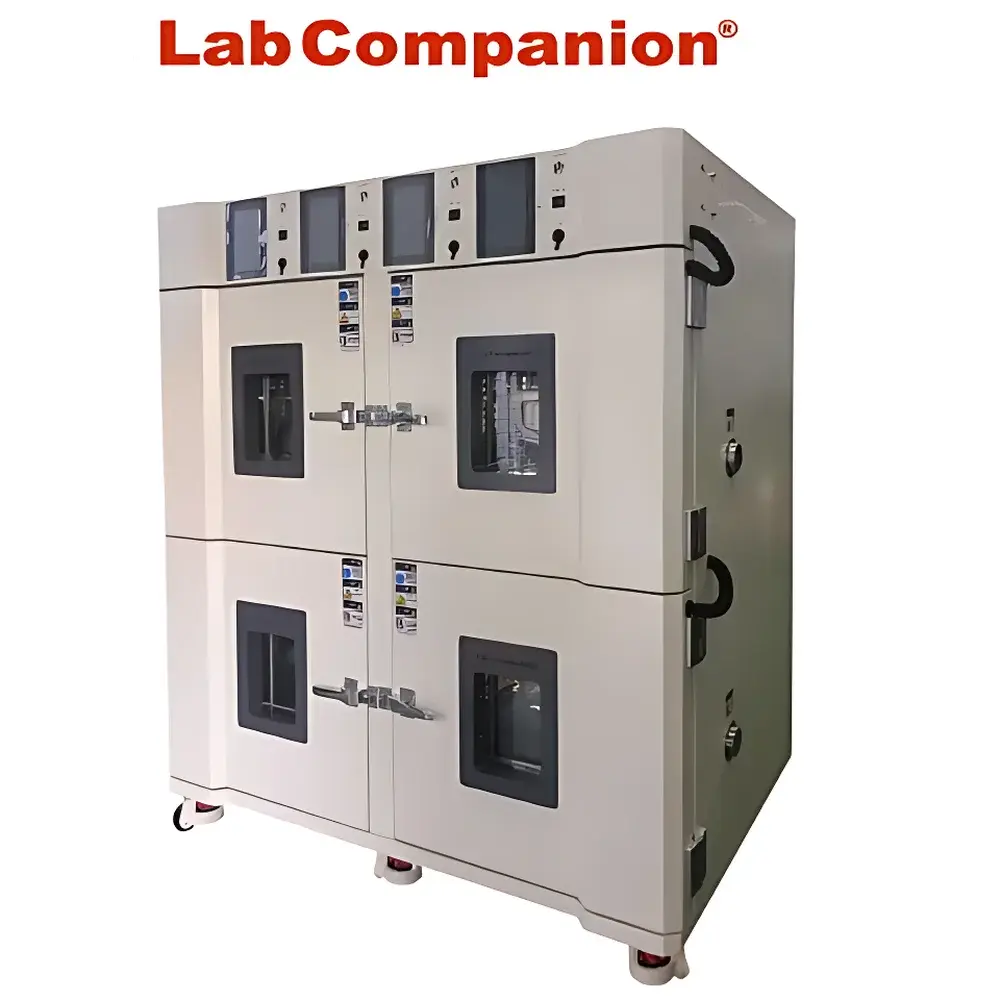
LabCompanion OVEN-100-4C Quad-Zone Precision High-Temperature Aging Chamber
| Brand | LabCompanion |
|---|---|
| Origin | Guangdong, China |
| Manufacturer Type | Direct Manufacturer |
| Model | OVEN-100-4C |
| Temperature Range | RT to 200 °C |
| Temperature Uniformity | ≤2 °C |
| Temperature Fluctuation | ≤±0.5 °C |
| Temperature Deviation | ≤±2.0 °C |
| Heating Rate | 3.5 °C/min (average, no-load, from ambient +20 °C to 200 °C) |
| Internal Dimensions (W×H×D) | 500×500×400 mm |
| Chamber Volume | 100 L per zone |
| Total Zones | 4 independent temperature-controlled chambers |
Overview
The LabCompanion OVEN-100-4C is a quad-zone precision high-temperature aging chamber engineered for accelerated thermal stability testing, material degradation analysis, and long-term reliability evaluation under controlled elevated temperatures. Unlike conventional single-chamber ovens, the OVEN-100-4C integrates four physically isolated test compartments—each with its own dedicated heating system, air circulation assembly, and digital PID temperature controller—enabling simultaneous yet independent thermal exposure of multiple samples at identical or divergent setpoints. This architecture supports comparative aging studies, process validation, and statistical repeatability across parallel test conditions, all within a compact footprint. The chamber operates on forced-air internal recirculation with axial-flow fans and optimized duct geometry to ensure uniform convective heat transfer. Heating is delivered via high-stability nickel-chromium alloy resistive elements, while temperature sensing relies on calibrated PT100 platinum resistance thermometers mounted in representative locations per zone. Designed for compliance-critical environments, the system meets baseline requirements for ISO 17025-compliant calibration traceability and supports GLP/GMP-aligned operational documentation when integrated with validated data logging protocols.
Key Features
- Four fully independent temperature-controlled zones—each with dedicated PID controller, heater, fan, and sensor—enabling concurrent multi-condition aging experiments.
- Precision temperature control: ±0.5 °C fluctuation and ≤±2.0 °C deviation across the working range (RT to 200 °C), verified per ASTM E2202 and IEC 60068-3-5.
- High uniformity airflow system featuring internal balanced recirculation, low-turbulence axial fans, and baffle-guided duct design—achieving ≤2 °C spatial uniformity per zone (measured at 9-point grid per IEC 60068-3-5 Annex B).
- Robust thermal insulation using high-density ultra-fine glass fiber (≥100 mm thickness) and double-sealed silicone gasket doors to minimize thermal leakage and energy consumption.
- Intelligent dual-stage safety architecture: primary controller-based overtemperature protection (adjustable limit +15 °C above setpoint) plus independent mechanical overtemperature cutout with audible alarm and automatic standby lockout.
- Comprehensive fault diagnostics including heater short-circuit detection, blower motor overload monitoring, anti-dry-burn logic (via mid-stream thermal sensor), and RCD-protected main power input.
Sample Compatibility & Compliance
The OVEN-100-4C accommodates a broad spectrum of sample types—including lithium-ion battery cells, polymer films, PCB assemblies, automotive elastomers, aerospace composites, and pharmaceutical packaging materials—without cross-contamination between zones. Each 100 L chamber (500×500×400 mm internal) permits standard rack-mounting or tray-based loading. The stainless steel interior (SUS304) and electrostatically coated cold-rolled steel exterior ensure chemical resistance and long-term structural integrity. The system conforms to key environmental test standards including IEC 60068-2-2 (Test B: Dry Heat), MIL-STD-810H Method 501.7, and JIS C 0042. While not inherently FDA 21 CFR Part 11 compliant, the controller supports audit-trail-ready data export (CSV/TXT) and can be integrated into validated electronic lab notebook (ELN) or LIMS platforms when paired with third-party 21 CFR Part 11-compliant acquisition software.
Software & Data Management
The embedded digital temperature controller provides real-time display of both setpoint and measured temperature per zone, with programmable ramp-soak profiles, auto-tuning PID parameters, and linear compensation for sensor drift correction. All operational events—including start/stop cycles, alarm triggers, and manual overrides—are timestamped and stored locally for ≥30 days. Data export is supported via USB interface (no proprietary drivers required); exported logs include zone ID, timestamp, setpoint, PV reading, and status flags. Optional RS485 Modbus RTU output enables integration with SCADA systems or centralized facility monitoring platforms. For regulated laboratories, external data loggers with NIST-traceable calibration certificates may be deployed to satisfy ALCOA+ data integrity principles during IQ/OQ/PQ validation.
Applications
- Accelerated aging of lithium-ion battery modules to assess capacity fade and impedance growth under thermal stress.
- Thermal endurance testing of wire insulation, encapsulants, and conformal coatings per UL 746B and IPC-CC-830B.
- Stability assessment of medical device polymers (e.g., PVC, polyolefins) under ISO 10993-12 simulated use conditions.
- Pre-conditioning of optical components and adhesives prior to environmental stress screening (ESS).
- Material qualification for automotive electronics per AEC-Q200 and GMW3172 thermal cycling prerequisites.
- Research-scale thermal degradation kinetics studies in academic and industrial polymer labs.
FAQ
What is the maximum operating temperature for each chamber?
Each of the four zones is rated for continuous operation up to 200 °C. Custom configurations supporting 250 °C or 300 °C are available upon request, subject to modified insulation, sensor, and heater specifications.
Can different temperature setpoints be maintained simultaneously across the four zones?
Yes—the OVEN-100-4C supports fully independent temperature programming per zone, enabling comparative studies such as Arrhenius modeling or multi-level stress testing.
Is the chamber suitable for use in ISO/IEC 17025-accredited laboratories?
Yes, provided that periodic verification (per ISO/IEC 17025 Clause 6.4.10) is performed using NIST-traceable reference thermometers and documented per laboratory SOPs.
How is temperature uniformity validated during installation qualification (IQ)?
Uniformity mapping is conducted using a 9-point sensor array per zone, following IEC 60068-3-5 Annex B methodology; results must demonstrate ≤2 °C spread across all measurement points at steady-state.
Does the system support remote monitoring or network connectivity?
Standard configuration includes local USB data export only; Ethernet or Wi-Fi connectivity requires optional communication module add-on and third-party middleware integration.



