
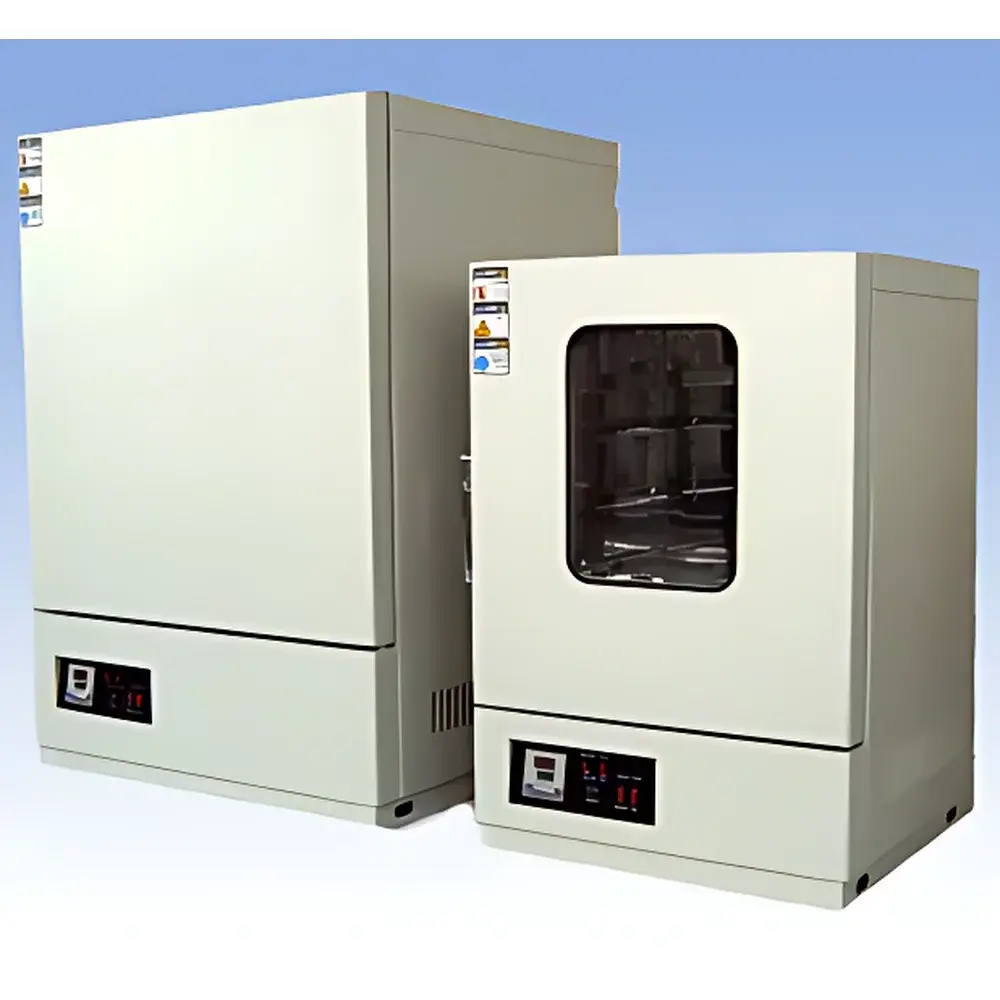
LabCompanion OVEN Series High-Temperature Forced-Air Drying Oven
| Brand | LabCompanion |
|---|---|
| Origin | Guangdong, China |
| Manufacturer Type | Direct Manufacturer |
| Country of Origin | China |
| Model | OVEN |
| Instrument Type | Vacuum Drying Oven |
| Temperature Range | R.T. to +300 °C |
| Temperature Uniformity | ±2.5% |
| Temperature Fluctuation | ±0.5 °C |
| External Dimensions | 620 × 530 × 490 mm |
| Internal Chamber Dimensions | 340 × 320 × 320 mm |
| Chamber Material | SUS304 Stainless Steel (≤300 °C) or Pre-galvanized Steel |
| Heating Method | Forced-air Convection & Thermal Oil Heating |
| Control System | Microprocessor-based PID Controller with PT100 Sensor |
| Timer Range | 0–999 min |
| Power Supply | AC 220 V / 50 Hz or AC 380 V / 50 Hz |
| Safety Features | Independent Over-Temperature Protection Circuit, Silicone Door Seal, Mineral Wool Insulation |
| Compliance | JB/T 5520–1991 (Technical Specification for Drying Ovens) |
| Optional Accessories | Programmable Temperature Controller, RS232/RS485 Interface, Chart Recorder, Observation Window, Cable Port (Φ50 mm), Additional Shelving |
Overview
The LabCompanion OVEN Series is a precision-engineered forced-air drying oven designed for controlled thermal processing in research laboratories, quality control environments, and industrial manufacturing settings. Operating on the principle of uniform convective heat transfer, the unit employs a high-efficiency axial fan and optimized internal airflow ducting to ensure rapid thermal equilibration and minimal spatial temperature deviation across the working chamber. Its operational range extends from ambient temperature (R.T.) up to +300 °C, making it suitable for applications including moisture removal, polymer curing, component aging, pre-baking of substrates, and thermal stabilization of electronic assemblies. The chamber’s construction—using either SUS304 stainless steel or high-grade pre-galvanized steel—ensures long-term resistance to oxidation and chemical exposure under repeated thermal cycling. All models comply with JB/T 5520–1991, the Chinese national standard governing performance, safety, and metrological requirements for laboratory drying ovens.
Key Features
- Forced-air convection system with adjustable-speed blower for consistent heat distribution and reduced temperature gradient (±2.5% uniformity)
- Microprocessor-based PID temperature controller with auto-tuning capability, enabling stable setpoint maintenance within ±0.5 °C fluctuation
- Dual-layer thermal insulation comprising ultra-fine glass wool and mineral wool, minimizing external surface temperature rise and energy consumption
- Independent over-temperature cut-off circuit with fail-safe relay, physically isolated from the main control loop per IEC 61000-6-2 and GB/T 14710 safety guidelines
- PT100 industrial platinum resistance thermometer (Class B, tolerance ±0.3 °C at 0 °C) for high-fidelity temperature feedback and traceable calibration
- Ergonomic design with four locking casters, two-tier adjustable stainless-steel shelving, and reinforced silicone door gasket ensuring leak-tight sealing at elevated temperatures
- Standard timer function (0–999 min) supporting unattended operation and repeatable process scheduling
Sample Compatibility & Compliance
The OVEN Series accommodates non-flammable, non-explosive solid and semi-solid samples commonly encountered in electronics, materials science, pharmaceutical development, and academic research. It is routinely deployed for thermal aging of LED/LCD modules, stress-relief baking of quartz crystals, burn-in testing of passive components (capacitors, resistors), and residual solvent removal from coated films or printed circuit boards. Chamber volume (34.8 L) and internal dimensions (340 × 320 × 320 mm) support standard ISO/IEC 17025-compliant sample placement protocols. While not certified for Class I Div 1 hazardous locations, the oven meets electromagnetic compatibility (EMC) requirements per GB/T 18268.1 and electrical safety standards per GB 4793.1. Documentation includes factory calibration certificate (traceable to NIM, China), user manual, and conformity declaration aligned with GB/T 19001–2016 (ISO 9001).
Software & Data Management
As a standalone benchtop instrument, the base model operates without embedded software but supports optional digital expansion via RS232 or RS485 serial interfaces. These ports enable integration into centralized lab data acquisition systems compliant with FDA 21 CFR Part 11 when paired with validated third-party SCADA or LIMS platforms. Optional programmable controllers offer multi-segment ramp-soak profiles, real-time logging (timestamped temperature readings at user-defined intervals), and audit-trail generation for GLP/GMP-regulated environments. All temperature data output conforms to Modbus RTU protocol, facilitating interoperability with industrial PLCs and enterprise MES systems. No proprietary drivers or cloud dependencies are required for basic operation or external communication.
Applications
- Thermal preconditioning of PCB assemblies prior to conformal coating or reflow soldering
- Moisture desorption from hygroscopic polymers and ceramic powders prior to sintering
- Accelerated life testing of optoelectronic devices under controlled thermal stress (e.g., JEDEC JESD22-A108)
- Drying of biological tissue sections, filter membranes, and chromatographic media without structural degradation
- Pre-heating of crucibles, boats, and quartzware for high-purity material synthesis
- Stabilization annealing of thin-film sensors and MEMS structures to reduce drift and hysteresis
FAQ
What is the maximum safe operating temperature for the stainless-steel chamber version?
The SUS304 inner chamber is rated for continuous operation up to +300 °C; intermittent excursions to +320 °C are permissible for ≤30 minutes per cycle, provided ambient conditions remain within specification.
Does the oven support vacuum operation out of the box?
No—the standard OVEN Series is a forced-air convection oven. Vacuum capability requires the separate LabCompanion VAC-OVEN variant, which integrates a vacuum-tight chamber, mechanical pump interface, and pressure monitoring port.
Can the unit be calibrated internally by the user?
Yes—users may perform offset calibration using the front-panel menu; however, full metrological verification requires external reference instrumentation (e.g., NIST-traceable dry-block calibrator) and is recommended annually per ISO/IEC 17025 Clause 6.5.
Is the RS485 option compatible with Modbus TCP networks?
The RS485 interface uses Modbus RTU only; conversion to Modbus TCP requires an external protocol gateway device meeting IEEE 802.3 compliance.
What is the typical warm-up time to reach 200 °C from ambient?
Under no-load conditions at 23 °C ambient, the unit achieves 200 °C in approximately 42 minutes, consistent with JB/T 5520–1991 Clause 4.3.2 test methodology.



