
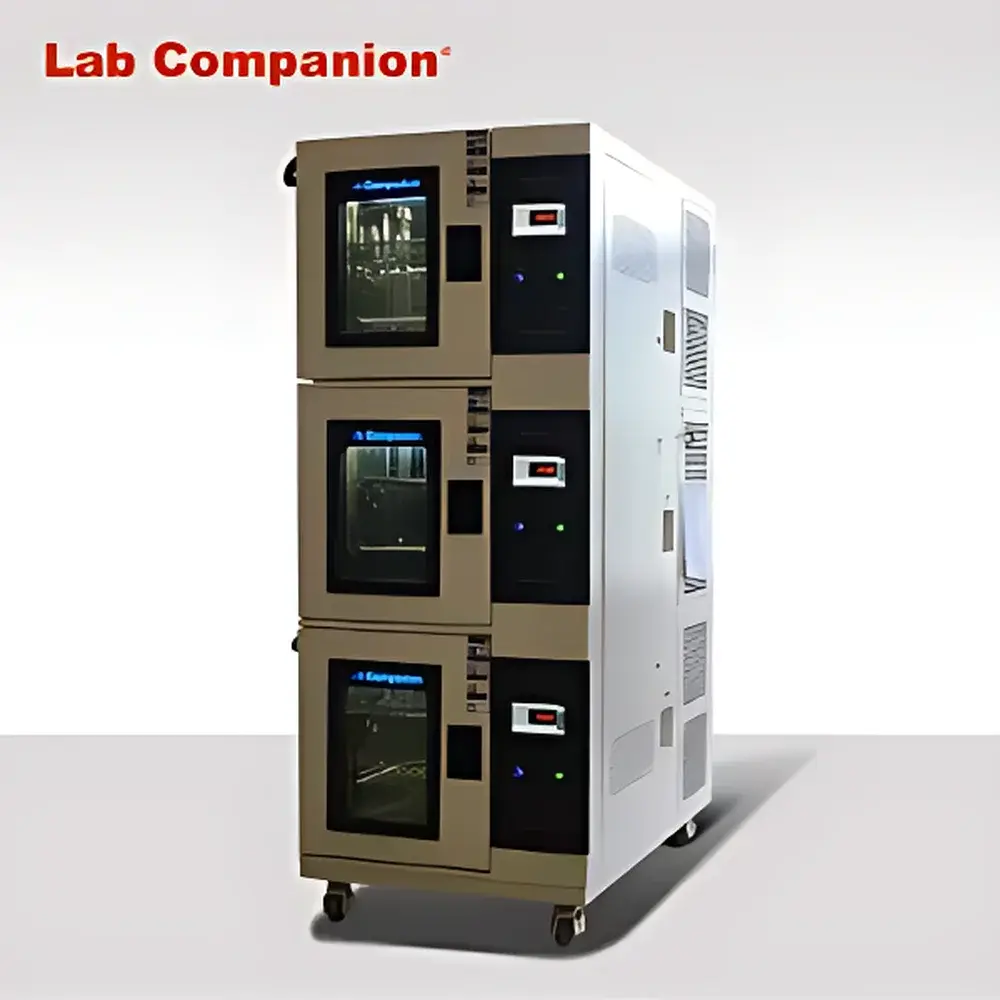
LabCompanion PS-150-3C Ceramic-Substrate Multi-Layer High-Low Temperature Environmental Test Chamber
| Brand | LabCompanion |
|---|---|
| Origin | Guangdong, China |
| Manufacturer Type | Direct Manufacturer |
| Country of Origin | China |
| Model | PS-150-3C |
| Temperature Range | -70 °C to +150 °C |
| Cooling Method | Compressor-Based Refrigeration |
| Explosion-Proof | Standard (Non-Explosion-Proof) |
| Temperature Fluctuation | ±0.5 °C |
| Temperature Uniformity | ±2.0 °C |
| Temperature Deviation | ±2.0 °C |
| Heating Rate (20 °C → 150 °C, no load) | 3.0–3.5 °C/min |
| Cooling Rate (20 °C → −70 °C, no load) | 1.2 °C/min |
| Internal Chamber Dimensions | 500 × 600 × 500 mm (W × D × H) |
| Nominal Volume | 150 L |
Overview
The LabCompanion PS-150-3C is a precision-engineered ceramic-substrate multi-layer high-low temperature environmental test chamber designed for rigorous thermal stress evaluation of advanced electronic substrates, multilayer ceramic capacitors (MLCCs), power modules, and semiconductor packaging materials. Its core architecture integrates thermally stable alumina-based ceramic insulation layers within the chamber wall assembly—minimizing thermal lag, suppressing condensation at extreme low temperatures, and enhancing long-term dimensional stability during repeated thermal cycling. Unlike conventional single-wall or foam-insulated chambers, this design delivers superior thermal inertia control and reduced thermal gradient propagation across the work volume, making it especially suitable for qualification testing per JEDEC JESD22-A104 (Temperature Cycling), MIL-STD-810H Method 502.7 (Low Temperature), and Method 501.7 (High Temperature). The chamber operates over a certified range of −70 °C to +150 °C under no-load conditions, with full compliance to IEC 60068-3-5 and ISO 16750-4 environmental simulation requirements.
Key Features
- Ceramic-substrate multi-layer insulation system: Al₂O₃-reinforced composite walls reduce thermal bridging and improve thermal recovery repeatability across 1,000+ cycles.
- High-efficiency dual-stage cascade refrigeration system with environmentally compliant R404A/R23 mixed refrigerant, enabling stable operation down to −70 °C without liquid nitrogen assist.
- PID-controlled forced-air convection with symmetrical dual-blower circulation ensures uniform airflow distribution and minimizes hot/cold spots in the test zone.
- Industrial-grade programmable controller (Siemens LOGO! or optional Eurotherm 3500 series) with real-time logging, alarm history, and configurable ramp-soak profiles (up to 99 segments).
- Stainless steel 304 interior chamber with rounded corners and removable floor tray for easy cleaning and residue inspection after high-humidity or flux-exposure tests.
- Standard RS485 Modbus RTU interface; optional Ethernet/IP or Profibus-DP for integration into centralized lab automation systems (LIMS/SCADA).
Sample Compatibility & Compliance
The PS-150-3C accommodates standard 19″ rack-mount test fixtures, PCB carriers, and ceramic substrate trays up to 450 mm × 450 mm. Its internal geometry supports simultaneous thermal exposure of multiple sample types—including bare die, wafer-level packages, and stacked SiC/GaN modules—without obstructing airflow or compromising temperature uniformity. The chamber meets structural and operational requirements for ISO/IEC 17025-accredited laboratories and supports audit-ready documentation for GLP and GMP environments. All thermal calibration procedures follow ASTM E742-22 (Standard Practice for Calibration of Temperature-Controlled Environmental Chambers) and are traceable to NIM (National Institute of Metrology, China) certified reference standards.
Software & Data Management
LabCompanion’s proprietary ChamberLink™ software (v4.2+) provides secure, role-based access for test setup, remote monitoring, and post-test analysis. It supports 21 CFR Part 11-compliant electronic signatures, full audit trail generation (user actions, parameter changes, alarm events), and automated report export in PDF/CSV formats. Data logging resolution is configurable from 1 s to 60 s intervals, with onboard storage retaining ≥30 days of continuous 4-channel data (chamber setpoint, actual temperature, air velocity, and door status). Optional cloud synchronization enables cross-site comparison of thermal cycle reproducibility across global R&D facilities.
Applications
- Thermal cycling reliability assessment of LTCC/HTCC substrates and thick-film hybrid circuits.
- Preconditioning of automotive-grade power electronics prior to AEC-Q200 stress testing.
- Moisture resistance validation of conformal-coated ceramic PCB assemblies under combined temperature/humidity profiles (when configured with optional humidity module).
- Accelerated aging studies of thermal interface materials (TIMs) bonded to AlN or BeO substrates.
- Process window qualification for reflow soldering simulation and cold-plate thermal interface testing.
FAQ
What is the maximum thermal cycling rate achievable with the PS-150-3C in standard configuration?
The standard model achieves an average heating rate of 3.0–3.5 °C/min and cooling rate of 1.2 °C/min (20 °C ↔ −70 °C, no load), measured per IEC 60068-3-10.
Can the chamber be validated for ISO/IEC 17025-compliant temperature mapping?
Yes—equipped with 9 pre-wired PT100 sensor ports (including 8 chamber-distributed and 1 reference probe), supporting IQ/OQ/PQ protocols with third-party validation support documentation.
Is the ceramic-substrate insulation structure serviceable or field-replaceable?
The multi-layer ceramic composite panels are permanently bonded and not user-serviceable; however, full chamber refurbishment—including insulation replacement—is available through LabCompanion’s authorized service centers under extended warranty plans.
Does the PS-150-3C support custom ramp-and-soak profiles with dwell times below 1 minute?
Yes—the controller supports minimum dwell times of 10 seconds and linear/non-linear ramp transitions with adjustable acceleration limits to prevent thermal shock to sensitive samples.
What electrical supply specifications are required for installation?
220 V ±10%, 50 Hz, 3-phase + PE, with dedicated 32 A circuit breaker and minimum 6 mm² copper conductor—grounding resistance must be ≤4 Ω per IEC 61000-6-2.



