
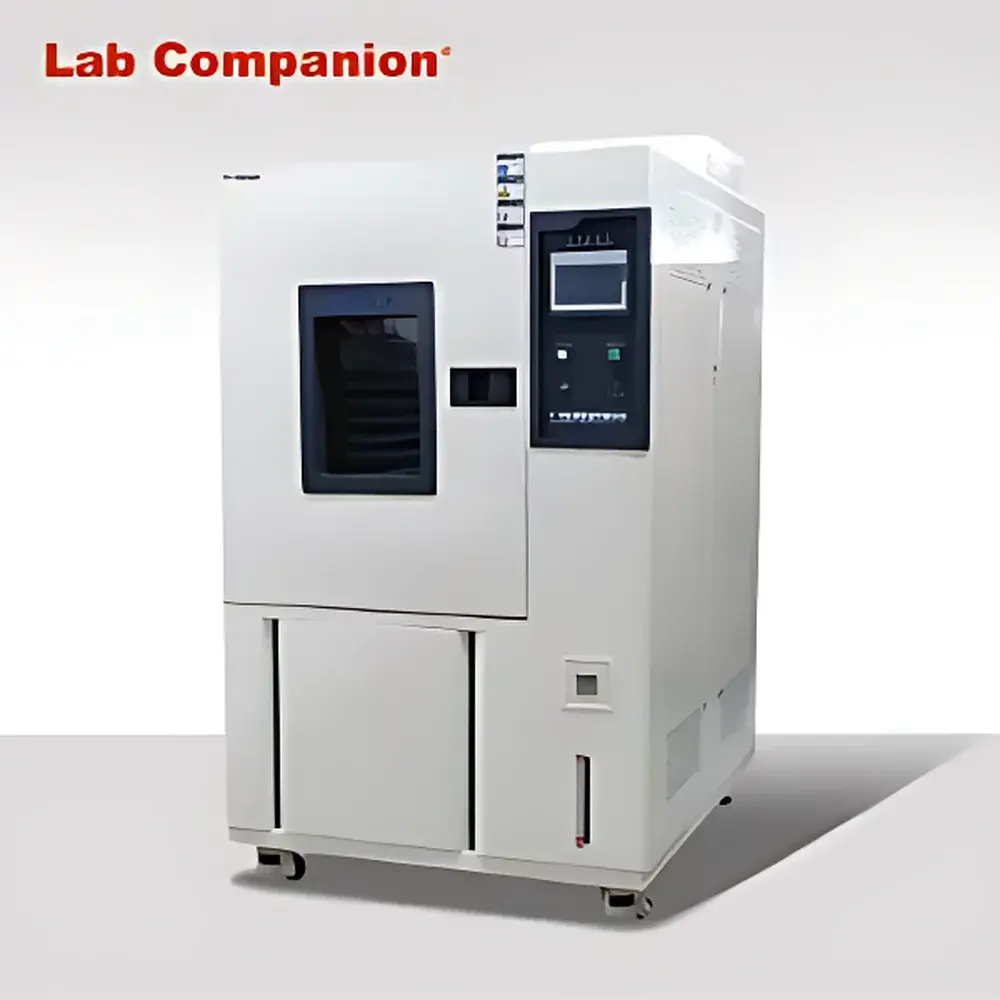
LabCompanion PS-80 High-Low Temperature Environmental Test Chamber
| Brand | LabCompanion |
|---|---|
| Model | PS-80 |
| Origin | Guangdong, China |
| Manufacturer Type | Direct Manufacturer |
| Temperature Range | −70 °C to +150 °C |
| Cooling Method | Compressor-Based Refrigeration |
| Explosion-Proof | Standard (Non-Explosion-Proof) |
| Temperature Fluctuation | ±0.5 °C |
| Temperature Uniformity | ±2.0 °C |
| Temperature Deviation | ±2.0 °C |
| Heating Rate | 1.0–3.0 °C/min |
| Cooling Rate | 1.2 °C/min |
| Internal Chamber Dimensions (W×D×H) | 500 mm × 600 mm × 500 mm |
| Viewing Window | Large-Area Tempered Glass |
| Door Locking Mechanism | Dual-Point Lever-Type Seal |
| Electrical Feedthroughs | Dual-Side Optional Cable Ports (φ50 / φ80 / φ100 / φ150 mm) |
| Safety Protection | Multi-Stage Independent Over-Temperature Cut-Off |
| Optional Accessories | Pure Water Auto-Supply System (for humidity-enabled variants), Chart Recorder or Digital Data Logger, RS485/RS232 Communication Interface with PC Software, Removable Precision PT100 Sensor, Air Dryer Module, Custom Load-Bearing Sample Rack & Reinforced Floor Plate, Extended High-Temp Option (up to 180 °C), Low-Humidity Configuration (down to 5 °C / 5 % RH, continuous operation) |
Overview
The LabCompanion PS-80 High-Low Temperature Environmental Test Chamber is an engineered thermal stress testing platform designed for accelerated reliability evaluation of solid-state storage devices—including SSDs, NAND flash modules, and embedded memory controllers—under controlled, repeatable extreme temperature conditions. Built upon a dual-stage compressor refrigeration system and precision PID-controlled resistive heating architecture, the chamber delivers stable thermal profiles across a wide operational envelope from −70 °C to +150 °C. Its core function is to simulate real-world environmental aging, cold-start failure modes, solder joint fatigue, and die-level thermo-mechanical stress during qualification testing per JEDEC JESD22-A104 (Temperature Cycling), JESD22-A106 (Highly Accelerated Temperature and Humidity Stress Test, HAST), and IEC 60068-2-14 (Change of Temperature). The chamber’s robust stainless-steel interior, seamless welded construction, and low-outgassing insulation minimize contamination risk—critical for cleanroom-compatible SSD validation workflows.
Key Features
- Stable thermal performance with ±0.5 °C temperature fluctuation and ±2.0 °C uniformity across the full 150 L workspace (500 × 600 × 500 mm)
- Dual-point lever-action door seal ensuring consistent chamber integrity and minimal thermal leakage during extended dwell cycles
- Large-diameter tempered glass observation window enabling real-time visual monitoring without compromising thermal stability
- Modular electrical feedthrough system with configurable cable ports (φ50, φ80, φ100, or φ150 mm) on both left and right walls for synchronized power, signal, and thermal sensor routing
- Triple-layer independent over-temperature protection: primary controller limit, secondary mechanical cut-off, and tertiary thermocouple-based safety interlock
- Programmable ramp-and-soak profiles supporting multi-segment thermal cycling, dwell-hold sequences, and step-change protocols compliant with MIL-STD-810G Method 502.6
Sample Compatibility & Compliance
The PS-80 accommodates standard 2.5″ and M.2 NVMe SSD form factors mounted on custom load-bearing sample racks (optional). Its internal dimensions and reinforced floor plate support up to 30 kg distributed static load—sufficient for multi-unit test fixtures with active thermal management interfaces. The chamber meets structural and operational requirements for ISO/IEC 17025-accredited laboratories conducting environmental qualification per JEDEC, AEC-Q100, and IPC-9592 standards. Optional low-humidity configuration (5 °C / 5 % RH) enables combined thermal–dry storage testing aligned with SSD data retention specifications under IEC 60749-27. All control firmware and logging outputs are traceable and support GLP/GMP audit readiness when paired with optional digital data logger and 21 CFR Part 11-compliant software.
Software & Data Management
Standard RS485/RS232 communication interface enables integration with LabVIEW, MATLAB, or custom SCADA systems for automated test sequencing and remote supervision. Optional PC-based control software provides real-time graphing, alarm event logging, calibration history tracking, and exportable CSV/Excel reports. Temperature data from the removable high-accuracy PT100 sensor (±0.15 °C at 25 °C) is time-stamped and archived with user-defined metadata—supporting full traceability in regulated environments. Firmware supports password-protected parameter locking and role-based operator access levels to ensure procedural consistency across shifts.
Applications
- Thermal cycling validation of SSD firmware behavior and NAND endurance under −40 °C cold boot and +85 °C sustained write workloads
- Accelerated life testing of BGA solder joints and PCB substrate warpage in enterprise-grade U.2 and EDSFF form factors
- Qualification of thermal interface materials (TIMs) and heat spreader adhesion under repeated expansion/contraction cycles
- Environmental screening of SSD controller ICs per AEC-Q100 Grade 2 (−40 °C to +105 °C) and Grade 1 (−40 °C to +125 °C) requirements
- Combined thermal–low-humidity stress testing to assess moisture-related corrosion risks in stacked-die packaging architectures
FAQ
What is the maximum allowable sample weight inside the PS-80 chamber?
The standard chamber floor supports up to 30 kg of evenly distributed static load. Custom heavy-duty floor plates and reinforced racks are available for higher mass configurations.
Can the PS-80 be integrated into an automated test line?
Yes—via RS485/RS232 serial interface or optional Ethernet module, enabling Modbus RTU/TCP command control and status feedback for factory-floor MES integration.
Is calibration documentation provided with shipment?
Each unit ships with a NIST-traceable as-delivered calibration certificate covering temperature uniformity, fluctuation, and deviation at three reference points (−40 °C, 25 °C, +85 °C).
Does the chamber meet CE or UKCA marking requirements?
The PS-80 complies with EU Machinery Directive 2006/42/EC and Electromagnetic Compatibility Directive 2014/30/EU; CE marking is applied post-factory conformity assessment.
Can the temperature range be extended beyond +150 °C?
An optional high-temperature upgrade kit extends the upper limit to +180 °C, using upgraded heating elements and thermal insulation—validated per IEC 60068-2-2 (Test B: Dry Heat).



