
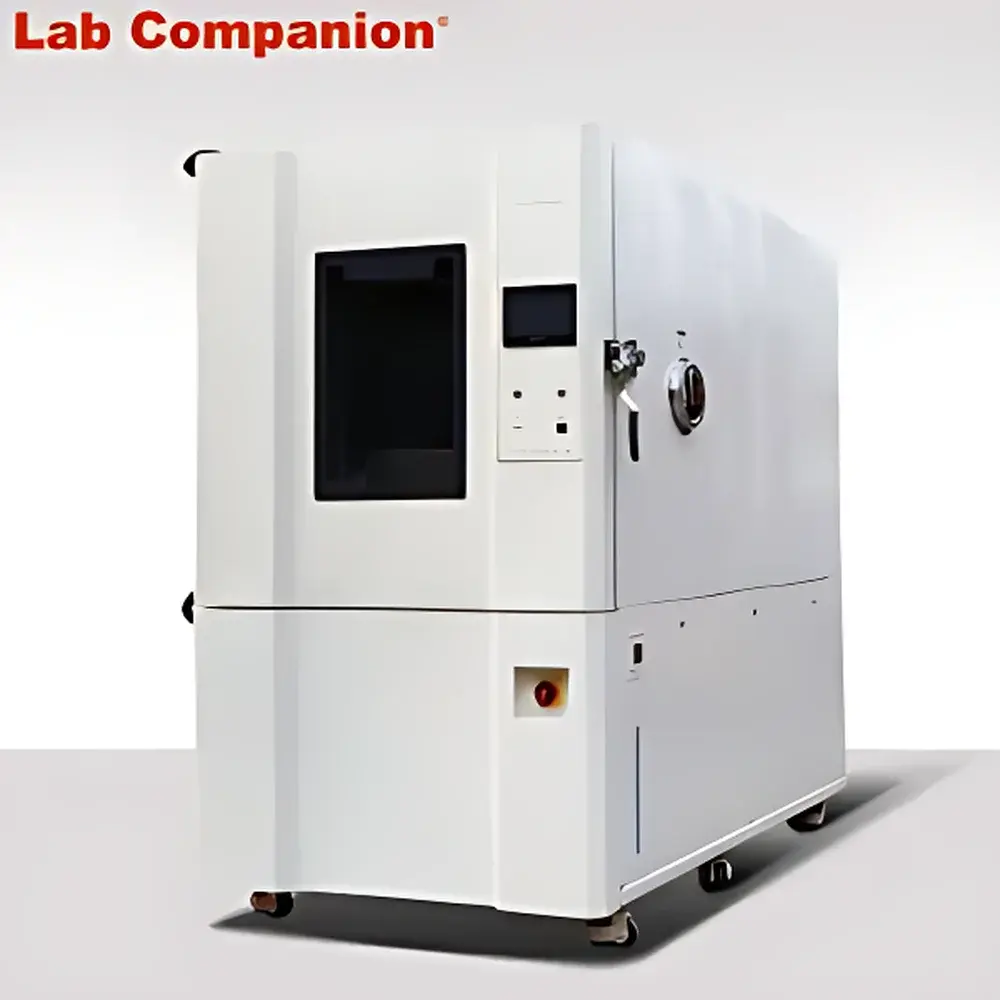
LabCompanion PS408 Explosion-Proof High-Low Temperature Thermal Cycling Chamber
| Brand | LabCompanion |
|---|---|
| Origin | Guangdong, China |
| Manufacturer | LabCompanion (Dongguan Hongzhan Instrument Co., Ltd.) |
| Model | PS408 |
| Temperature Range | -70 °C to +150 °C |
| Refrigeration Method | Compressor-based |
| Explosion-Proof Design | Yes |
| Temperature Fluctuation | ±0.5 °C |
| Temperature Uniformity | ±2.0 °C |
| Temperature Deviation | ±2.0 °C |
| Heating Rate | 1.0–3.0 °C/min |
| Cooling Rate | 1.2 °C/min |
| Internal Chamber Dimensions (W×H×D) | 800 × 850 × 600 mm |
| Compliance | GB/T 5170.2–2008 (Temperature Performance Testing for Environmental Testing Equipment) |
Overview
The LabCompanion PS408 Explosion-Proof High-Low Temperature Thermal Cycling Chamber is an engineered environmental test system designed to evaluate material and product reliability under rapid, controlled thermal transitions. It operates on the principle of forced-air convection with dual-stage compressor refrigeration and PID-controlled electric heating, enabling precise simulation of extreme ambient conditions—from cryogenic cold (-70 °C) to high-temperature exposure (+150 °C). Unlike static temperature chambers, the PS408 supports dynamic thermal cycling protocols critical for assessing thermomechanical stress responses, including solder joint fatigue, polymer embrittlement, seal integrity loss, and interfacial delamination in electronic assemblies, automotive components, aerospace composites, and medical device packaging. Its explosion-proof construction meets Class I, Division 1, Group C/D hazardous location requirements per NEC Article 500, making it suitable for testing volatile or flammable samples in regulated industrial R&D and QA laboratories.
Key Features
- Explosion-proof enclosure certified to IEC 60079-0 and GB 3836.1–2010 standards, with intrinsically safe control wiring and pressure-relief venting
- Dual-stage cascade refrigeration system using environmentally compliant HFC-404A/HFC-23 refrigerant blends, ensuring stable sub-zero operation down to -70 °C without liquid nitrogen dependency
- High-efficiency axial fan array with optimized air baffle geometry, delivering ≤±2.0 °C temperature uniformity across the full 408 L working volume (800 × 850 × 600 mm)
- Real-time temperature monitoring via three calibrated PT100 sensors (one at center, two at diagonal corners), feeding closed-loop feedback to the 10.1″ touchscreen controller
- Integrated safety architecture: over-temperature cut-off, compressor high-pressure shutdown, phase failure detection, door-open alarm, and emergency power-off circuit
- LED-lit observation window with double-glazed, low-emissivity tempered glass—maintains thermal integrity while enabling non-intrusive visual inspection during active cycles
- Modular insulation: 150 mm thick polyurethane foam (λ = 0.022 W/m·K) with vacuum-degassed core, minimizing heat leakage and reducing energy consumption by up to 28% versus conventional chambers
Sample Compatibility & Compliance
The PS408 accommodates a broad spectrum of sample types—including PCB assemblies, lithium-ion battery modules, elastomeric gaskets, optical lenses, and pharmaceutical primary packaging—without compromising thermal fidelity. Its chamber interior features stainless steel 304 construction (electropolished finish), removable perforated shelves, and standardized 12-mm-diameter cable ports with silicone gland seals. All thermal performance specifications conform to GB/T 5170.2–2008 (equivalent to IEC 60068-3-5), with traceable calibration certificates available per ISO/IEC 17025. The system supports validation protocols aligned with GMP Annex 15, ASTM E2293–22 (Standard Practice for Thermal Cycling Tests), and MIL-STD-810H Method 503.7 (Temperature Shock). Optional IQ/OQ documentation packages are provided for FDA-regulated environments requiring 21 CFR Part 11-compliant audit trails.
Software & Data Management
Control and data acquisition are managed via LabCompanion’s TC-Link™ v4.2 software suite, running on an embedded ARM Cortex-A9 platform with real-time Linux OS. The interface supports up to 99 programmable test profiles, each with unlimited segments (ramp/soak/step), conditional branching, and event-triggered logging. Temperature data is recorded at user-selectable intervals (0.1–60 s), timestamped to UTC with microsecond precision, and stored internally (8 GB eMMC) plus exported via USB 2.0 or Ethernet (TCP/IP, Modbus TCP). Raw datasets export in CSV and .tdms formats; trend visualization includes deviation mapping, cycle-to-cycle overlay, and statistical process control (SPC) charts (X̄-R, Cp/Cpk). Remote monitoring is enabled through HTTPS-secured web server access, compatible with enterprise LIMS integration via RESTful API.
Applications
- Thermal shock qualification of avionics enclosures per DO-160G Section 4.5
- Accelerated aging studies of adhesives and encapsulants under ISO 11357-6
- Pre-conditioning of automotive ECUs prior to vibration testing (SAE J2380)
- Stability assessment of sterile barrier systems in ISO 11607-1 packaging validation
- Material coefficient of thermal expansion (CTE) screening via digital image correlation (DIC)-coupled testing
- Qualification of additive-manufactured metal parts for cyclic thermal fatigue resistance (ASTM F3302)
FAQ
What is the maximum thermal ramp rate achievable with the standard PS408 configuration?
The standard compressor-only system achieves 1.2 °C/min cooling and 1.0–3.0 °C/min heating under no-load conditions per GB/T 5170.2–2008. Optional liquid nitrogen assist (LN2-Boost Kit) increases cooling rates to 25 °C/min between -40 °C and +85 °C.
Does the PS408 support humidity control?
No—the PS408 is a dry thermal cycling chamber. For combined temperature/humidity testing, refer to the LabCompanion TH series (e.g., TH400) with integrated steam humidification and desiccant drying.
Can the chamber be integrated into an automated test cell?
Yes—RS-485 (Modbus RTU), Ethernet (Modbus TCP), and dry-contact I/O terminals enable seamless integration with PLCs, SCADA systems, and robotic material handlers.
Is third-party calibration included with purchase?
A factory-as-built calibration report (per ISO/IEC 17025) is supplied. On-site accredited calibration services are available as an optional add-on, including uncertainty budgets and traceability to NIM (China) or NIST (USA).
What maintenance intervals are recommended for long-term reliability?
Compressor oil and filter replacement every 24 months; condenser coil cleaning quarterly; PT100 sensor verification annually; full system performance re-qualification every 24 months or after 5000 operational hours—whichever occurs first.
Related Products



