
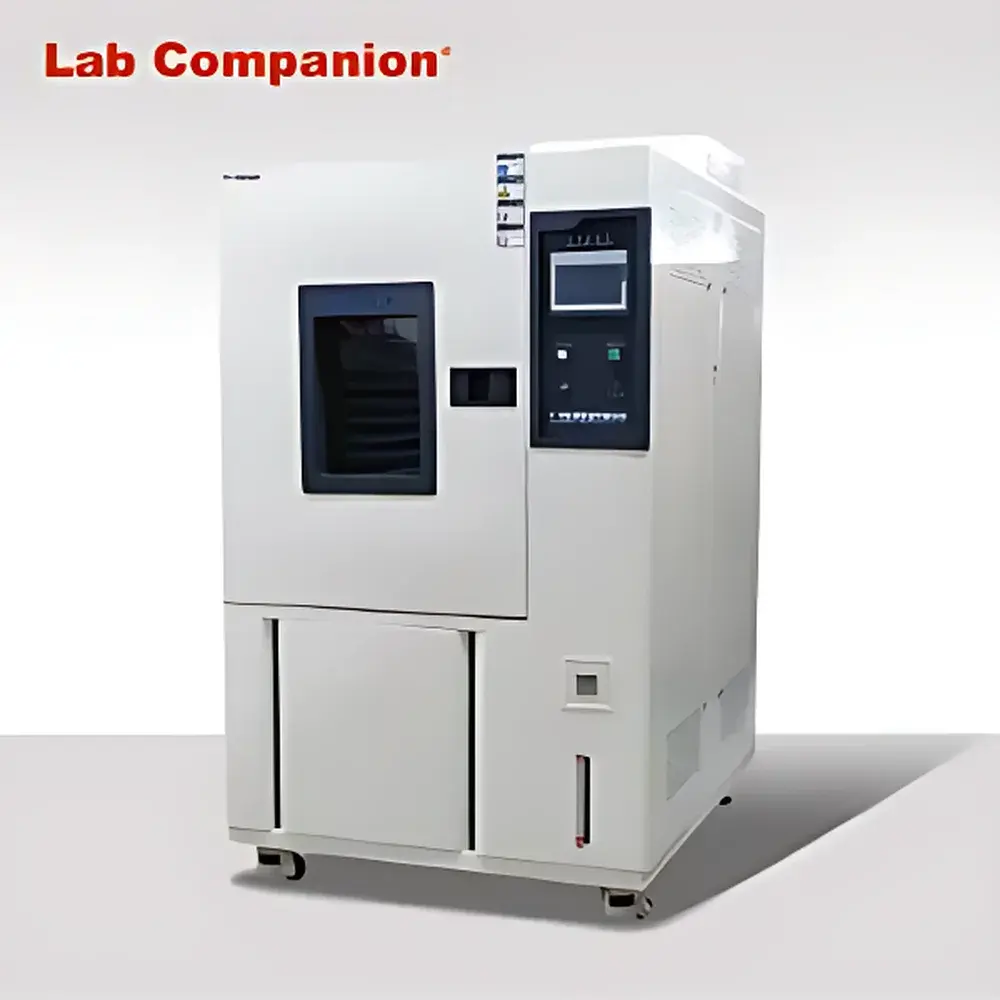
LabCompanion RCP Series High-Low Temperature Environmental Test Chamber
| Brand | LabCompanion |
|---|---|
| Origin | Guangdong, China |
| Manufacturer Type | Direct Manufacturer |
| Country of Origin | China |
| Model | RCP |
| Temperature Range | −70 °C to +150 °C |
| Explosion-Proof | Standard (Non-Explosion-Proof) |
| Temperature Fluctuation | ±0.5 °C |
| Temperature Deviation | ±2.0 °C |
| Temperature Uniformity | ±2.0 °C |
| Heating Rate | 3.0–3.5 °C/min |
| Cooling Rate | 1.2 °C/min |
| Working Chamber Dimensions | 800 × 950 × 800 mm (W × H × D) |
Overview
The LabCompanion RCP Series High-Low Temperature Environmental Test Chamber is an engineered solution for controlled thermal stress evaluation of materials, components, and finished products under defined climatic conditions. Based on forced-air convection with dual-stage refrigeration and PID-controlled electric heating, the chamber delivers stable, repeatable thermal profiles across a wide operational range from −70 °C to +150 °C. Its architecture supports both static exposure (storage/transport simulation) and dynamic cycling (thermal shock precursor testing), making it suitable for reliability validation in electronics, automotive sensors, aerospace subsystems, and industrial instrumentation. The system operates in accordance with fundamental thermal test principles outlined in IEC 60068-2-1 (cold), IEC 60068-2-2 (dry heat), and ISO 16750-4 (road vehicles), while maintaining structural and control integrity under continuous duty cycles.
Key Features
- Robust double-wall insulated chamber construction with high-efficiency polyurethane foam (≥100 mm thickness) and stainless steel inner liner (SUS304) for long-term corrosion resistance and thermal stability.
- PID-based digital temperature controller with real-time feedback loop, enabling precise setpoint tracking and minimizing overshoot during ramp transitions.
- Independent air circulation system with adjustable multi-directional vanes ensures uniform airflow distribution—critical for minimizing thermal gradients across the working volume (validated uniformity: ±2.0 °C).
- Refrigeration circuit utilizing environmentally compliant R404A/R23 cascade configuration, supporting rapid cooldown (1.2 °C/min average) and stable sub-zero operation down to −70 °C.
- Heating system with sheathed tubular heaters and over-temperature cut-off protection (dual independent sensors) complies with functional safety requirements per IEC 61508 SIL1.
- Front-mounted observation window with double-layer low-emissivity glass and anti-fog heater allows visual monitoring without compromising chamber integrity or thermal performance.
Sample Compatibility & Compliance
The RCP chamber accommodates samples up to 800 × 950 × 800 mm (W × H × D), supporting standard test specimens, PCB assemblies, enclosures, and packaged goods. Internal mounting rails and optional load-bearing shelves facilitate flexible fixture integration. The unit meets national and international environmental test standards including GB/T 10589–2008 (low-temperature test), GB/T 10586–2006 (humidity-capable variants), GB/T 2423.1–2008 (cold), GB/T 2423.2–2008 (dry heat), and aligns with the test condition definitions referenced in MIL-STD-810H Method 502.7. While configured as a standard (non-explosion-proof) model, it may be deployed in non-hazardous classified areas per NEC Class I, Division 2 guidelines when operated within specified ambient limits.
Software & Data Management
Equipped with embedded 7-inch TFT touchscreen HMI, the RCP provides intuitive local operation with programmable multi-step profiles (up to 99 segments), real-time trend logging, and alarm history storage (≥10,000 events). Optional RS485 Modbus RTU or Ethernet TCP/IP interface enables integration into centralized laboratory management systems (LIMS) or MES platforms. Data export is supported in CSV format; time-stamped records include chamber setpoint, actual temperature, ramp rate, and fault codes. For regulated environments, optional validation packages—including IQ/OQ documentation templates, calibration traceability to NIM (National Institute of Metrology, China), and electronic audit trail capability—support GLP, ISO/IEC 17025, and FDA 21 CFR Part 11 compliance requirements.
Applications
- Qualification testing of consumer electronics (e.g., smartphones, wearables) per JEDEC JESD22-A104 for operating temperature limits.
- Pre-conditioning of polymer-based medical device housings prior to biocompatibility assessment (ISO 10993-12).
- Thermal aging studies of lithium-ion battery modules under accelerated storage conditions (UN 38.3 Thermal Cycling).
- Verification of sensor drift and hysteresis in industrial pressure transmitters across extended temperature spans.
- Stress screening of solder joints and conformal coatings in printed circuit board assemblies (IPC-9701).
- Validation of packaging material integrity (e.g., blister packs, pouch seals) under simulated logistics temperature excursions.
FAQ
What is the maximum sample weight the RCP chamber can accommodate?
The chamber does not specify a fixed weight limit; however, safe operation requires that total load mass does not obstruct airflow or exceed the structural capacity of internal shelves (rated at 30 kg per shelf, uniformly distributed).
Is remote monitoring supported out-of-the-box?
Standard configuration includes local HMI only; remote supervision requires optional communication module installation and third-party SCADA/LIMS integration.
Can the RCP perform temperature cycling between −40 °C and +85 °C?
Yes—fully programmable ramp-and-soak profiles support automated cycling across any subset of the full temperature range, with user-defined dwell times, transition rates, and loop counts.
Does the unit include calibration certification upon delivery?
A factory calibration report (traceable to NIM standards) is provided; full metrological certification with uncertainty budget requires on-site verification by an accredited calibration provider.
How often should preventive maintenance be performed?
Recommended intervals: refrigerant circuit inspection every 12 months, condenser coil cleaning every 3 months (in dusty environments), and controller firmware update checks semiannually.



