
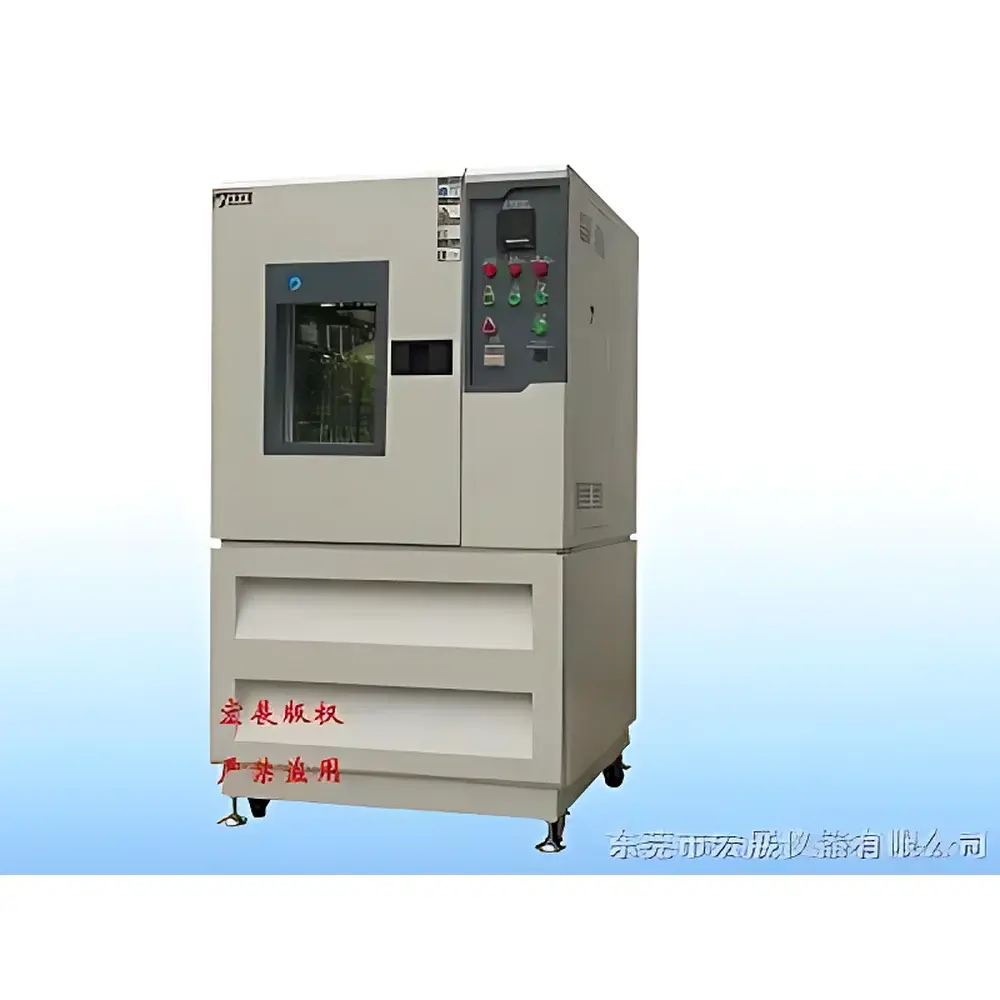
LabCompanion T-Series Programmable Low-Temperature Environmental Test Chamber
| Brand | LabCompanion |
|---|---|
| Model | T-Series |
| Temperature Range | –70 °C to +150 °C |
| Temperature Uniformity | ±2 °C |
| Temperature Fluctuation | ±0.5 °C |
| Programmable Profiles | 4 curves, up to 1000 segments |
| PID Tuning | 6 independent sets |
| Communication Interfaces | RS-232, RS-485 |
| Cooling Options | Air-cooled or water-cooled |
| Refrigeration System | Tecumseh (France) hermetic or Copeland (Germany) semi-hermetic compressors |
| Interior Material | SUS304 stainless steel |
| Insulation | Polyurethane foam or fiberglass |
| Standard Ports | One φ50 mm test port with cover, two adjustable shelves, four shelf supports, fluorescent interior lighting |
Overview
The LabCompanion T-Series Programmable Low-Temperature Environmental Test Chamber is an engineered solution for precise, repeatable thermal stress testing and long-term low-temperature storage of materials and electronic components. Designed in accordance with fundamental principles of thermodynamic chamber control and heat transfer dynamics, the T-Series employs a dual-stage refrigeration architecture—configured either with air-cooled or water-cooled condensation—to achieve stable operation across a wide operational envelope from –70 °C to +150 °C. Its core functionality relies on high-fidelity closed-loop temperature regulation using imported intelligent controllers that implement adaptive PID algorithms with six independently tunable parameter sets. The chamber’s internal airflow system utilizes a uniquely optimized tangential blower configuration with multi-directional ducting, ensuring uniform thermal distribution (±2 °C deviation) and minimal spatial gradient—critical for compliance with IEC 60068-2-1 (Cold), IEC 60068-2-2 (Dry Heat), and MIL-STD-810H thermal shock protocols.
Key Features
- Programmable thermal profiles supporting up to 1000 segments across four independent curves—enabling complex cycling sequences required for accelerated aging, qualification testing, and HALT/HASS pre-screening.
- Intelligent controller interface with Q8-900 touchscreen HMI—featuring intuitive graphical navigation, real-time trend display, and on-device data logging without external PC dependency.
- Vacuum-sealed double-glazed observation window with integrated anti-frost heating—maintaining optical clarity during sub-zero operation while minimizing thermal bridging.
- Robust mechanical architecture: cold-rolled steel exterior with electrostatic epoxy coating; interior constructed entirely from food-grade SUS304 stainless steel for corrosion resistance and cleanroom compatibility.
- Redundant safety systems including over-temperature cut-off, compressor high-pressure protection, phase failure detection, and power-loss recovery mode with automatic resume from last saved segment.
- Standardized 50 mm diameter test port with insulated cap—designed for integration with external instrumentation such as thermocouple feedthroughs, vacuum lines, or signal cables under controlled environmental conditions.
Sample Compatibility & Compliance
The T-Series accommodates samples ranging from small PCB assemblies and semiconductor packages to full-size avionics enclosures (up to 1000 × 1000 × 800 mm internal volume). Its structural design and thermal inertia characteristics meet the physical and procedural requirements of multiple international standards, including GB/T 2423.1–2023 (Test A: Cold), GB/T 2423.2–2023 (Test B: Dry Heat), GB/T 10589–2008 (Low-Temperature Chambers), and MIL-STD-810H Method 502.7. It also satisfies functional equivalence to ISO 16750-4 (Road vehicles — Environmental conditions and testing for electrical and electronic equipment — Part 4: Climatic loads) and supports validation under GLP and GMP frameworks when paired with optional audit-trail-capable software.
Software & Data Management
While the onboard Q8-900 controller provides standalone operation, the T-Series supports full remote supervision via RS-232 and RS-485 interfaces compliant with Modbus RTU protocol. Optional LabCompanion ChamberLink™ software enables centralized fleet monitoring, automated report generation (PDF/CSV), alarm event logging with timestamps, and secure user access control (role-based permissions). All data records—including setpoint history, actual chamber temperature traces, and fault codes—are timestamped and stored with checksum integrity verification, satisfying FDA 21 CFR Part 11 requirements for electronic records and signatures when configured with digital signature modules and audit trail activation.
Applications
This chamber serves critical roles in reliability engineering and product qualification workflows across aerospace, defense electronics, automotive Tier-1 suppliers, and medical device manufacturers. Typical use cases include cold-start validation of battery management systems, low-temperature functional testing of MEMS sensors, thermal cycling of fiber-optic transceivers, cryogenic preconditioning prior to mechanical shock testing, and extended-duration storage simulation for pharmaceutical packaging stability studies. Its ability to maintain tight thermal tolerances during prolonged exposure makes it suitable for ASTM D792–22 (density of plastics), ASTM D696–22 (coefficient of linear thermal expansion), and IPC-9701A (performance qualification of surface mount solder attachments) test execution.
FAQ
What is the standard temperature recovery time after door opening?
Recovery to ±0.5 °C of setpoint within 15 minutes post-door-open event (measured at center point, ambient 25 °C, door open duration ≤ 30 seconds).
Can the T-Series be integrated into a central laboratory monitoring network?
Yes—via optional Ethernet-to-RS485 gateway and LabCompanion ChamberLink™ SCADA-ready drivers compatible with Ignition, Siemens Desigo, and Schneider EcoStruxure platforms.
Is calibration traceability available for factory-installed sensors?
All PT100 class A sensors are supplied with NIST-traceable calibration certificates (as per ISO/IEC 17025), valid for 12 months from shipment.
Does the chamber support humidity control?
No—the T-Series is a dry-temperature-only chamber. For combined temperature/humidity testing, refer to the LabCompanion TH-Series Environmental Test Chambers.
What maintenance intervals are recommended for the refrigeration system?
Compressor oil analysis and filter-drier replacement every 24 months; annual inspection of refrigerant charge integrity and condenser coil cleanliness per ISO 5149-2:2021 guidelines.



