
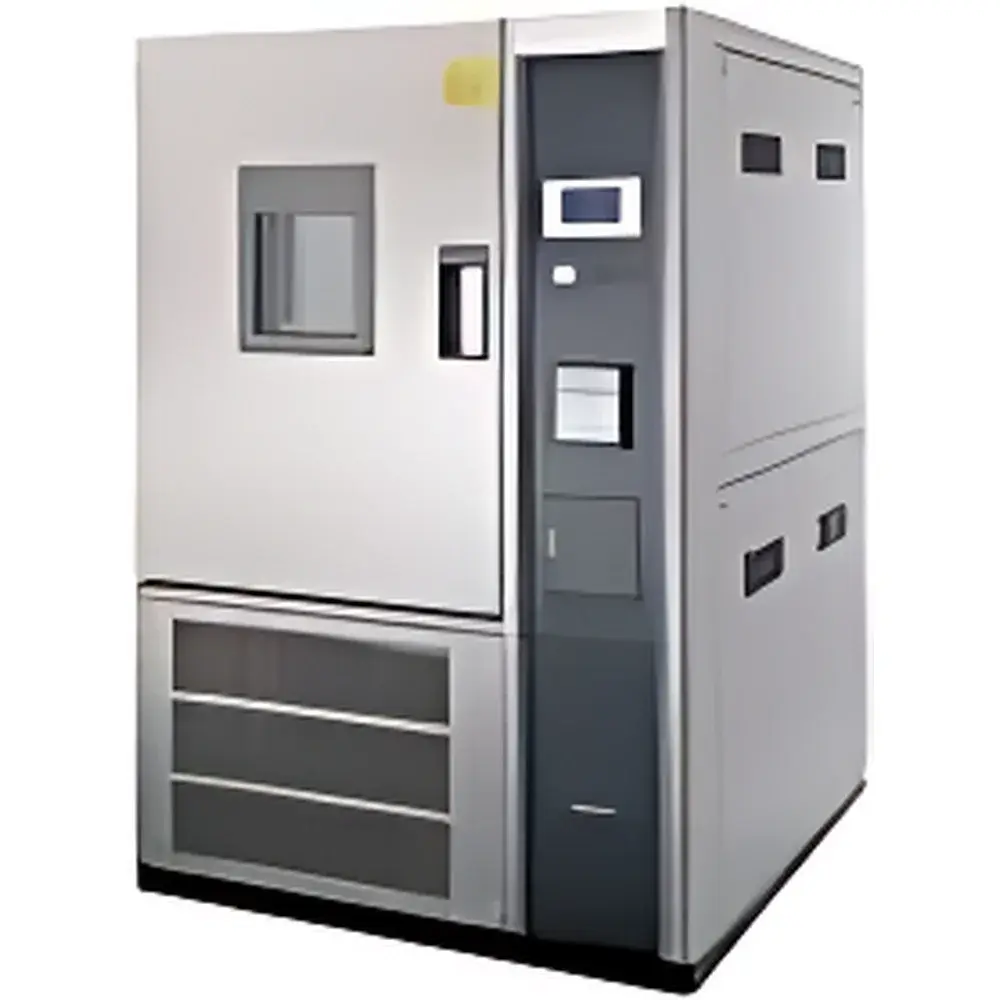
LabCompanion P-Series Temperature and Humidity Environmental Test Chamber
| Brand | LabCompanion |
|---|---|
| Origin | Guangdong, China |
| Manufacturer Type | Direct Manufacturer |
| Origin Classification | Domestic (China) |
| Model | P-Series |
| Pricing | Available Upon Request |
| Operating Ambient Temperature | +5°C to +30°C |
| Power Supply | AC 220 ±10% V, 50 ±0.5 Hz (Single-phase, 2-wire + PE) or AC 380 ±10% V, 50 ±0.5 Hz (Three-phase, 4-wire + PE) |
| Standard Accessories | Φ50 mm Cable Port Cap (1 pc), Adjustable Shelves (2 sets), Fuse (2 pcs), Overflow Drain Tube (1 pc), User Manual (1 set) |
| Optional Accessories | Chart Recorder, RS232/RS485 Communication Interface, PC Control Software |
| Note 1 | External dimensions exclude protruding components |
| Note 2 | All technical specifications measured at 20°C ambient temperature under no-load conditions. |
| Note 3 | Specifications subject to change without notice. |
Overview
The LabCompanion P-Series Temperature and Humidity Environmental Test Chamber is an engineered solution for precise, repeatable simulation of climatic stress conditions in laboratory and industrial quality assurance environments. Designed around a dual-refrigeration + steam-humidification architecture with PID-controlled heating, cooling, and humidification subsystems, the chamber enables stable, programmable control across wide thermal and hygroscopic ranges. Its core operational principle relies on closed-loop feedback regulation of chamber air temperature (via electric heater and cascade refrigeration system) and relative humidity (via stainless-steel steam generator and precision humidity sensor), ensuring compliance with standardized environmental stress testing protocols including IEC 60068-2-1 (cold), IEC 60068-2-2 (dry heat), IEC 60068-2-30 (damp heat cyclic), and MIL-STD-810G Method 507.5. The unit is intended for use in R&D validation, accelerated aging studies, reliability screening, and pre-shipment environmental qualification of electronic components, polymers, packaging materials, and medical devices.
Key Features
- Robust double-wall insulated construction with high-density polyurethane foam (≥100 mm thickness) and seamless stainless-steel inner chamber for thermal stability and corrosion resistance
- Microprocessor-based controller with intuitive touch interface, real-time graphing, and multi-segment programmable profiles (up to 99 cycles, 999 steps)
- High-accuracy Pt100 temperature sensors and capacitive RH sensors calibrated traceably to NIST standards, delivering ±0.3°C temperature uniformity and ±2.5% RH accuracy across working volume
- Dual-stage refrigeration system with environmentally compliant R404A/R23 mixed refrigerant for rapid cooling down to –70°C (model-dependent), supported by hot-gas bypass modulation for fine-tuned temperature ramp control
- Steam-type humidification system featuring stainless-steel boiler, automatic water level detection, and anti-scaling design—compatible with deionized or distilled water supply
- Integrated safety architecture including over-temperature cutoff, compressor high-pressure protection, door interlock, and independent mechanical thermostat backup
Sample Compatibility & Compliance
The P-Series accommodates a broad range of sample types—including PCB assemblies, lithium-ion battery cells, automotive ECUs, pharmaceutical primary packaging, and elastomeric seals—without compromising chamber integrity or test fidelity. Internal chamber volume options span from 100 L to 1000 L (custom configurations available), with standard shelves rated for ≥15 kg load per shelf. All models are designed and verified to meet electromagnetic compatibility (EMC) requirements per EN 61326-1 and electrical safety standards per IEC 61010-1. For regulated industries, optional audit-trail-enabled software supports 21 CFR Part 11 compliance when paired with validated user access controls and electronic signature workflows. Routine operation aligns with GLP and ISO/IEC 17025 documentation expectations for environmental test records.
Software & Data Management
LabCompanion’s optional PC-based control suite (ChamberLink™ v3.x) provides remote monitoring, data logging at configurable intervals (1 sec–60 min), automated report generation (PDF/CSV), and alarm history export. The software supports both RS232 and RS485 interfaces with Modbus RTU protocol, enabling integration into centralized MES or LIMS platforms. All logged parameters—including chamber setpoint, actual temperature/RH, compressor status, and alarm events—are time-stamped and stored with immutable file attributes. Data integrity safeguards include cyclic redundancy check (CRC) validation, encrypted local database storage, and optional cloud backup via secure TLS 1.2 transmission.
Applications
- Temperature cycling and thermal shock evaluation per JEDEC JESD22-A104
- Damp heat testing of conformally coated electronics (IPC-CC-830B)
- Stability testing of sterile barrier systems (ISO 11607-1)
- Accelerated weathering of polymer composites (ASTM D4329)
- Validation of cold-chain packaging performance (ISTA 7E)
- Humidity-induced failure analysis of MEMS sensors and optical coatings
FAQ
What is the typical temperature and humidity operating range for the P-Series?
Standard configurations support –70°C to +180°C temperature range and 10%–98% RH (non-condensing), with specific limits dependent on model variant and chamber loading.
Can the chamber be validated for IQ/OQ/PQ protocols?
Yes—LabCompanion provides factory-issued calibration certificates (traceable to national standards), as well as optional on-site qualification support documentation aligned with GAMP5 and Annex 15 guidelines.
Is deionized water mandatory for humidification?
While tap water may be used temporarily, long-term operation requires deionized or distilled water to prevent mineral deposition and ensure sensor longevity and steam purity.
How is temperature uniformity verified inside the chamber?
Uniformity is assessed using a 9-point thermocouple mapping procedure per ASTM E2297, conducted under steady-state no-load conditions at three representative setpoints (–40°C, 25°C, +85°C).
Does the system support Ethernet connectivity?
Ethernet capability is available via optional gateway module (RS485-to-Ethernet converter), enabling TCP/IP communication and SNMP-based network monitoring.



