
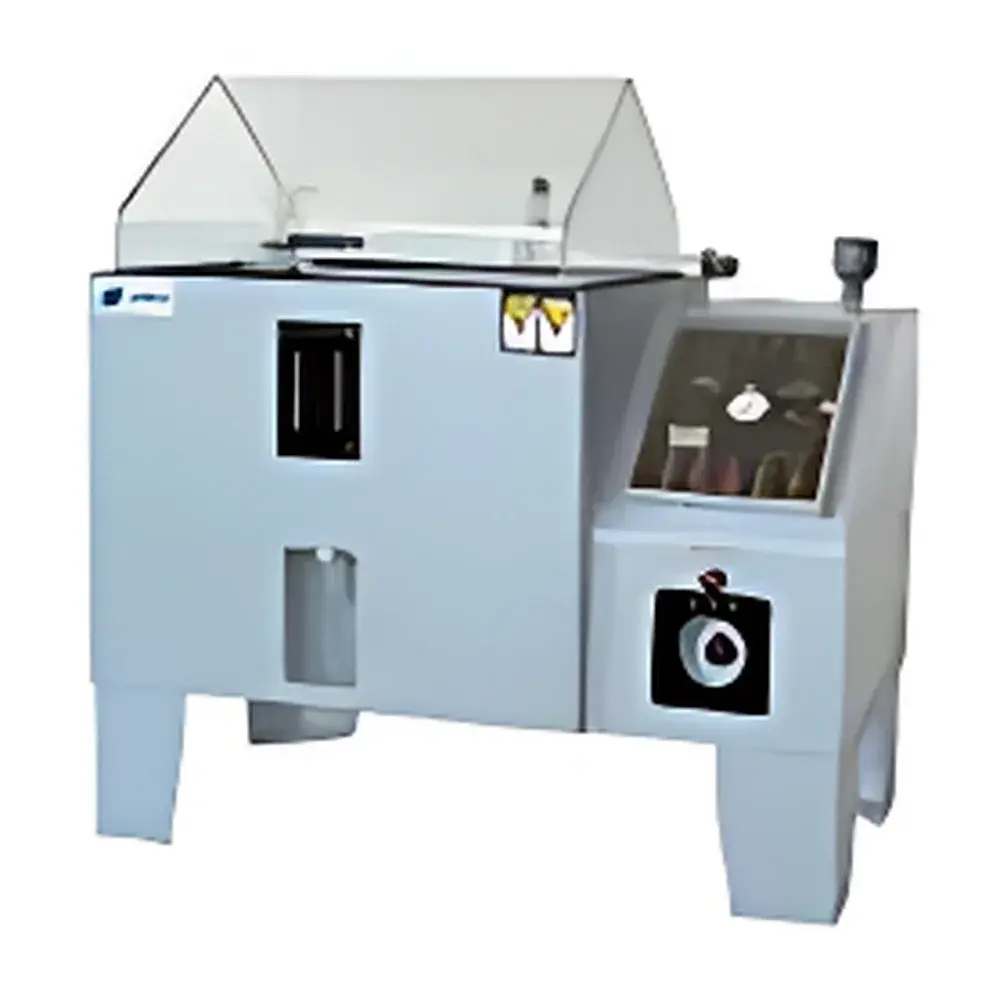
LabCompanion SH-60 Salt Spray Test Chamber
| Brand | LabCompanion |
|---|---|
| Origin | Guangdong, China |
| Manufacturer Type | Direct Manufacturer |
| Model | SH-60 |
| Power | 1.3 kW |
| Temperature Range | +5°C to 55°C |
| Temp. Uniformity | ≤ ±2°C |
| Temp. Stability | ≤ ±0.5°C |
| Salt Spray Deposition Rate | 1–2 mL / 80 cm²·h |
| Spray Mode | Continuous or Cyclic |
| Test Timer | 1–999 (s/min/h) adjustable |
| Chamber Dimensions (D×W×H) | 450×600×400 mm |
| External Dimensions (D×W×H) | 560×1140×1000 mm |
| Compliance | ASTM B117, ISO 9227, GB/T 2423.17, GB/T 10125, JIS Z 2371, DIN 50021, IEC 60068-2-11 |
Overview
The LabCompanion SH-60 Salt Spray Test Chamber is a precision-engineered environmental test system designed for accelerated corrosion evaluation of metallic materials, coated surfaces, electroplated components, and finished products across electronics, automotive, aerospace, and industrial manufacturing sectors. It operates on the principle of controlled aerosol generation—atomizing a standardized sodium chloride (NaCl) solution into fine, stable salt mist within a thermally regulated chamber—to replicate aggressive marine or industrial atmospheric conditions. The chamber complies fully with ASTM B117 (Standard Practice for Operating Salt Spray (Fog) Apparatus), ISO 9227 (Corrosion tests in artificial atmospheres — Salt spray tests), and equivalent national standards including GB/T 2423.17 and GB/T 10125. Its design enables reproducible, traceable, and auditable corrosion testing under strictly defined thermal and spray dynamics—critical for quality assurance, R&D validation, and regulatory conformance.
Key Features
- High-accuracy PID temperature control system with ±0.1°C setpoint stability; optional digital controllers from Fuji, RKC, or Honeywell available with integrated print output (time interval, speed, and format configurable)
- Tower-type spray system with non-crystallizing nozzles engineered for uniform fog distribution and adjustable deposition rate (1–2 mL/80 cm²·h), verified per ISO 9227 calibration protocols
- Pneumatically assisted lid mechanism ensures smooth, ergonomic opening/closing while maintaining water-sealed integrity—preventing salt fog leakage during operation
- Independent heating circuit with Ni-Cr alloy heaters and dual overheat protection (electronic + mechanical) for operational safety and long-term reliability
- Full chamber construction from imported high-strength, UV-resistant PVC (interior and exterior) and transparent PC or PVC for the lid—ensuring chemical inertness, structural rigidity, and real-time visual monitoring
- Integrated salt solution filtration at suction point, pre-heating loop to equalize brine temperature with chamber ambient, and calibrated collection funnel + measuring cylinder for deposition verification
- Comprehensive safety architecture: leakage current protection, short-circuit interruption, low-water cutoff, overcurrent tripping, end-of-test auto-shutdown, and thermal runaway prevention
Sample Compatibility & Compliance
The SH-60 accommodates standard test specimens up to 450 × 600 × 400 mm (W × D × H) internal volume. It supports both neutral salt spray (NSS) and acetic acid salt spray (AASS) test methods per ISO 9227 Annexes A and B. Sample racks include V-shaped and cylindrical fixtures fabricated from corrosion-resistant stainless steel or titanium—minimizing interference with test chemistry. All materials contacting the saline environment—including tubing, nozzles, reservoirs, and seals—are selected for long-term resistance to NaCl hydrolysis and chloride-induced stress corrosion cracking. The system meets GLP-aligned documentation requirements: temperature and timer logs are timestamped and exportable (when equipped with optional controller); physical calibration records (deposition rate, temperature uniformity) align with ISO/IEC 17025 traceability frameworks. It is routinely deployed in laboratories undergoing FDA 21 CFR Part 11 readiness assessments and ISO 9001:2015 certified QA/QC environments.
Software & Data Management
While the base SH-60 utilizes a microprocessor-based LED PID controller with S.S.R. output and PT100 platinum resistance sensor input, optional upgrade paths include RS-485 Modbus RTU interface for integration into centralized lab management systems (LIMS) or SCADA platforms. Controller firmware supports audit-trail-enabled parameter logging—including setpoint history, actual chamber temperature, spray activation cycles, and fault event timestamps—with user-defined retention policies. Data export is compatible with CSV and Excel formats for statistical process control (SPC) analysis. For GxP-regulated users, the optional controller variant includes electronic signature capability, role-based access control, and 21 CFR Part 11-compliant audit trail generation—meeting FDA expectations for data integrity in corrosion qualification studies.
Applications
This chamber serves as a core tool in comparative coating performance assessment (e.g., zinc-nickel, epoxy-polyester, chromate conversion), validation of passivation treatments on stainless steels, qualification of solder mask adhesion in PCB assemblies, and durability benchmarking of fasteners, hinges, and chassis components in automotive Tier-1 supply chains. It is routinely specified in procurement contracts requiring evidence of corrosion resistance per MIL-STD-810H Method 509.5, IEC 60068-2-11, or OEM-specific material specifications (e.g., Ford WSK-M2G227-A2, GMW14872). Research institutions utilize it for fundamental studies on pitting initiation kinetics, crevice corrosion propagation, and galvanic coupling behavior under cyclic wet-dry conditions when extended with optional humidity modules.
FAQ
What standards does the SH-60 comply with?
ASTM B117, ISO 9227, GB/T 2423.17, GB/T 10125, JIS Z 2371, DIN 50021, IEC 60068-2-11, and MIL-STD-810H Method 509.5.
Can the SH-60 perform cyclic corrosion tests?
The base SH-60 supports continuous and programmable cyclic spray modes; for full multi-stage corrosion testing (e.g., wet/dry/salt/humidity cycles), integration with optional humidity control modules or pairing with a separate climate chamber is required.
Is the chamber suitable for AASS (Acetic Acid Salt Spray) testing?
Yes—when configured with pH-adjusted solution delivery and corrosion-resistant internal components, it meets ISO 9227 Annex B requirements for AASS.
What maintenance intervals are recommended?
Daily: inspect nozzle for clogging, verify solution level and purity; weekly: clean salt deposit from chamber walls and drain lines; quarterly: calibrate temperature sensor and validate deposition rate using standardized funnels and graduated cylinders.
Does the system support remote monitoring?
With optional RS-485/Modbus or Ethernet-enabled controller upgrades, real-time status, alarms, and logged data can be accessed via local network or cloud-connected lab infrastructure.



