
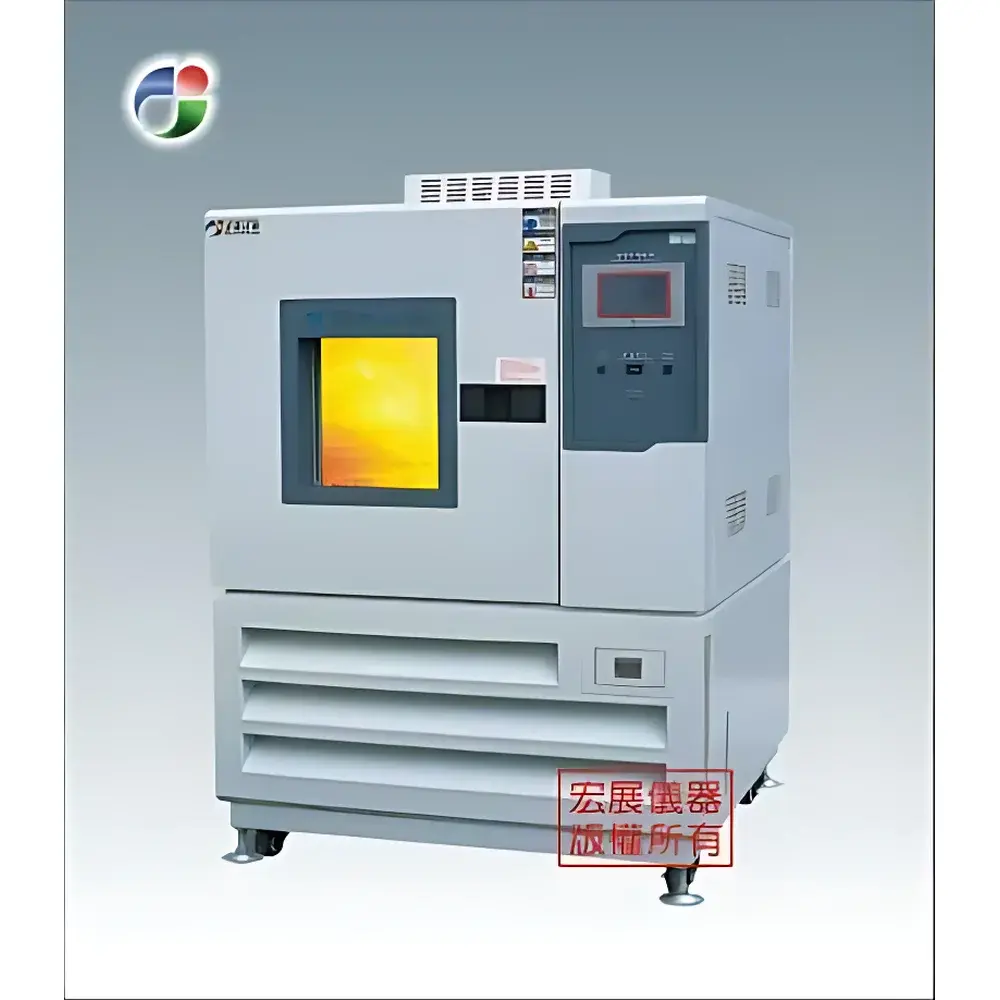
LabCompanion SH-90 Salt Spray Test Chamber
| Brand | LabCompanion |
|---|---|
| Origin | Guangdong, China |
| Manufacturer Type | OEM Manufacturer |
| Model | SH-90 |
| Voltage | 220V/50Hz or 380V/50Hz |
| Chamber Material | Imported PVC rigid plastic board |
| Saturated Air Tank Material | SUS304 stainless steel |
| Heating Method | Direct steam heating |
| Temperature Control | Microcomputer PID controller with SSR output |
| Temperature Accuracy | ±0.1°C |
| Spray Nozzle | Precision PYREX glass nozzle |
| Spray Distribution | Conical disperser + adjustable fog settling rate |
| Safety Protections | Dual overtemperature protection (chamber & saturated air tank), low-water-level cutoff, overcurrent breaker |
| Compliance | GB/T 10587–2006, GB/T 2423.17–2008, IEC 60068-2-11:1987 |
| Internal Volume Options | 100 L to 1080 L |
| Power Consumption | 1.5 kW to 8 kW |
Overview
The LabCompanion SH-90 Salt Spray Test Chamber is an engineered environmental test system designed for accelerated corrosion evaluation of metallic coatings, automotive components, electronic assemblies, architectural materials, and industrial finishes. It operates on the principle of continuous or cyclic salt fog exposure—generating a controlled, reproducible chloride-rich aerosol environment that simulates decades of natural marine or industrial atmospheric corrosion in days or weeks. The chamber complies with internationally recognized corrosion testing standards including GB/T 2423.17 (equivalent to IEC 60068-2-11), GB/T 10587, and ASTM B117 (when configured per specification). Its core architecture integrates precision humidity and temperature regulation, stable fog generation via PYREX glass nozzles, and robust chemical resistance—ensuring long-term operational integrity under aggressive saline conditions.
Key Features
- Chamber construction from imported high-purity PVC rigid plastic board—resistant to HCl, NaCl, and other corrosive agents; non-aging, smooth surface finish ensures consistent internal reflectivity and easy cleaning.
- Direct steam heating system for rapid, uniform chamber temperature ramp-up and stabilization; eliminates thermal gradients that compromise test repeatability.
- Precision PYREX glass spray nozzles produce fine, homogeneous salt mist with adjustable deposition rates (typically 1.0–2.0 mL/80 cm²/h, per ASTM B117 calibration protocols).
- Saturated air tank fabricated from SUS304 stainless steel and regulated by Henry’s Law-based humidification—maintains precise relative humidity (≥95% RH) and preheats compressed air to prevent condensation-induced droplet coalescence.
- Dual independent PID controllers (one for chamber temperature, one for saturated air tank)—digital display, SSR-driven output, ±0.1°C control accuracy, and user-defined setpoint retention.
- Integrated safety architecture: dual overtemperature cutoffs (chamber and saturator), automatic water-level monitoring with alarm and test suspension, and circuit-breaker-protected power input.
- Water-tight transparent acrylic lid with ergonomic hinge mechanism—prevents salt fog leakage while enabling real-time visual inspection without interrupting test cycles.
Sample Compatibility & Compliance
The SH-90 accommodates flat specimens, small subassemblies, PCBs, coated fasteners, painted panels, and galvanized sheet metal—mounted on standardized polypropylene test racks. Its modular interior dimensions (from 450 × 600 × 400 mm to 900 × 2000 × 600 mm) support custom fixture integration. All models meet national and international regulatory requirements for corrosion qualification: GB/T 2423.17–2008 (Ka test), GB/T 10587–2006 (chamber performance criteria), and IEC 60068-2-11:1987. When operated with traceable NaCl solution (5.0 ± 0.1% w/w), calibrated collection funnels, and certified temperature/humidity sensors, data generated is admissible for ISO/IEC 17025-accredited laboratory reporting and supplier qualification audits.
Software & Data Management
While the base SH-90 utilizes embedded microcontroller logic with manual parameter entry, optional RS485/Modbus RTU interface enables integration with centralized lab management systems (LIMS) or SCADA platforms. Real-time temperature logging (chamber and saturator), runtime tracking, and event-triggered alarms (e.g., low water, overtemp) are recorded with timestamped entries. For GLP/GMP environments, external data loggers compliant with FDA 21 CFR Part 11 may be deployed to ensure audit-ready electronic records—including user authentication, change history, and digital signature capability.
Applications
- Evaluation of electroplated zinc, nickel, chromium, and cadmium coatings on steel substrates.
- Qualification of automotive brake calipers, fuel rails, and under-hood electronics per ISO 16750-4.
- Corrosion resistance validation of printed circuit boards (PCBs) and conformal-coated connectors in telecom and aerospace supply chains.
- Performance benchmarking of architectural cladding systems (aluminum composite panels, stainless steel façades) against EN ISO 9227.
- QC release testing for powder-coated furniture, agricultural equipment, and marine hardware.
FAQ
What standards does the SH-90 comply with?
It meets GB/T 2423.17–2008, GB/T 10587–2006, and IEC 60068-2-11:1987. With proper calibration and procedural adherence, it supports ASTM B117 execution.
Is compressed air required for operation?
Yes—a clean, oil-free, dry compressed air source (typically 1–2 bar) is mandatory for雾化 (fog generation); optional air compressor packages are available.
Can test parameters be logged and exported?
The standard unit provides local digital readouts; data export requires optional communication modules or third-party validated data loggers.
What maintenance is recommended for long-term reliability?
Daily drain of saturator condensate, weekly cleaning of PYREX nozzles with deionized water, quarterly inspection of PVC chamber seals, and annual verification of temperature/humidity sensors per ISO/IEC 17025 guidelines.
Are custom chamber sizes available?
Yes—LabCompanion offers OEM engineering support for non-standard internal volumes, mounting configurations, and auxiliary features (e.g., programmable cycling, pH-controlled solutions).



