
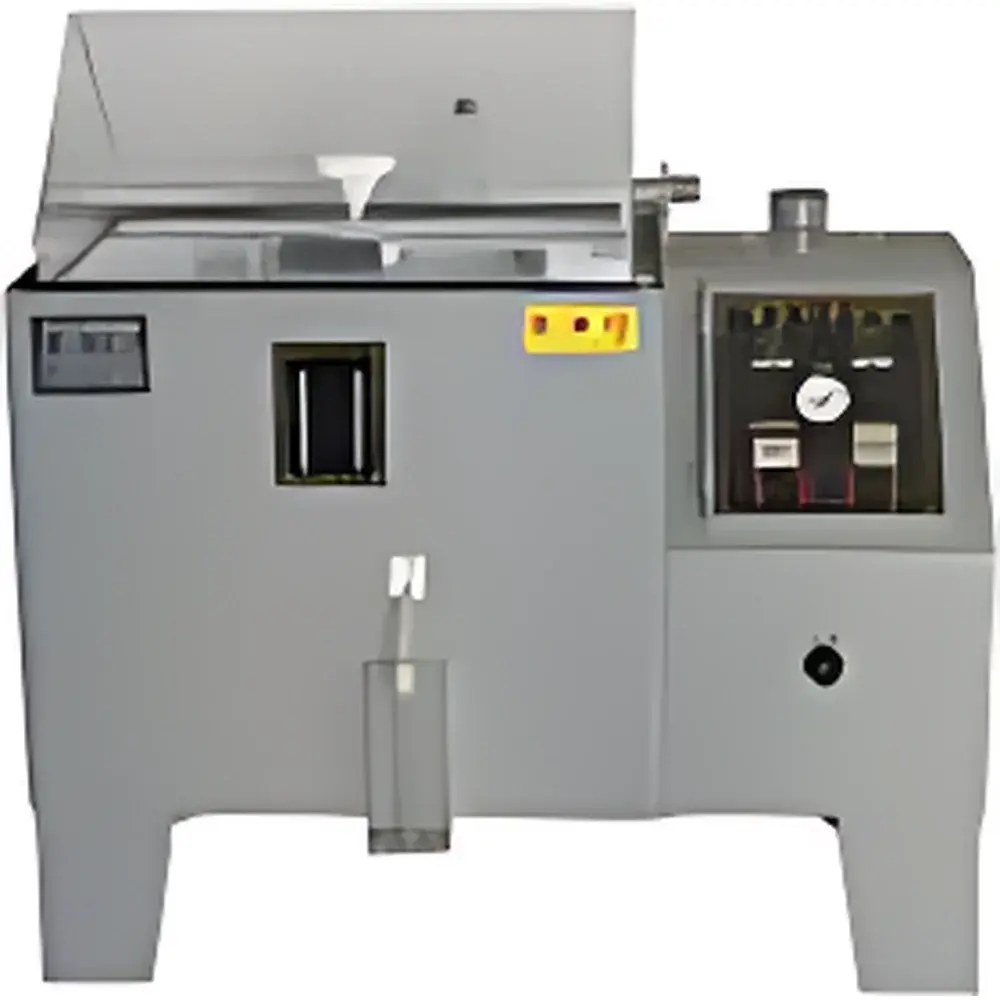
LabCompanion SH15-90 Salt Spray Test Chamber
| Brand | LabCompanion |
|---|---|
| Model | SH15-90 |
| Origin | Guangdong, China |
| Manufacturer | LabCompanion (OEM/ODM Producer) |
| Chamber Internal Dimensions (W×D×H, mm) | 600×450×400 to 2000×900×600 |
| External Dimensions (W×D×H, mm) | 1080×800×1080 to 2700×1300×1550 |
| Internal Volume | 100–1080 L |
| Power Consumption | 1.5–8 kW |
| Supply Voltage | 220 V / 380 V, 50 Hz |
| Safety Protections | Overcurrent Circuit Breaker, Test Chamber Overtemperature Protection, Saturated Air Tank Overtemperature Protection, Low-Water-Level Cut-off |
| Standard Accessories | Sample Rack, Calibrated Graduated Cylinder, Fog Collection Funnel, Borosilicate Glass Nozzle, Spray Tower Assembly, User Manual |
| Optional Accessories | Oil-free Air Compressor, Additional Glass Nozzles |
Overview
The LabCompanion SH15-90 Salt Spray Test Chamber is an engineered environmental test system designed for accelerated corrosion evaluation of metallic and coated materials under controlled sodium chloride (NaCl) aerosol exposure. It operates on the principle of continuous or cyclic salt fog generation via compressed air atomization through precision borosilicate glass nozzles, producing a stable, uniform mist with defined droplet size distribution (typically 1–10 µm median diameter). The chamber maintains strict compliance with standardized test protocols including ASTM B117, ISO 9227, JIS Z2371, and GB/T 2423.17—enabling reproducible assessment of coating adhesion, galvanic protection integrity, and base metal corrosion resistance. Its robust stainless steel construction, double-wall insulation, and saturated air tank design ensure thermal stability and consistent humidity saturation (≥95% RH) within the test space—critical for eliminating condensation artifacts and ensuring adherence to specification-defined spray deposition rates (1.0–2.0 mL/80 cm²/h).
Key Features
- Modular chamber architecture supporting six standard internal volume configurations (100 L to 1080 L), enabling scalability from R&D benchtop validation to full-size component testing.
- Dual-zone temperature control: independent regulation of test chamber (RT+5°C to 55°C) and saturated air tank (RT+10°C to 47°C) ensures precise Cl⁻ ion delivery without oversaturation or dry-out.
- Integrated safety interlock system featuring overcurrent circuit breakers, real-time chamber and saturator overtemperature monitoring (with redundant thermal cutoffs), and automatic low-water-level shutdown to prevent heater dry-firing.
- Corrosion-resistant interior: 304 stainless steel chamber walls, floor, and ceiling; PTFE-coated heating elements; and acid-resistant silicone gaskets guarantee long-term operational reliability in aggressive saline environments.
- Calibrated spray tower assembly with adjustable air pressure (0.8–1.2 bar) and solution flow rate (1–3 L/h), coupled with standardized fog collection funnels positioned per ASTM B117 layout requirements.
- Front-accessible maintenance design: removable glass nozzles, slide-out sample racks, and top-mounted saturator lid facilitate routine cleaning, calibration verification, and nozzle replacement without disassembly.
Sample Compatibility & Compliance
The SH15-90 accommodates flat panels, fasteners, electronic housings, automotive trim components, and small assembled subassemblies. Sample racks are configurable for vertical or angled mounting (15°–30°) to simulate real-world exposure geometry. All models meet structural and performance criteria outlined in IEC 60068-2-11 (salt mist test method), and support GLP-compliant documentation when paired with optional data logging modules. The chamber’s physical dimensions and internal airflow pattern have been validated to ensure uniform fog distribution across the entire test area—verified by fog collection mapping per ISO 9227 Annex A. For regulatory submissions requiring audit-ready records, integration with LabCompanion’s optional 21 CFR Part 11–compliant software enables electronic signatures, user access controls, and immutable audit trails.
Software & Data Management
While the base SH15-90 operates via analog/manual controls (digital temperature display, mechanical timer), optional digital controllers provide programmable test profiles—including multi-step cycles (e.g., salt spray → dry → humidity → wet) aligned with ISO 14993 or ASTM G85 Annex A5. Data logging modules record chamber temperature, saturator temperature, elapsed time, and spray duration at user-defined intervals (1–60 min), exporting timestamped CSV files compatible with LIMS and statistical process control platforms. All firmware adheres to IEC 62443-3-3 cybersecurity guidelines for industrial control systems, with password-protected configuration access and firmware update authentication.
Applications
- Quality assurance of electroplated, anodized, and organic-coated metals in automotive, aerospace, and electronics manufacturing.
- Comparative evaluation of corrosion inhibitors and passivation treatments per MIL-DTL-16232 or ASTM D610.
- Pre-qualification testing of marine-grade fasteners and structural alloys (e.g., ASTM A123, ASTM B633).
- Failure analysis labs conducting root-cause investigations of field corrosion incidents using accelerated life modeling.
- Academic research on atmospheric corrosion mechanisms, including chloride-induced pitting and crevice corrosion kinetics.
FAQ
What standards does the SH15-90 comply with?
It is configured and validated for ASTM B117, ISO 9227, JIS Z2371, GB/T 2423.17, and IEC 60068-2-11.
Is the chamber suitable for cyclic corrosion testing (CCT)?
Yes—when equipped with the optional programmable controller and auxiliary humidity/dry modules, it supports ASTM G85 Annexes A1–A5 and ISO 14993 protocols.
How is fog deposition rate verified and maintained?
Using the included calibrated graduated cylinder and fog collection funnels placed at specified locations; verification must be performed daily per ASTM B117 Section 7.3.
Can the chamber be customized for non-standard specimen sizes?
Yes—LabCompanion offers OEM engineering services for bespoke internal dimensions, door configurations, and accessory mounting interfaces.
What maintenance is required for long-term accuracy?
Weekly cleaning of nozzles and saturator with deionized water, monthly inspection of heater elements and level sensors, and annual calibration of temperature sensors traceable to NIST standards.



