
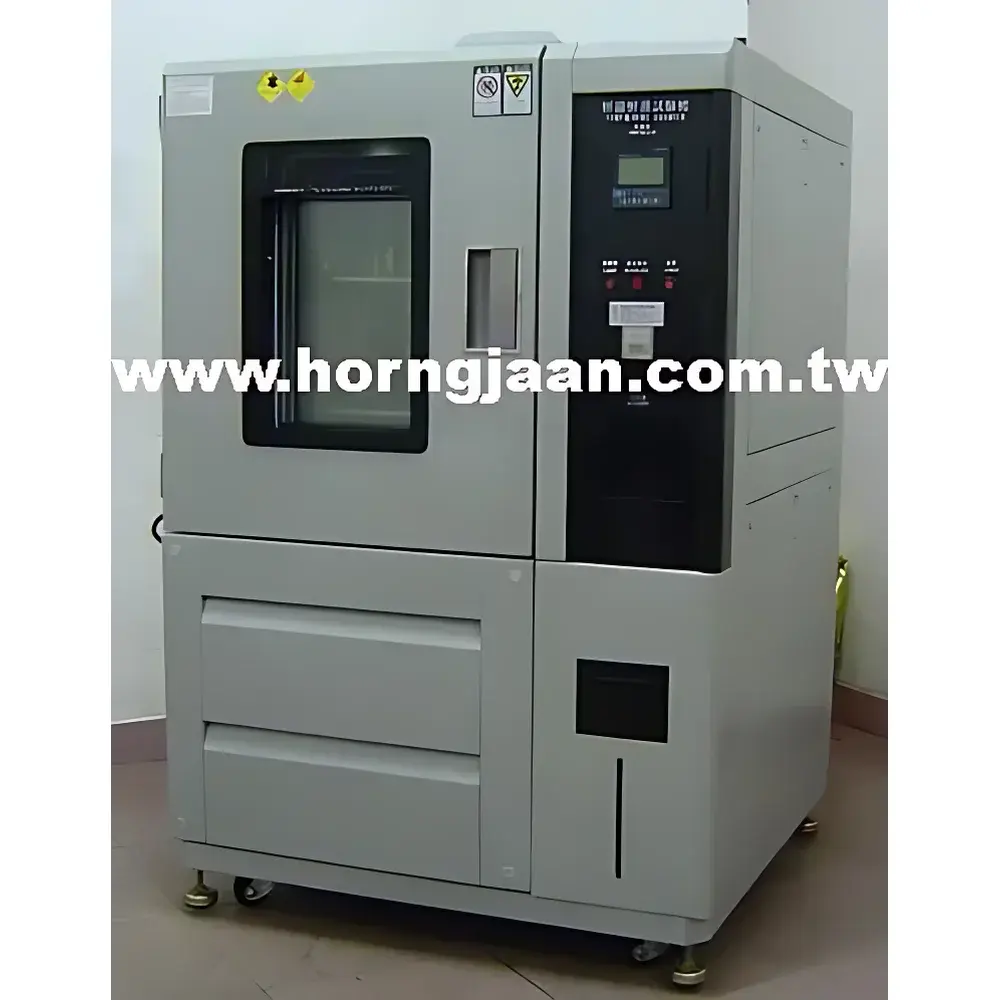
LabCompanion SP-408 Temperature and Humidity Controlled Environmental Test Chamber for LED & Electronics Reliability Testing
| Brand | LabCompanion |
|---|---|
| Origin | Guangdong, China |
| Manufacturer Type | Direct Manufacturer |
| Model | SP-408 |
| Internal Volume | 408 L |
| Internal Dimensions (H×W×D) | 850×600×800 mm |
| External Dimensions (H×W×D) | 1100×1780×1250 mm |
| Temperature Range | −40 °C to +150 °C |
| Humidity Range | 20 %RH to 98 %RH |
| Temperature Uniformity | ±0.5 °C |
| Humidity Uniformity | ±1.0 %RH |
| Heating Rate | −70 °C to +150 °C in <90 min |
| Cooling Rate | +20 °C to −40 °C in <60 min |
| Control Method | BTHC (Balanced Temperature and Humidity Control) |
| Sensor Type | PT100 Dry/Wet Bulb Sensors |
| Heating System | Nickel-Chromium Alloy Wire Heaters |
| Humidification System | Shallow-Tank Electric Heater Type |
| Refrigeration System | Hermetic Twin-Screw Compressor (Tecumseh, Eco-Friendly Refrigerant R404A/R23) |
| Controller | TEMI Touchscreen HMI (Korea) |
| Insulation | Rigid Polyurethane Foam + Glass Wool |
| Inner Chamber Material | Mirror-Finished Stainless Steel (SUS304) |
| Outer Chamber Material | Powder-Coated Steel or Stainless Steel |
| Safety Protections | Compressor Overheat/Overcurrent/High-Pressure, Dry-Burn Prevention, Over-Temperature Alarm, Low-Water Level Alert, Circuit Isolation for Humidification Lines |
| Power Supply | 3φ5W 380 VAC ±10 % or 2φ3W 220 VAC ±10 % |
| Standard Accessories | Fluorescent Illuminated Viewing Window, φ50 mm Cable Port (Left Side), Two Adjustable Sample Racks, Castor Wheels, Integrated Water Reservoir (Rear-Mounted) |
| Optional | RS-485 Interface, Data Logger, Inner Glass Door with Glove Ports |
Overview
The LabCompanion SP-408 Temperature and Humidity Controlled Environmental Test Chamber is an engineered solution for accelerated reliability validation of optoelectronic components—particularly LED packages, drivers, substrates, and display modules—under rigorously defined thermal and hygrothermal stress conditions. Designed in accordance with IEC 60068-2-1 (cold), IEC 60068-2-2 (dry heat), IEC 60068-2-30 (damp heat, cyclic), and JEDEC JESD22-A101 (steady-state humidity), the chamber employs a Balanced Temperature and Humidity Control (BTHC) architecture to maintain precise, stable, and repeatable test environments across its full operational envelope. Its core thermodynamic performance—±0.5 °C temperature uniformity and ±1.0 %RH humidity uniformity—is achieved through independent PID-controlled heating, refrigeration, and humidification subsystems, coupled with a high-efficiency centrifugal air circulation system calibrated to deliver uniform laminar flow and minimal thermal stratification within the 408 L working volume.
Key Features
- Robust dual-sensor PT100 dry/wet bulb measurement system, traceable to NIST standards via factory calibration certificate, ensuring metrological integrity for long-term data comparability.
- Hermetically sealed Tecumseh twin-stage refrigeration unit using environmentally compliant R404A/R23 refrigerant blend, enabling rapid thermal transitions—including −70 °C to +150 °C in under 90 minutes and +20 °C to −40 °C in under 60 minutes—without condensation-induced sensor drift.
- Electric shallow-tank humidifier with isolated fluid circuitry: all water piping is physically segregated from control boards, power supplies, and signal wiring to eliminate risk of electrical short-circuiting during maintenance or leakage events.
- Front-mounted illuminated observation window with embedded heating element on tempered glass—eliminates fogging without mechanical wipers and maintains optical clarity throughout extended high-humidity cycles (up to 98 %RH).
- Modular controller interface (TEMI touchscreen HMI, Korea) supporting up to 100 programmable segments, 999 cycles, and real-time deviation alarms—with optional audit trail logging compliant with FDA 21 CFR Part 11 requirements when paired with validated software.
- Structural integrity reinforced by 100 mm-thick composite insulation (rigid polyurethane foam + glass wool), minimizing thermal bridging and sustaining energy efficiency across continuous operation at extreme setpoints.
Sample Compatibility & Compliance
The SP-408 accommodates full-size LED luminaires, PCB-mounted SMD LED arrays, COB modules, and driver IC assemblies on two independently height-adjustable stainless-steel sample racks. A rear-accessible 50 mm cable port (rated for 2 A continuous load) enables live electrical monitoring during thermal cycling. The chamber conforms to ISO/IEC 17025–accredited laboratory environmental conditioning protocols and supports test execution per MIL-STD-810H Method 507.6 (Humidity), IPC-9701A (Performance Classes for Surface Mount Solder Attachments), and AEC-Q102 (Stress Test Qualification for Discrete Optoelectronic Components). All safety interlocks—including low-water cutoff, compressor overpressure shutdown, and heater dry-burn protection—are hardwired and independently certified to UL 61010-1 and EN 61010-1.
Software & Data Management
Standard RS-485 serial interface enables bidirectional communication with Windows-based LabCompanion TestSuite software (v3.2+), permitting remote programming, real-time parameter visualization, automated data export (CSV/Excel), and event-triggered logging. When configured with optional validation package, the system supports electronic signatures, user role-based access control, and immutable audit trails meeting GLP/GMP documentation requirements. Raw sensor outputs (temperature, humidity, elapsed time, alarm status) are timestamped at 1-second intervals and stored locally on SD card (included) with 32 GB capacity—retaining ≥12 months of continuous test records at default sampling rate.
Applications
- LED package qualification: thermal shock testing (JEDEC JESD22-A104), high-temperature operating life (HTOL), and damp heat storage (JESD22-A101) for phosphor degradation and encapsulant delamination analysis.
- Automotive lighting module validation per ISO 16750-4 (climate resistance) and SAE J1211 (headlamp environmental stress screening).
- Reliability screening of OLED display backplanes, touch controllers, and flexible PCBs subjected to combined thermal-hygric stress.
- Accelerated aging of conformal coatings, silicone lenses, and silicone-based encapsulants used in outdoor LED signage.
- Pre-compliance environmental stress screening for medical-grade LED surgical lights per IEC 60601-1 Clause 11.1 (environmental testing).
FAQ
What is the maximum allowable sample weight per shelf?
Each adjustable rack supports up to 35 kg uniformly distributed; total chamber loading must not exceed 80 kg to preserve airflow uniformity and thermal stability.
Can the chamber operate continuously at 98 %RH and +85 °C?
Yes—the shallow-tank humidifier and BTHC algorithm are validated for uninterrupted operation at this demanding setpoint for durations exceeding 1,000 hours per IEC 60068-2-30 Ed. 3.2 Annex A.
Is third-party calibration documentation included?
A factory-issued calibration report (traceable to CNAS-accredited lab) is supplied with each unit, covering PT100 sensor accuracy, temperature/humidity uniformity mapping, and ramp rate verification.
How is condensation managed during rapid cooldown phases?
The chamber utilizes dynamic dew-point suppression logic: refrigeration output is modulated in coordination with dehumidification duty cycle to prevent internal surface condensation while maintaining target RH setpoint fidelity.
What maintenance intervals are recommended for the humidification system?
Distilled water replenishment is required every 48–72 hours during continuous high-RH operation; quarterly descaling of the shallow tank and annual replacement of the wet-bulb wick are advised per maintenance manual Section 7.2.



