
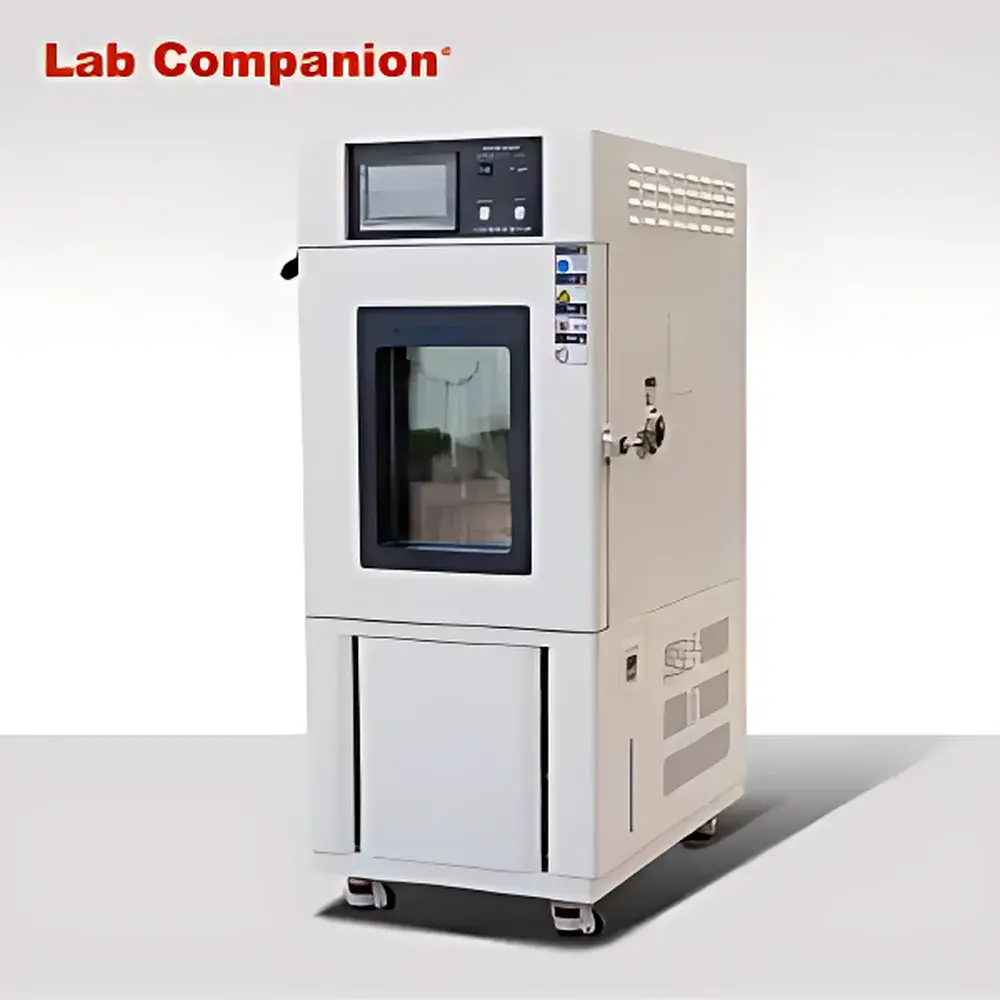
LabCompanion TC-Series Compact Thermal Cycling Chamber
| Brand | LabCompanion |
|---|---|
| Origin | Guangdong, China |
| Manufacturer Type | Direct Manufacturer |
| Product Category | Domestic |
| Model | TC-Series Compact Thermal Cycling Chamber |
| Temperature Range | −70 °C to +150 °C |
| Cooling Method | Compressor-Based Refrigeration |
| Explosion-Proof | Standard (Non-Explosion-Proof) |
| Temperature Fluctuation | ±0.5 °C |
| Temperature Deviation | ±2.0 °C |
| Temperature Uniformity | ±2.0 °C |
| Heating Rate | 5.0 °C/min |
| Cooling Rate | 5.0 °C/min |
| Internal Chamber Dimensions | 400 mm × 500 mm × 400 mm |
Overview
The LabCompanion TC-Series Compact Thermal Cycling Chamber is an engineered environmental test system designed for precise, repeatable thermal stress evaluation of materials, components, and electronic assemblies under controlled low- and high-temperature conditions. Built upon a dual-stage compressor refrigeration architecture with PID-controlled forced-air convection, the chamber delivers stable thermal profiles across its full operational range of −70 °C to +150 °C. Its compact footprint (external dimensions optimized for benchtop or small-footprint lab integration) makes it suitable for R&D laboratories, quality control labs, and reliability testing facilities where space efficiency and thermal fidelity are critical. The system operates on fundamental thermodynamic principles—utilizing vapor-compression refrigeration for sub-ambient cooling and resistive heating with proportional-integral-derivative (PID) feedback for accurate setpoint tracking—ensuring compliance with standard thermal cycling protocols defined in IEC 60068-2-14, MIL-STD-810H Method 502.7, and JEDEC JESD22-A104.
Key Features
- Compact internal workspace (400 × 500 × 400 mm) enables efficient use of laboratory floor space without compromising test volume capacity.
- High-fidelity temperature control: ±0.5 °C fluctuation at steady state, ±2.0 °C deviation from setpoint, and ±2.0 °C uniformity across the working zone—validated per ISO 16750-4 Annex A and ASTM E145-22 Class II requirements.
- Symmetrical heating and cooling rates of 5.0 °C/min support accelerated thermal cycling tests compliant with automotive electronics qualification standards (e.g., AEC-Q200).
- Robust stainless-steel inner chamber and insulated double-wall construction minimize thermal leakage and enhance long-term stability.
- Intuitive 7-inch color touchscreen HMI with multi-language interface (English, German, Japanese), real-time trend graphing, and user-accessible calibration offset adjustment.
- Standard RS485 Modbus RTU and optional Ethernet/IP or Profibus-DP interfaces enable seamless integration into centralized lab automation systems and LIMS environments.
Sample Compatibility & Compliance
The TC-Series accommodates a broad spectrum of non-hazardous samples—including PCB assemblies, polymer specimens, battery cells, optical components, and medical device housings—within its non-explosion-proof configuration. Chamber interior geometry supports standardized test fixtures and universal mounting brackets (M4/M6 threaded inserts available upon request). All thermal performance specifications are verified using NIST-traceable PT100 sensors per ISO/IEC 17025-accredited procedures. The unit conforms to CE marking requirements (2014/30/EU EMC Directive and 2014/35/EU LVD Directive), RoHS 2011/65/EU, and meets UL 61010-1 safety criteria for laboratory equipment. It is not certified for Class I Div 1 hazardous locations; alternative ATEX-certified variants are available under separate model designation.
Software & Data Management
LabCompanion’s proprietary TC-Control Suite (v3.2+) provides comprehensive test sequence programming—including ramp-hold cycles, step profiling, and user-defined thermal shock patterns—with up to 99 segments per program. Data logging records temperature, time, and alarm status at configurable intervals (1 s to 60 min resolution) and exports CSV or XML files compatible with JMP, MATLAB, and Minitab. Audit trail functionality complies with FDA 21 CFR Part 11 requirements when paired with optional user role management and digital signature modules. Raw sensor data is stored locally on industrial-grade SD card (included) and mirrored via FTP/SFTP to networked storage—supporting GLP/GMP documentation workflows.
Applications
- Thermal cycling validation of automotive ECUs and ADAS sensors per ISO 16750-4 and SAE J2245.
- Accelerated aging studies of lithium-ion battery modules under extreme thermal gradients.
- Material coefficient-of-thermal-expansion (CTE) characterization via dimensional metrology correlation.
- Pre-conditioning of adhesives, encapsulants, and conformal coatings prior to mechanical or electrical testing.
- Reliability screening of MEMS devices and optoelectronic packages during qualification (JEDEC JESD22-B104, B106).
- Stability testing of pharmaceutical packaging under ICH Q1A(R3) climatic zone IV conditions (with extended dwell capability).
FAQ
What is the maximum sample weight the chamber can accommodate without affecting thermal uniformity?
The chamber is rated for static loads up to 25 kg distributed evenly on the standard perforated shelf; exceeding this may impede airflow and compromise uniformity—consult engineering team for custom load-bearing configurations.
Can the TC-Series be integrated with external data acquisition systems?
Yes—RS485 Modbus RTU is standard; optional Ethernet/IP, Profibus-DP, or analog 4–20 mA output modules are available for OEM-level integration.
Is remote monitoring supported over LAN/WAN networks?
TC-Control Suite supports secure remote access via HTTPS-enabled web interface (requires static IP or DNS configuration); TLS 1.2 encryption and session timeout enforcement are enabled by default.
Does the system include calibration documentation?
Each unit ships with a factory calibration certificate traceable to NIST standards, covering temperature accuracy across five points (−40 °C, 0 °C, 25 °C, 85 °C, 125 °C); annual recalibration services are available through authorized service centers.
What maintenance intervals are recommended for compressor-based operation?
Compressor oil inspection every 2,000 operating hours; condenser coil cleaning every 6 months in standard lab environments; full preventive maintenance (refrigerant pressure check, PID tuning verification) annually or after 5,000 cycles—per ISO 13374-1 guidelines.



