
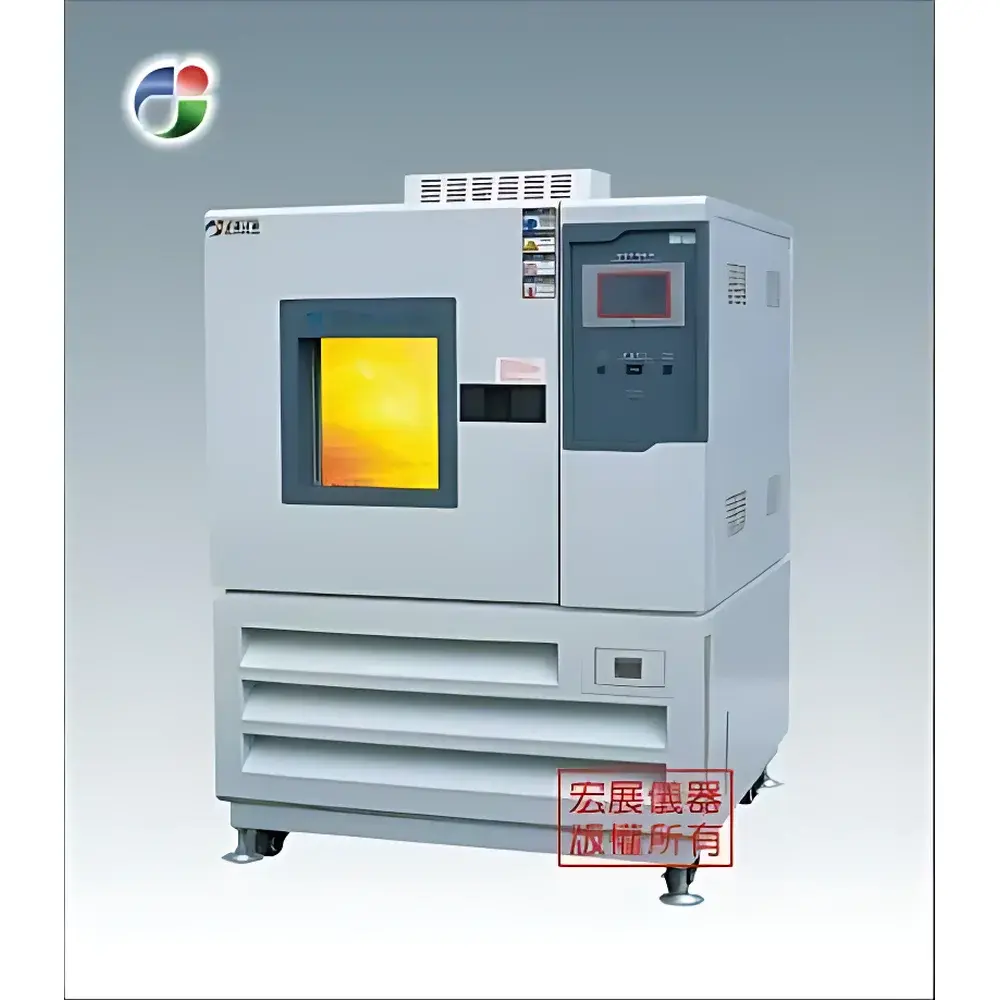
LabCompanion THC-150 Precision Temperature and Humidity Calibration Chamber
| Brand | LabCompanion |
|---|---|
| Origin | Guangdong, China |
| Manufacturer Type | Direct Manufacturer |
| Model | THC-150 |
| Power Supply | AC 3~380 V / 50 Hz |
| Rated Power | 6.0 kVA |
| Internal Dimensions | 500 × 500 × 500 mm |
| Temperature Range | 5–50 °C |
| Humidity Range | 30–95 %RH |
| Max. Temp. Error (10–40 °C) | ±0.3 °C |
| Max. RH Error (30–80 %RH) | ±2 %RH |
| Temp. Uniformity | ≤0.3 °C |
| RH Uniformity | ≤1.0 %RH |
| Temp. Stability | ±0.2 °C |
| RH Stability | ±0.8 %RH (at 20 °C) |
| Observation Window | 400 × 400 mm (triple-side + rear wide-view) |
| Heating Power | 2 kW |
| Steam Generator Power | 3 kW |
| Refrigeration Capacity | 1.5 kW |
| Compressor Power | 400 W |
| Refrigerant | R22 (500 g) |
| Weight | 230 kg |
| External Dimensions | 750 × 850 × 1600 mm |
| Safety Compliance | EN 60519-2 (Thermal Safety Class 2), JJG205–2005 |
Overview
The LabCompanion THC-150 is a metrology-grade temperature and humidity calibration chamber engineered for high-accuracy verification and calibration of mechanical hygrometers, psychrometers, hair hygrometers, and other analog or digital humidity-sensing instruments. It operates on the principle of controlled equilibrium conditioning—utilizing dual independent PID-regulated heating, steam-based humidification, and vapor-compression refrigeration to maintain stable, traceable environmental conditions within its stainless-steel working chamber. Designed in strict accordance with JJG205–2005 “Verification Regulation for Mechanical Hygrometers” (China National Metrological Verification Regulation), the THC-150 delivers certified uniformity and stability metrics validated under standardized test protocols—including Annex D for spatial uniformity and temporal stability assessment. Its core architecture eliminates reliance on forced-air convection for thermal homogeneity, instead achieving ≤0.3 °C temperature uniformity and ≤1.0 %RH humidity uniformity at 20 °C through symmetrical thermal mass distribution, ultra-thick insulation (polyurethane + glass wool), and vacuum-glazed triple-view observation windows. This passive uniformity strategy satisfies stringent regulatory constraints—such as the ≤0.2 m/s air velocity requirement for dry/wet-bulb thermometer calibration—without compromising measurement fidelity or instrument integrity.
Key Features
- Triple-side + rear wide-angle observation windows (400 × 400 mm front + two side + wide rear) enabling simultaneous visual inspection of up to 10 hair hygrometers without parallax error or occlusion.
- Dual ergonomic access ports with extended silicone gloves (arm-length), allowing in-chamber instrument adjustment without door opening—preserving thermal/hygrometric stability during calibration procedures.
- Integrated, fixed-position ventilated dry/wet-bulb sensor system using high-stability platinum resistance thermometers (PRTs); supports adjustable dry-bulb coefficient and humidity offset correction for traceable alignment with national standard reference instruments.
- Surface-evaporation humidification system delivering molecular-level water vapor—ensuring low-amplitude RH fluctuations (<±0.8 %RH) and homogeneous distribution, unlike ultrasonic or steam injection methods that introduce micro-droplets and localized saturation.
- Direct heating/cooling architecture (no water-jacket intermediaries) enabling rapid thermal response: typical stabilization time 3-hour delays associated with indirect heat-transfer systems.
- Comprehensive hardware-level protection suite: compressor temperature lockout, compressor restart delay timer (configurable), dual-stage overtemperature cutoff (STB + software limit), heater/humidifier drive fault detection, and automatic lighting timeout control.
- Two independently movable PRT probe assemblies—configurable as separate temperature sensors or combined into a portable dry/wet-bulb pair—for real-time mapping of spatial temperature/humidity gradients across the 500 L workspace.
Sample Compatibility & Compliance
The THC-150 accommodates large-format mechanical hygrometers, dial thermometers, sling psychrometers, and capillary-type humidity indicators—up to 5 kg per shelf—with unobstructed mounting geometry enabled by its square-section chamber and non-cylindrical internal profile (a deliberate deviation from suboptimal cylindrical designs incompatible with JJG205–2005’s geometric reference plane requirements). All materials contacting the test environment meet ISO 17025-relevant cleanliness and outgassing criteria: electropolished 304 stainless steel interior, rust-inhibited cold-rolled steel exterior with epoxy-polyester coating, and non-hygroscopic insulation layers. The chamber conforms to EN 60519-2:1993 (Thermal Safety Class 2) for operator and specimen protection, and supports GLP/GMP-aligned audit trails when integrated with optional external data loggers compliant with FDA 21 CFR Part 11 requirements.
Software & Data Management
The THC-150 employs an embedded microprocessor controller with intuitive Chinese-language LED interface (unit symbols fully rendered), supporting both fixed-offset and two-point linear correction algorithms for humidity measurement calibration—addressing non-linear sensor drift across the full 30–95 %RH range. While the base unit does not include PC connectivity, its analog voltage outputs (0–10 V for temperature, 0–10 V for RH) are compatible with third-party DAQ systems supporting ASTM E2877-22 (Standard Guide for Uncertainty Analysis in Humidity Measurements) and ISO/IEC 17025 Clause 7.7 (Control of Equipment). Optional RS485 Modbus RTU interface enables integration into centralized lab management platforms for automated report generation, electronic signature capture, and long-term trend analysis aligned with metrological quality assurance frameworks.
Applications
This calibration chamber serves accredited metrology laboratories, national institutes of standards, aerospace QA departments (e.g., avionics environmental qualification), pharmaceutical stability testing units (ICH Q1/Q5 compliance support), and industrial calibration service providers requiring JJG205–2005 traceability. Typical use cases include periodic verification of field-deployed hygrometers in cleanrooms (ISO 14644), validation of HVAC humidity sensors in bioreactor facilities, inter-laboratory comparison studies for humidity transfer standards, and certification of reference instruments used in climate-controlled storage validation (USP , EU GMP Annex 15). Its design specifically addresses known failure modes in legacy chambers—such as sensor drift-induced bias (>2 %RH/year in capacitive sensors), condensation-induced instrument damage at high RH, and thermal inertia-induced overshoot during cycling—making it suitable for continuous operation in metrological reference environments.
FAQ
Does the THC-150 comply with JJG205–2005 for official verification of mechanical hygrometers?
Yes—the chamber’s physical geometry, sensor placement, airflow characteristics, and performance specifications (uniformity, stability, error limits) are all designed to satisfy the mandatory requirements outlined in JJG205–2005 Annex D and Clause 7.1.1.2.
Why does the THC-150 use ventilated dry/wet-bulb sensing instead of capacitive RH sensors?
Ventilated PRT-based dry/wet-bulb systems exhibit negligible long-term drift (<0.1 %RH/year), remain functional at 100 %RH, and serve as primary humidity standards per ISO 8503-2; capacitive sensors degrade rapidly above 80 %RH and require annual recalibration.
Can the chamber maintain stability during frequent door openings for instrument loading?
The dual-glove port design minimizes chamber disturbance; however, for formal calibration procedures, door opening is discouraged. When unavoidable, the direct heating/cooling architecture ensures recovery to setpoint within ≤15 minutes (per JJG205–2005 recovery time definition).
Is remote monitoring or data export supported?
Analog outputs (0–10 V) enable connection to external compliant data loggers. Optional RS485 Modbus interface supports SCADA integration for automated reporting and electronic record retention.
What maintenance intervals are recommended for metrological continuity?
Annual verification of sensor accuracy against NIST-traceable references is advised. Steam generator descaling every 6 months and refrigerant pressure checks annually ensure sustained performance within published specifications.



