
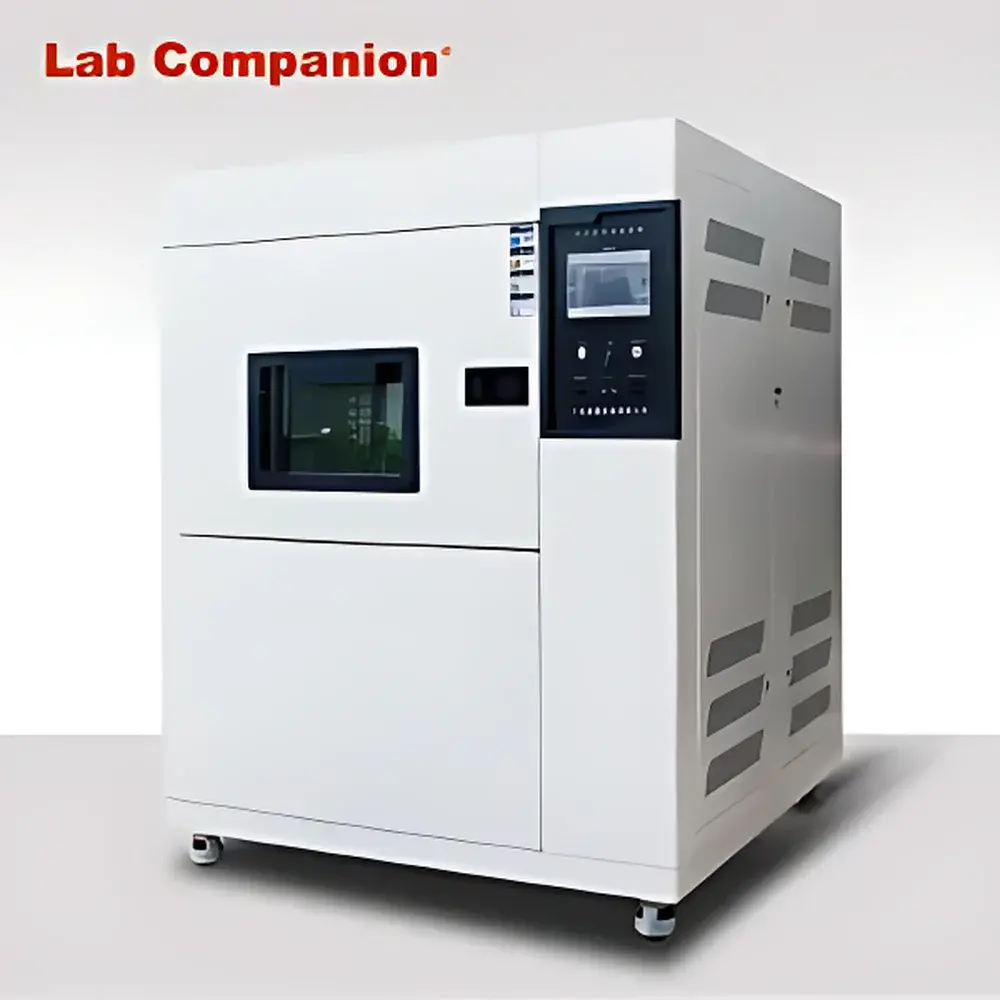
LabCompanion TS3-2 Exchange-Type Thermal Shock Test Chamber
| Brand | LabCompanion |
|---|---|
| Origin | Guangdong, China |
| Manufacturer Type | Direct Manufacturer |
| Product Origin | Domestic (China) |
| Model | TS3-2 |
| High-Temperature Range | +150 °C |
| Low-Temperature Range | −65 °C |
| Thermal Shock Range | −65 °C to +150 °C |
| Heating Rate | +60 °C to +200 °C ≤ 20 min |
| Cooling Rate | +20 °C to −75 °C ≤ 60 min |
Overview
The LabCompanion TS3-2 Exchange-Type Thermal Shock Test Chamber is an engineered environmental test system designed for rapid, repeatable thermal cycling between extreme high- and low-temperature zones without physical movement of the test specimen. Unlike basket-type (two-chamber) systems that rely on mechanical transfer, the TS3-2 employs a three-zone architecture—comprising separate, thermally isolated high-temperature, low-temperature, and test chambers—with controlled air exchange via high-efficiency pneumatic dampers and insulated ductwork. This exchange-type configuration eliminates mechanical stress from shuttle motion, reduces thermal inertia, and ensures precise dwell-time control at target extremes. The chamber operates on the principle of forced convection heat transfer using optimized airflow distribution and dual independent refrigeration/heating circuits, enabling strict compliance with thermal shock profiles defined in IEC 60068-2-14, MIL-STD-810H Method 503.7, and JESD22-A104D.
Key Features
- Three-chamber exchange architecture: Independent hot zone (+150 °C), cold zone (−65 °C), and ambient test chamber—eliminates specimen handling and mechanical wear
- Dual independent climate control: Separate high-efficiency refrigeration system (cascade-type, R404A/R23) and electric heating system (stainless steel sheathed heaters with PID modulation)
- Precise thermal transition performance: Achieves +60 °C to +200 °C ramp in ≤20 minutes; +20 °C to −75 °C in ≤60 minutes (measured per ASTM E1545-22 calibration protocol)
- Robust thermal insulation: 150 mm thick polyurethane foam (λ ≤ 0.022 W/m·K) with vacuum-deposited aluminum foil vapor barrier
- Programmable dwell time: Adjustable soak duration from 10 seconds to 999 hours per temperature extreme, with automatic transition sequencing
- Integrated safety interlocks: Over-temperature cutoff, refrigerant pressure monitoring, door open detection, and emergency power-off per IEC 61000-6-2/6-4 EMC requirements
Sample Compatibility & Compliance
The TS3-2 accommodates standard internal volumes of 36 L, 80 L, 150 L, and 225 L, with custom configurations available up to 8000 L upon engineering review. Specimen access is facilitated via double-gasketed, electrically latched insulated doors with viewing windows (tempered glass, anti-fog coating). All models meet ISO 17025 traceability requirements when calibrated using NIST-traceable PT100 sensors (Class A, ±0.15 °C accuracy). The system supports GLP/GMP-aligned validation protocols—including IQ/OQ/PQ documentation packages—and complies with FDA 21 CFR Part 11 for electronic record integrity when paired with optional audit-trail-enabled software.
Software & Data Management
Control is managed via the LabCompanion TSCore v4.2 embedded HMI, featuring a 10.1″ capacitive touchscreen with multi-language UI (English, German, Japanese, Korean). The system supports up to 99 programmable test profiles, each with 99 segments, including ramp/soak/handling steps. Real-time data logging records temperature at ≥1 Hz resolution across all three zones, with CSV export via USB or Ethernet. Optional TSCloud Connect module enables remote monitoring, alarm notification (email/SMS), and secure cloud backup compliant with ISO/IEC 27001. Full audit trail functionality—including user login history, parameter change logs, and calibration event tracking—is available for regulated environments requiring 21 CFR Part 11 compliance.
Applications
- Electronics reliability testing: Solder joint fatigue evaluation, PCB delamination screening, and IC package cracking analysis under repeated thermal expansion mismatch
- Aerospace component qualification: Testing avionics enclosures, sensor housings, and composite fasteners per DO-160 Section 24
- Automotive electronics validation: ECUs, battery management systems (BMS), and ADAS modules subjected to transient thermal loads simulating under-hood conditions
- Medical device sterilization cycle verification: Assessing material integrity of polymer housings and seals after repeated autoclave-like thermal excursions
- Materials science research: Characterizing coefficient of thermal expansion (CTE) discontinuities, phase transition hysteresis, and interfacial adhesion loss in multilayer thin-film structures
FAQ
What distinguishes the exchange-type (three-chamber) design from basket-type thermal shock chambers?
The TS3-2 uses controlled air transfer between isolated hot/cold reservoirs and the test chamber—no moving parts contact the specimen. This avoids mechanical shock, improves repeatability, and extends service life compared to shuttle-based systems.
Can the TS3-2 perform ramp-and-soak profiles with non-thermal variables (e.g., humidity or vibration)?
No—the TS3-2 is a dedicated thermal shock platform. For combined stress testing, LabCompanion’s THV series (temperature-humidity-vibration) or TC series (rapid temperature change with optional humidity) are recommended.
Is third-party calibration certification included with purchase?
Factory calibration with ISO/IEC 17025-accredited certificate is provided. On-site field calibration and annual revalidation services are available under separate service agreement.
What maintenance intervals are recommended for the refrigeration system?
Refrigerant oil analysis and filter-drier replacement every 24 months; full cascade system performance verification annually per manufacturer’s Maintenance Manual Rev. 3.1.
Does the system support custom test sequence scripting (e.g., Python or LabVIEW integration)?
Yes—via optional RS485/Modbus RTU or Ethernet/IP interface, enabling bidirectional communication with external control platforms for automated test orchestration.



