
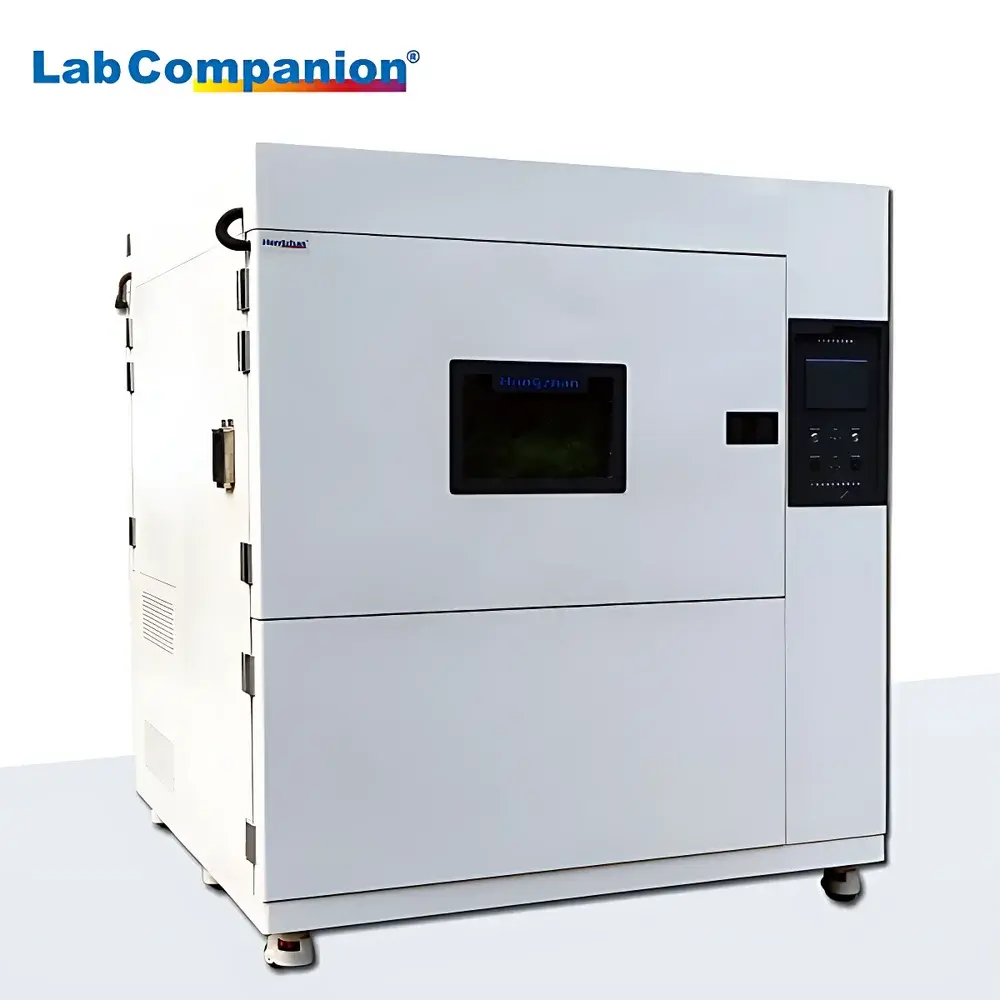
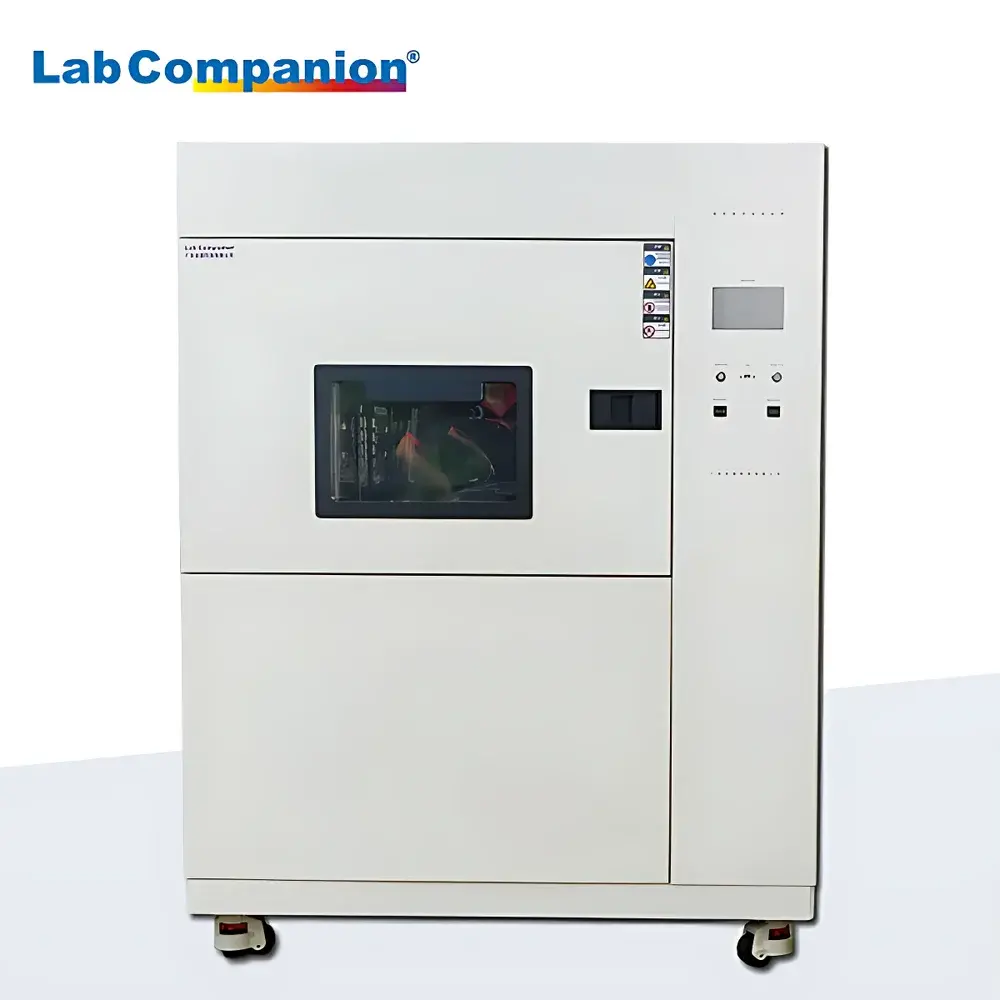
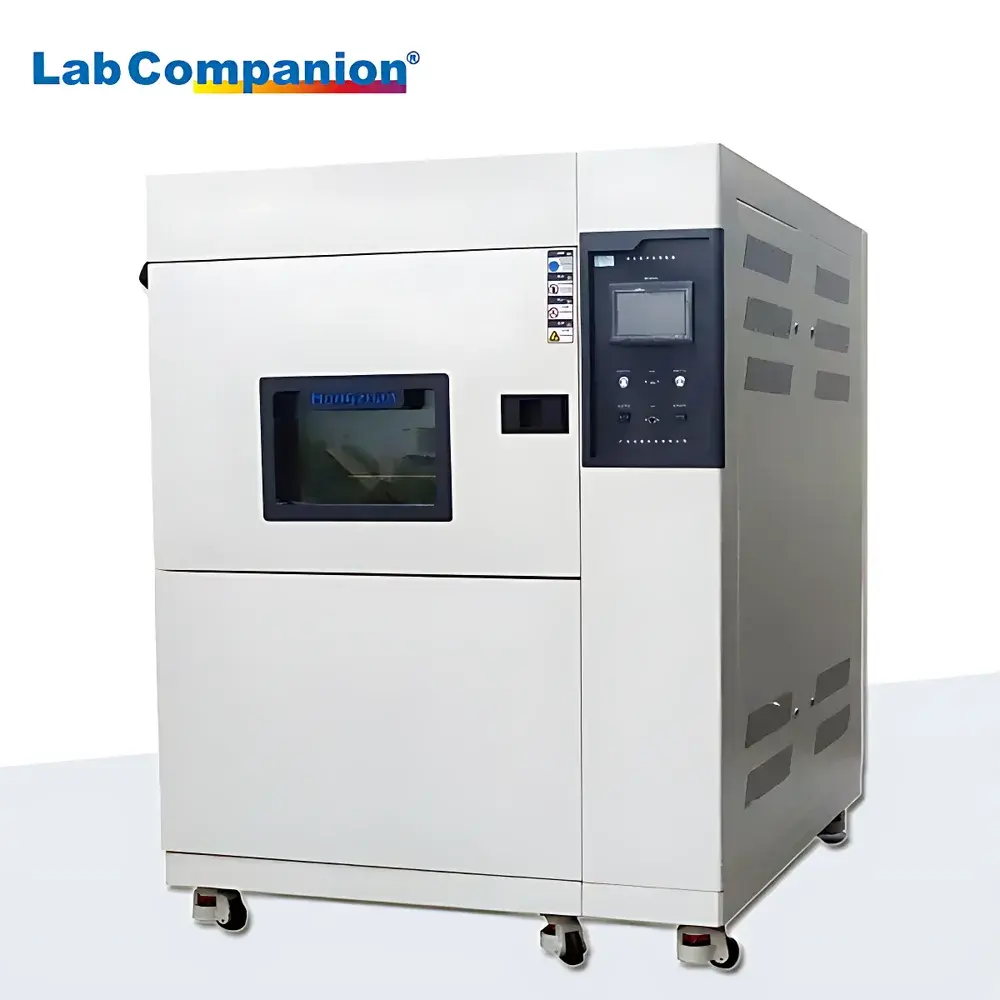
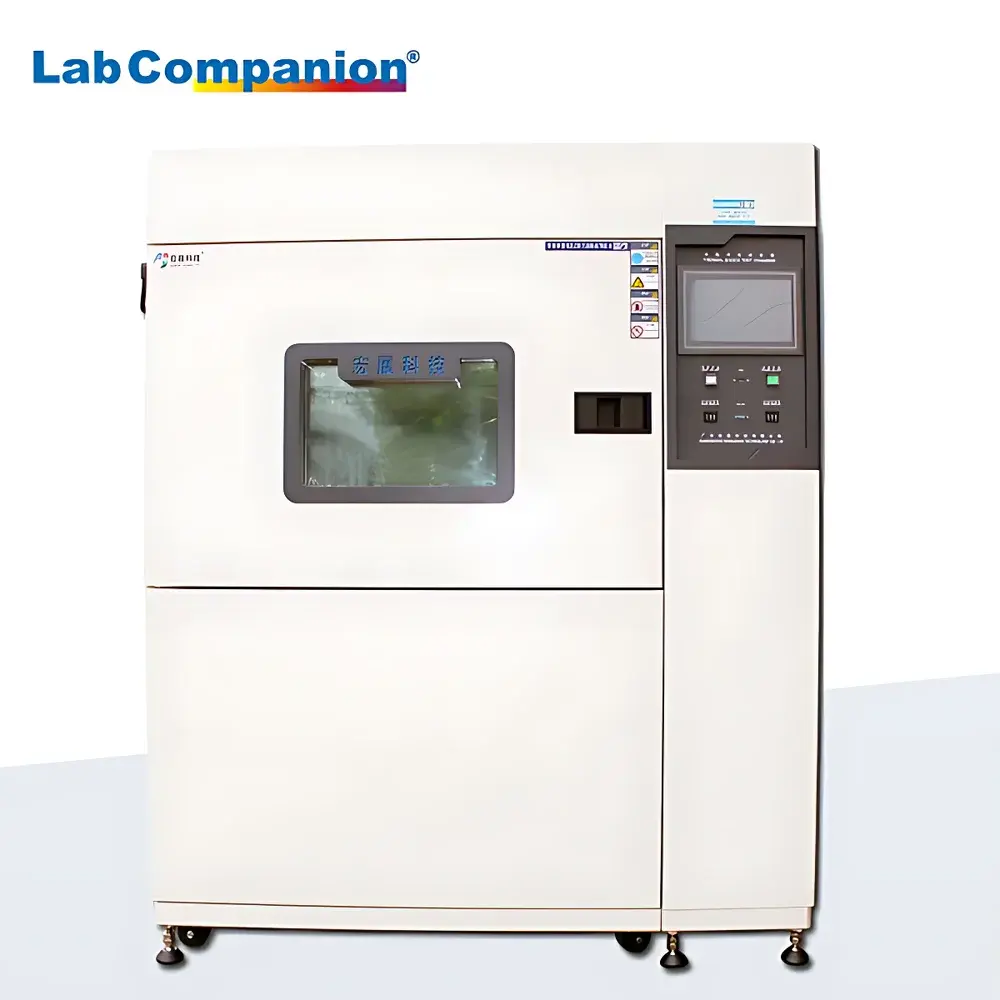
LabCompanion TSS-408W Thermal Shock Test Chamber
| Brand | LabCompanion |
|---|---|
| Origin | Guangdong, China |
| Manufacturer Type | Direct Manufacturer |
| Model | TSS-408W |
| High-Temperature Range | +60 °C to +200 °C |
| Low-Temperature Range | −78 °C to 0 °C |
| Thermal Shock Range | −65 °C to +150 °C |
| Temperature Stability | ±2 °C |
| Heating Rate | +60 °C to +200 °C ≤ 20 min |
| Cooling Rate | +20 °C to −75 °C ≤ 60 min |
Overview
The LabCompanion TSS-408W Thermal Shock Test Chamber is an engineered environmental test system designed for rapid, repeatable thermal cycling between extreme high- and low-temperature zones. It operates on a three-zone (hot chamber / cold chamber / test chamber) pneumatic door-switching architecture, enabling precise, high-fidelity simulation of thermal shock conditions encountered in aerospace component qualification, automotive electronics validation, and semiconductor packaging reliability testing. Unlike single-chamber ramp-based systems, the TSS-408W eliminates thermal inertia delays by physically transferring test specimens between pre-conditioned environments—ensuring true step-change temperature transitions with minimal overshoot or dwell deviation. Its core function is to accelerate failure mechanisms associated with coefficient-of-thermal-expansion (CTE) mismatch, interfacial delamination, solder joint fatigue, and hermetic seal integrity loss under accelerated life-cycle stress.
Key Features
- Three-zone independent thermal control architecture with pneumatically actuated transfer mechanism for sub-5-second specimen transfer between hot and cold chambers
- High-stability dual-refrigeration system: cascade refrigeration for low-temperature zone (−78 °C minimum), electric heating + forced convection for high-temperature zone (+200 °C maximum)
- Temperature uniformity maintained at ±2 °C across the full test volume (W850 × H600 × D800 mm internal dimensions) per IEC 60068-3-5
- Programmable thermal shock profiles supporting up to 999 cycles, with user-defined dwell times (1–999 minutes), transfer timing, and sequence logic
- Stainless-steel insulated chamber construction with double-glazed observation window, nitrogen purge port, and RS-485/Modbus RTU interface for factory automation integration
- Integrated safety interlocks including over-temperature cutoff, refrigerant pressure monitoring, door position verification, and emergency power-off circuit
Sample Compatibility & Compliance
The TSS-408W accommodates specimens up to 10 kg mass and 30 kg static load on its adjustable stainless-steel test rack. Compatible sample types include PCB assemblies, molded plastic IC packages (e.g., QFP, BGA), MEMS sensors, battery modules, and polymer-coated optical components. The chamber meets essential compliance requirements for reliability testing protocols defined in MIL-STD-810H Method 503.5 (Temperature Shock), JEDEC JESD22-A104F, IEC 60749-25, and AEC-Q200 stress verification. All temperature calibration points are traceable to NIST-certified reference standards, and system validation reports support GLP/GMP audit readiness per ISO/IEC 17025 guidelines.
Software & Data Management
Control and data acquisition are managed via the LabCompanion TCMS v3.2 software suite running on embedded industrial PC. The interface supports real-time multi-channel temperature logging (up to 8 external thermocouple inputs), automatic generation of test reports in PDF/CSV format, and configurable alarm thresholds with email/SNMP notification. Audit trail functionality complies with FDA 21 CFR Part 11 requirements, including electronic signature capture, operator login authentication, and immutable event logs covering parameter changes, door operations, and fault events. Historical datasets can be exported for Weibull analysis, Arrhenius modeling, or integration into enterprise LIMS platforms via OPC UA gateway.
Applications
- Qualification testing of avionics hardware per DO-160 Section 4.5 (Temperature Shock)
- Reliability screening of automotive ECUs exposed to under-hood thermal transients
- Failure mode analysis of lead-free solder joints in high-density PCBs
- Hermeticity validation of medical implant housings subjected to sterilization-to-body-temperature transitions
- Material compatibility assessment for cryogenic seals used in satellite payload enclosures
- Accelerated aging studies of lithium-ion battery cells under repeated charge/discharge thermal excursions
FAQ
What is the typical temperature recovery time after specimen transfer?
Temperature recovery to setpoint within the test chamber is verified at ≤5 minutes under standard conditions (ambient +25 °C, circulating coolant at +25 °C, using a 7.5 kg plastic-encapsulated IC as reference load), per IEC 60068-3-10.
Does the system support automated test sequencing with external triggers?
Yes—the TSS-408W includes digital I/O ports and Modbus TCP support for synchronization with external handlers, power supplies, or functional testers during HALT/HASS campaigns.
Is nitrogen purging capability included as standard?
A dedicated nitrogen inlet port with flow regulator and pressure gauge is provided; inert gas purging is optional but recommended for oxidation-sensitive samples such as bare copper substrates or thin-film resistors.
How is calibration maintained over long-term operation?
The system supports on-site verification using external Class I platinum RTDs; annual recalibration services—including sensor mapping, controller PID tuning, and mechanical door alignment—are available through LabCompanion’s global service network.
Can the chamber operate continuously for extended burn-in cycles?
Rated for continuous duty at any setpoint within its operational envelope; mean time between failures (MTBF) for critical subsystems exceeds 15,000 hours based on field reliability data from industrial customers in Asia and Europe.
Related Products



