
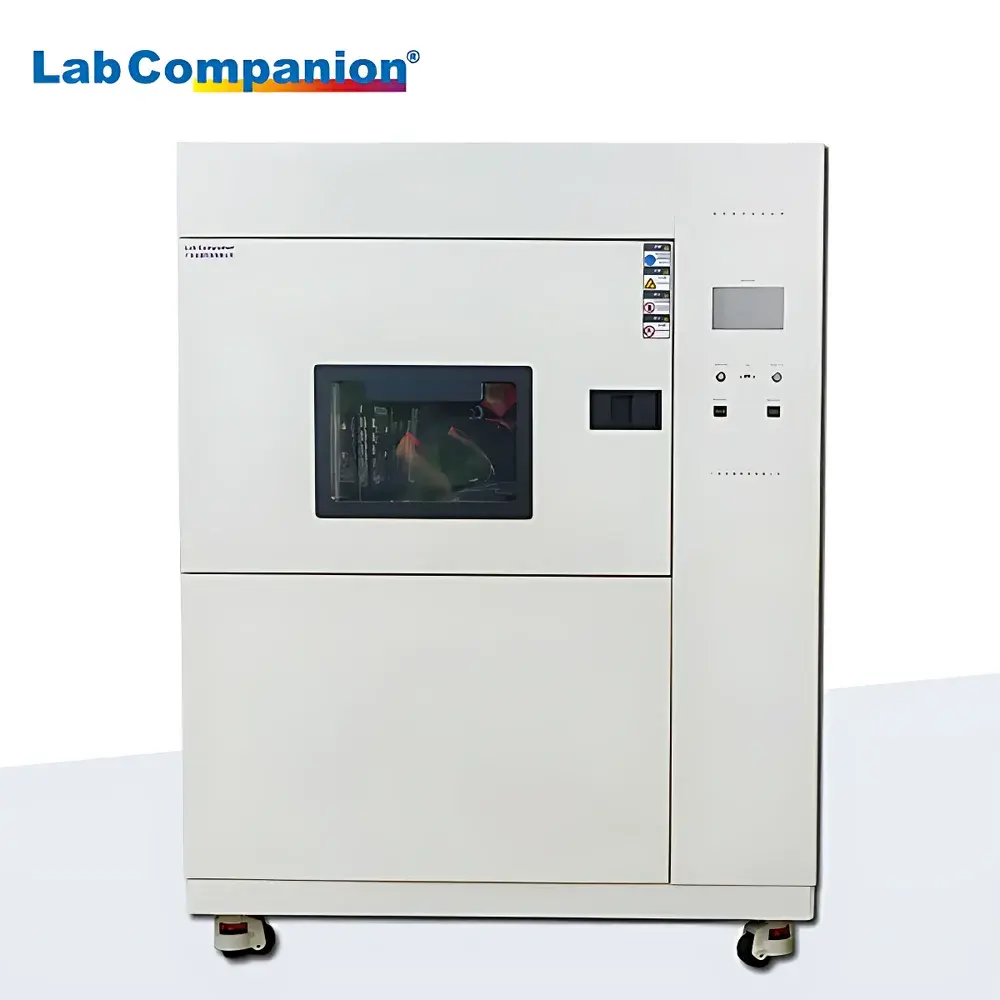
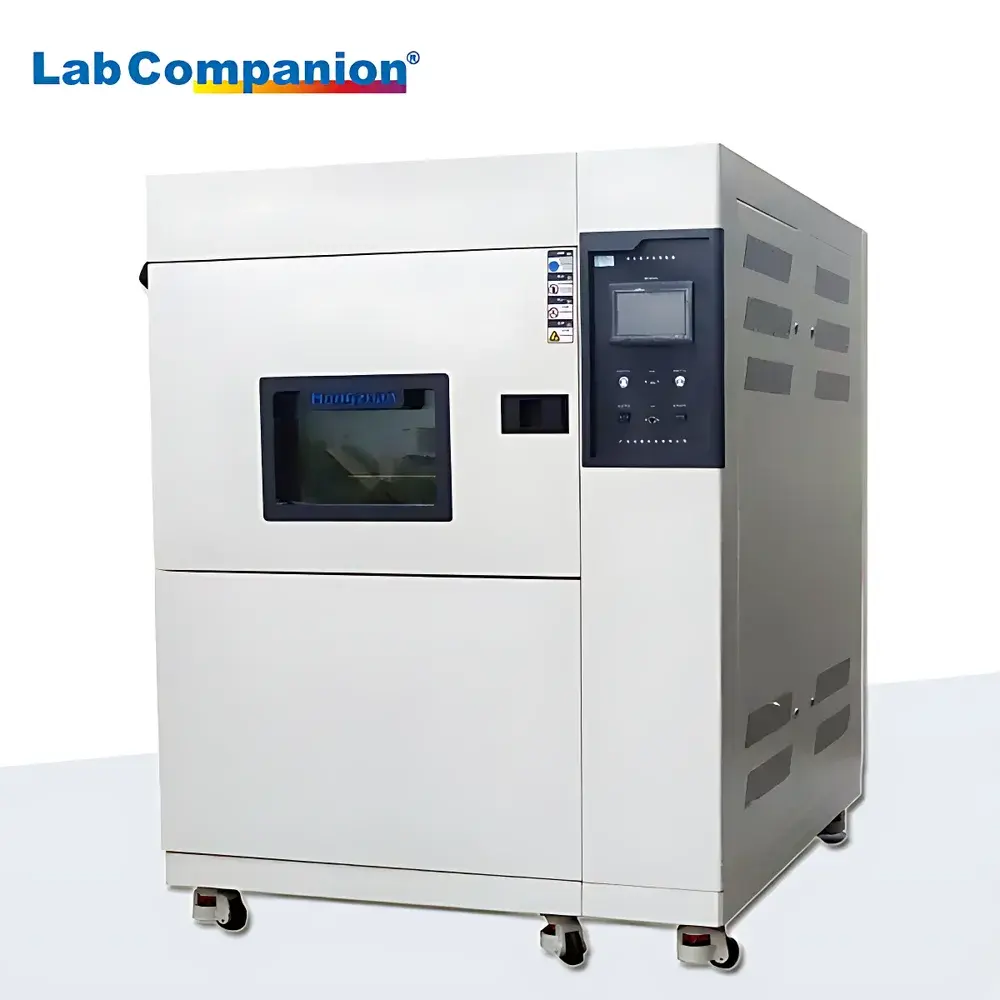
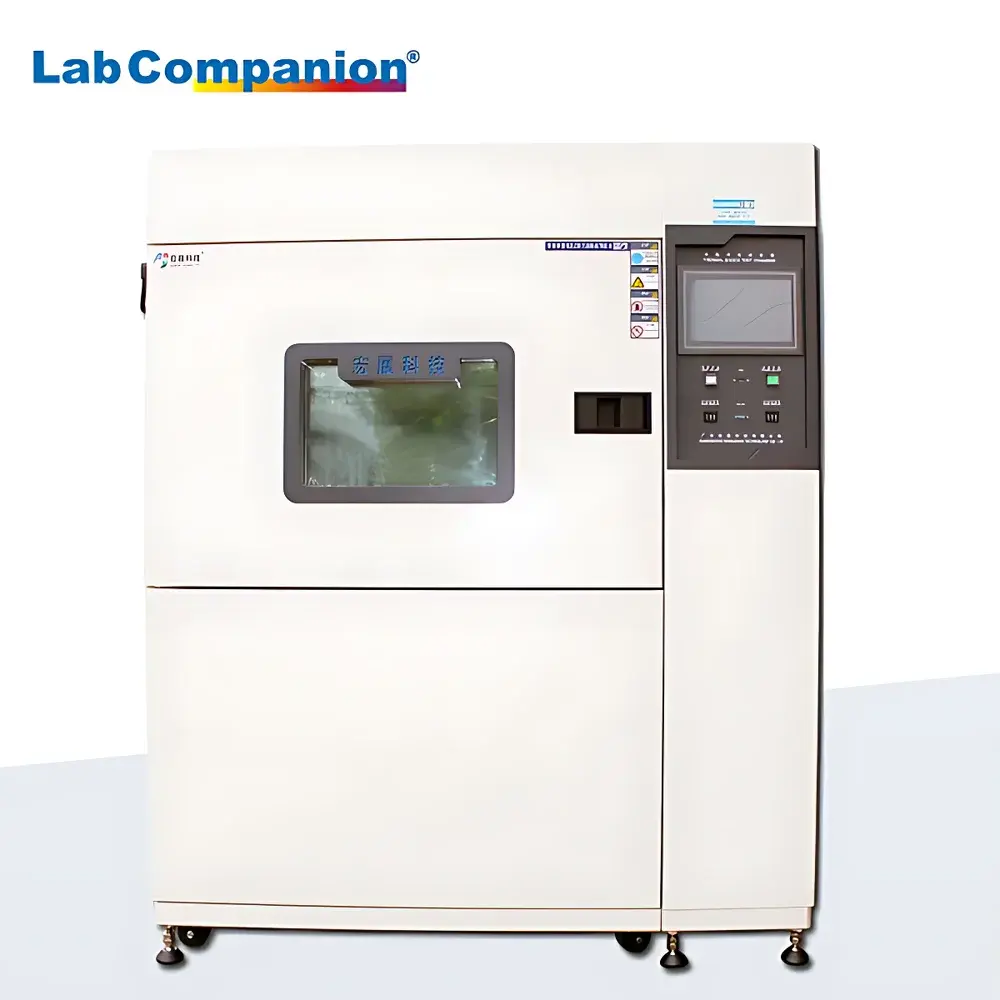
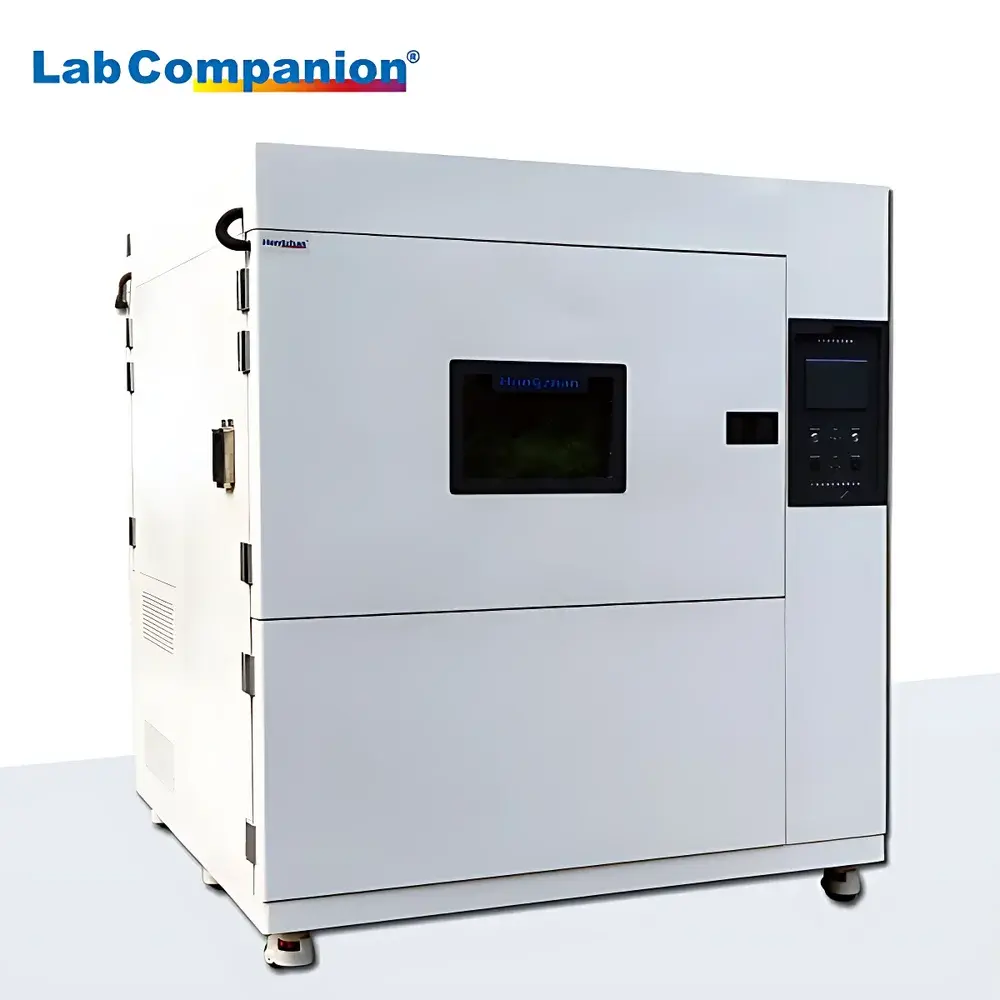
LabCompanion TSS-80W Compact Thermal Shock Test Chamber
| Brand | LabCompanion |
|---|---|
| Origin | Guangdong, China |
| Manufacturer Type | Direct Manufacturer |
| Model | TSS-80W |
| High-Temperature Range | +60 °C to +200 °C |
| Low-Temperature Range | −78 °C to 0 °C |
| Thermal Shock Range | −65 °C to +150 °C |
| Temperature Stability | ±2 °C |
| Heating Rate | +60 °C to −200 °C ≤ 20 min |
| Cooling Rate | +20 °C to −75 °C ≤ 60 min |
Overview
The LabCompanion TSS-80W Compact Thermal Shock Test Chamber is an engineered solution for accelerated reliability assessment of electronic components, PCB assemblies, automotive sensors, and polymer-based packaging under rapid, repetitive temperature transitions. It operates on a two-zone pneumatic door-switching architecture—comprising independent high-temperature and low-temperature chambers—to subject test specimens to controlled, high-fidelity thermal cycling between extreme setpoints. Unlike single-chamber ramp-based systems, this design eliminates thermal mass interference, enabling precise dwell-time control at each extreme and minimizing transition overshoot or lag. The chamber supports standardized thermal shock profiles per MIL-STD-810H Method 503.5, JEDEC JESD22-A104F, and IEC 60068-2-14, making it suitable for qualification testing in R&D labs, quality assurance departments, and contract manufacturing organizations requiring GLP-compliant environmental stress screening.
Key Features
- Compact footprint (1460 × 1840 × 1500 mm external) optimized for space-constrained laboratories without compromising internal test volume (500 × 400 × 400 mm).
- Dual independent chamber system with pneumatically actuated insulated doors ensures <5-minute temperature recovery time after specimen transfer—critical for maintaining profile fidelity per ASTM E1545 and ISO 16750-4.
- High-temperature chamber calibrated to +60 °C to +200 °C with heating rate of ≤20 minutes from +60 °C to +200 °C; low-temperature chamber rated from −78 °C to 0 °C using cascade refrigeration, achieving −65 °C to +150 °C operational shock range.
- Temperature uniformity maintained within ±2 °C across the working volume during steady-state dwell, verified per IEC 60068-3-5 and supported by NIST-traceable sensor calibration documentation.
- Stainless-steel interior construction (SUS304), reinforced insulation (polyurethane foam, 150 mm thick), and leak-tested chamber seals ensure long-term thermal integrity and resistance to condensation-induced corrosion.
- Integrated safety interlocks include over-temperature cutoff, refrigerant pressure monitoring, door position verification, and emergency power-off—fully compliant with EN 61000-6-2/6-4 EMC and UL 61010-1 electrical safety requirements.
Sample Compatibility & Compliance
The TSS-80W accommodates specimens up to 7.5 kg with a maximum dimensional envelope of 450 × 350 × 350 mm. Its standard test rack supports up to 30 kg static load, facilitating multi-unit parallel testing of IC packages, LED modules, MEMS devices, and molded interconnect devices (MIDs). The chamber meets essential regulatory expectations for pre-compliance screening: temperature logging accuracy aligns with FDA 21 CFR Part 11 data integrity requirements when paired with optional audit-trail-enabled software; test records are exportable in CSV and PDF formats for inclusion in ISO 9001:2015 or IATF 16949 audit dossiers. All thermal shock protocols can be mapped to JEDEC A113D, IPC-9701A, and AEC-Q200 stress categories for automotive-grade component validation.
Software & Data Management
The embedded controller features a 7-inch capacitive touchscreen HMI with intuitive profile programming (up to 99 segments, 99 cycles), real-time graphing of chamber temperatures, and event-triggered alarm logging. Optional PC-based LabCompanion ThermalSuite™ software enables remote monitoring via Ethernet/Wi-Fi, automated report generation (including pass/fail status per cycle), and integration with LIMS platforms through OPC UA or Modbus TCP. All temperature data points are timestamped with millisecond resolution and stored internally for ≥30 days—supporting full traceability required under GLP and GMP environments. Calibration history, maintenance logs, and user access permissions are auditable and exportable.
Applications
- Qualification of solder joint integrity in lead-free BGA and QFN packages under repeated thermal expansion mismatch stress.
- Evaluation of delamination resistance in chip-scale packages (CSP) and fan-out wafer-level packages (FO-WLP).
- Reliability screening of EV battery management system (BMS) sensors exposed to under-hood thermal transients.
- Material compatibility testing of conformal coatings, potting compounds, and adhesive bonds used in aerospace avionics enclosures.
- Process validation of reflow soldering profiles against post-reflow thermal shock survivability thresholds.
FAQ
What is the minimum specimen weight required to avoid thermal loading artifacts during shock cycling?
No minimum weight is specified; however, specimens below 100 g should be mounted on a thermally massive aluminum carrier to stabilize thermal response and ensure representative dwell-time accuracy.
Can the TSS-80W perform three-zone thermal shock testing?
No—the TSS-80W is configured exclusively as a two-zone (hot/cold) pneumatic-switch system. Three-zone configurations (e.g., TSS-150 and above) are available under separate model numbers.
Is nitrogen purge capability integrated or optional?
Nitrogen purging is not factory-integrated but can be added via external manifold connection (DN15 interface provided); custom inert-atmosphere versions require formal engineering review.
Does the chamber support programmable ramp rates within the shock transition phase?
Transition is governed by mechanical door actuation speed and chamber thermal inertia—not variable ramp control. Profile compliance relies on fixed-rate switching per JEDEC and MIL-STD definitions.
How frequently must the system undergo preventive maintenance?
Compressor oil and refrigerant filter replacement is recommended every 24 months; door seal inspection and temperature sensor verification are scheduled quarterly per the included Maintenance Logbook and ISO/IEC 17025-aligned service checklist.
Related Products



