
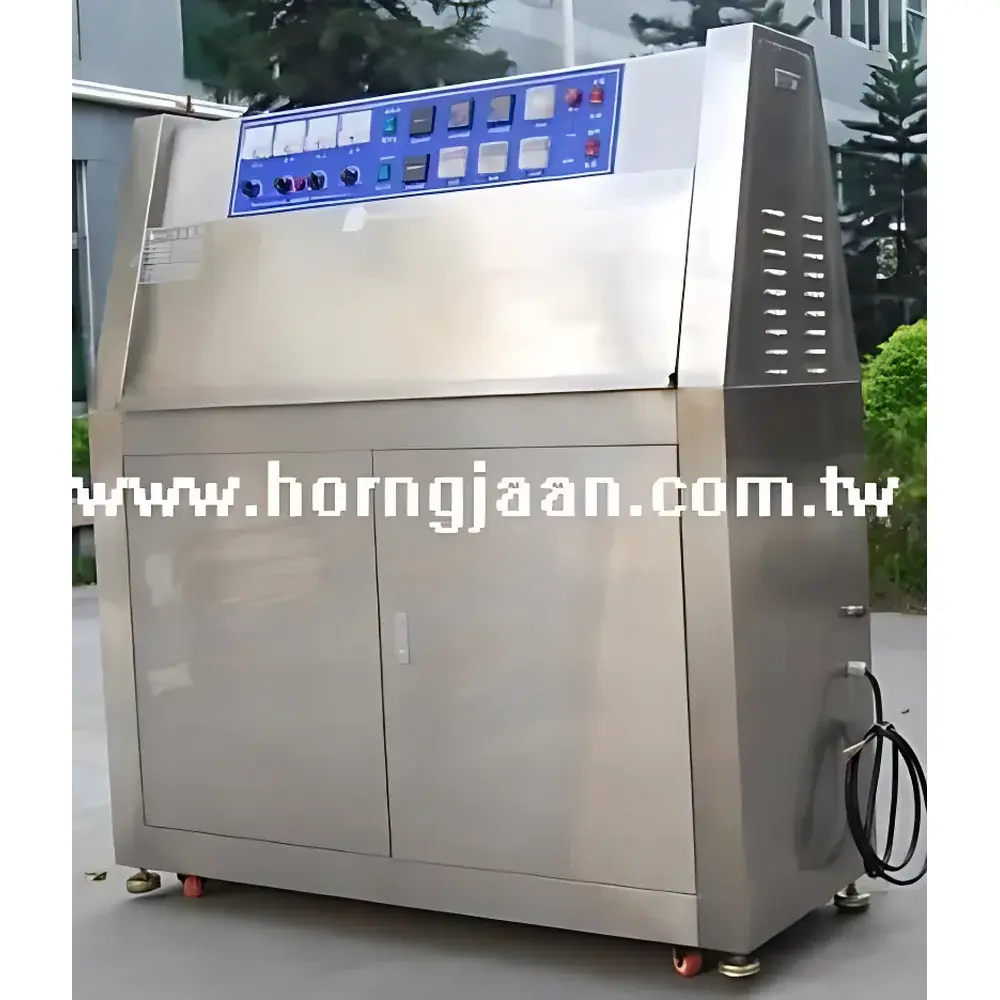
LabCompanion UV3 UV Aging Test Chamber
| Brand | LabCompanion |
|---|---|
| Origin | Guangdong, China |
| Manufacturer Type | Direct Manufacturer |
| Product Category | Domestic |
| Model | UV3 |
| Pricing | Upon Request |
| Temperature Range | RT+10 to 70 °C |
| Humidity Range | >90% RH |
| Sample-to-Lamp Distance | 50 ± 2 mm |
| Lamp Center-to-Center Spacing | 70 mm |
| Irradiance | UVA-340 @ 0.68 W/m², UVB-313 @ 0.60 W/m² |
| Interior Dimensions | 1170 × 450 × 500 mm (W×D×H) |
| Exterior Dimensions | 1300 × 550 × 1380 mm (W×D×H) |
| Construction | Stainless Steel Inner/Outer Chambers, Aluminum Frame Sample Holder |
| Control System | Intelligent Digital Controller with AI-PID Regulation, Dual-Mode (On/Off + Adaptive) |
| Safety Protections | Overcurrent, Ground Fault, Overtemperature, Low-Water, Compressor Overpressure |
| Compliance Standards | GB/T 16422.3–1997, ASTM G53–88, GB/T 14522–93 |
| Optional | UV Irradiance Sensor with Real-Time Feedback and Automatic Lamp Power Compensation |
Overview
The LabCompanion UV3 UV Aging Test Chamber is an engineered environmental test system designed for accelerated photochemical degradation assessment of polymeric, coating, and elastomeric materials under controlled ultraviolet (UV) irradiation, condensation, and thermal cycling. It operates on the principle of fluorescent UV lamp exposure—leveraging the high photon energy of short-wavelength UV radiation (295–400 nm) to replicate the dominant photo-oxidative mechanisms observed in natural outdoor weathering. Unlike full-spectrum solar simulators, the UV3 focuses exclusively on the most damaging spectral region of sunlight: the UV-B (280–315 nm) and UV-A (315–400 nm) bands. This targeted approach enables reproducible, time-efficient evaluation of surface degradation phenomena—including chalking, gloss loss, color shift, microcracking, embrittlement, and delamination—without requiring excessive test duration or complex optical filtering.
Key Features
- Two selectable UV lamp configurations: UVA-340 lamps (peak emission at 340 nm), optimized for realistic simulation of terrestrial sunlight UV spectrum between 295–360 nm; or UVB-313 lamps (peak at 313 nm), delivering higher-energy irradiation for rapid, severe-accelerated testing.
- Precise irradiance control via optional calibrated UV radiometer—enables closed-loop feedback regulation to maintain setpoint irradiance despite lamp aging, voltage fluctuation, or quartz sleeve fouling.
- Condensation cycle mechanism replicates nocturnal dew formation through saturated humid air contact with cooled specimen backs—mimicking real-world moisture ingress without water spray or immersion.
- Stainless steel chamber construction (SUS304 interior and exterior) ensures long-term corrosion resistance and compliance with ISO 9001 manufacturing practices.
- Intelligent digital controller with AI-enhanced PID algorithm supports multi-segment programming, real-time data logging, and deviation alarm triggering for temperature, humidity, and irradiance parameters.
- Integrated safety architecture includes redundant overtemperature cutoff, ground-fault interruption, low-water level detection, compressor overpressure monitoring, and automatic power shutdown upon fault detection.
Sample Compatibility & Compliance
The UV3 accommodates flat-panel specimens up to 110 mm × 200 mm per position across its standard aluminum frame sample holder—designed for uniform exposure geometry and mechanical stability during thermal expansion cycles. The chamber meets the geometric and operational requirements of major international standards for UV exposure testing, including ASTM G53–88 (Standard Practice for Operating Fluorescent Ultraviolet (UV) and Condensation Exposure Apparatus for Polymer Testing), GB/T 16422.3–1997 (Plastics—Methods of Exposure to Laboratory Light Sources—Part 3: Fluorescent UV Lamps), and GB/T 14522–93 (Artificial Climate Accelerated Aging Test Methods for Plastics, Coatings and Rubber Used in Mechanical Industry Products). Its design supports GLP-aligned validation protocols, including IQ/OQ documentation packages and traceable calibration of irradiance sensors against NIST-traceable reference detectors.
Software & Data Management
While the base UV3 operates via embedded front-panel controller, optional RS485/Modbus RTU interface enables integration into centralized laboratory data acquisition systems. Logged parameters—including chamber temperature, black panel temperature (BPT), relative humidity, cumulative UV dose (J/m²), and irradiance setpoint deviation—are timestamped and exportable as CSV files. The controller firmware supports audit trail functionality compliant with FDA 21 CFR Part 11 requirements when paired with validated third-party software platforms. All calibration events, alarm logs, and user-access records are retained with immutable timestamps—facilitating regulatory inspections and internal quality audits.
Applications
- Formulation screening of UV stabilizers, HALS additives, and pigment systems in automotive clearcoats and architectural coatings.
- Comparative durability ranking of thermoplastic elastomers (TPEs), PVC compounds, and polyolefin blends used in outdoor infrastructure components.
- Pre-certification aging verification for medical device polymer housings subject to ISO 10993–12 biocompatibility evaluation pathways.
- Root-cause analysis of field failures linked to photo-oxidative chain scission, evidenced by FTIR carbonyl index growth or tensile strength retention curves.
- Development of weather-resistant adhesives and sealants where interfacial delamination under UV/humidity stress is a critical failure mode.
FAQ
What is the primary difference between UVA-340 and UVB-313 lamp configurations?
UVA-340 lamps emit a spectral output closely matching natural sunlight down to 295 nm, making them suitable for realistic outdoor durability prediction. UVB-313 lamps emit shorter-wavelength UV with higher quantum efficiency, enabling faster degradation but potentially introducing non-representative failure modes.
Does the UV3 support black panel temperature (BPT) monitoring?
Yes—the standard configuration includes a calibrated black panel sensor mounted adjacent to the sample plane, providing direct measurement of radiant heating effects critical for ASTM G154 compliance.
Can the UV3 be validated for GMP/GLP environments?
Yes—when equipped with optional irradiance sensor, data logger, and electronic signature-capable software, the system supports full IQ/OQ/PQ execution and 21 CFR Part 11-compliant record retention.
Is condensation cycle timing programmable?
Yes—the controller allows independent setting of UV exposure duration, condensation hold time, and transition ramp rates between phases, supporting custom test profiles beyond standard cycles.
What maintenance intervals are recommended for UV lamp replacement?
Lamp life is typically 1,600–2,000 hours under continuous operation; however, irradiance decay should be monitored using the optional sensor, and replacement triggered when output falls below 90% of initial calibrated value.



