
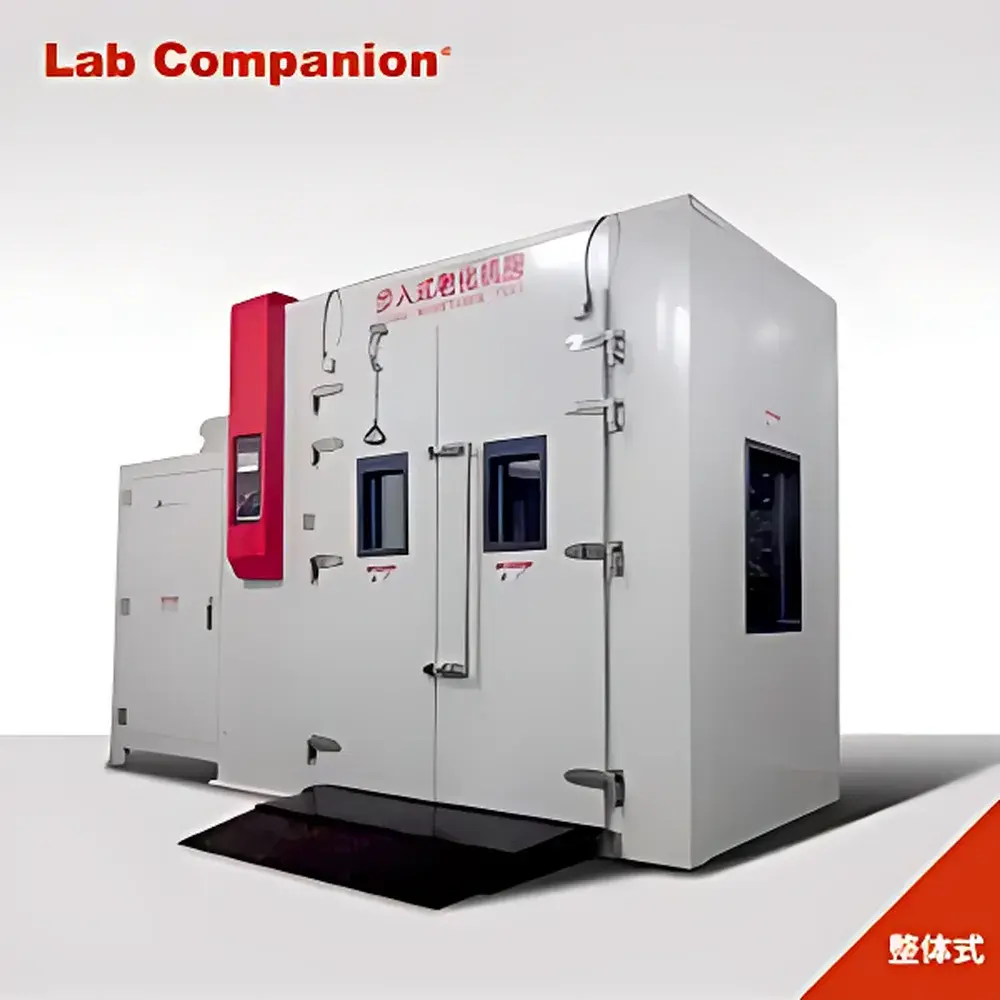
LabCompanion Walk-In Environmental Test Chamber
| Brand | LabCompanion |
|---|---|
| Origin | Guangdong, China |
| Manufacturer Type | OEM Manufacturer |
| Product Category | Domestic |
| Model | Walk-In Environmental Test Chamber |
| Price | Upon Request |
| Temperature Range | −70 °C to +200 °C (optional up to +250 °C) |
| Refrigeration Method | Compressor-Based Cooling |
| Explosion-Proof Option | Standard (Non-Explosion-Proof) |
| Temperature Fluctuation | ±0.5 °C |
| Temperature Uniformity | ±2.0 °C |
| Temperature Deviation | ±2.0 °C |
Overview
The LabCompanion Walk-In Environmental Test Chamber is a large-volume, floor-standing climate simulation system engineered for precision thermal and humidity conditioning of full-scale products, assemblies, and systems. Designed according to fundamental principles of convective heat transfer, forced-air circulation, and psychrometric control, it enables stable, repeatable exposure to extreme ambient conditions—spanning cryogenic cooling to high-temperature baking—within a fully accessible, operator-safe workspace. Unlike benchtop chambers, this walk-in architecture eliminates spatial constraints, supporting testing of complete automotive powertrains, server racks, medical imaging devices, aerospace avionics enclosures, and pharmaceutical storage pallets under controlled, traceable environmental stress. Its structural integrity, thermal insulation performance, and closed-loop PID/PLC-based control architecture comply with the physical and operational requirements defined in IEC 60068-3-5, ISO 16750-4, and MIL-STD-810H for environmental stress screening (ESS) and reliability qualification.
Key Features
- Modular or monolithic welded construction options—customizable from 4 m³ to 260 m³ internal volume
- High-efficiency compressor refrigeration system with 0–100% variable capacity modulation, reducing energy consumption by up to 30% versus conventional heater-balanced control
- Double-wall insulated chamber walls using either high-density polyurethane foam or hybrid insulation (centrifugal glass fiber + polyurethane), achieving thermal conductivity ≤0.022 W/(m·K)
- Interior chamber constructed from SUS304 stainless steel for corrosion resistance, thermal fatigue endurance, and long-term dimensional stability
- Heavy-duty silicone rubber door gasket with dual-seal design, ensuring air-tight closure and minimizing thermal leakage at temperature extremes
- Large-area, double-glazed, electrically heated observation window with anti-frost functionality and integrated LED interior lighting
- Standard safety protections: motor overcurrent/overheat cutoff, heater short-circuit protection, refrigerant high-pressure shutdown, and emergency stop circuitry
- Eco-friendly R404A or R507A refrigerant (subject to regional phase-out timelines per EU F-Gas Regulation and EPA SNAP program)
Sample Compatibility & Compliance
The chamber accommodates test specimens ranging from individual PCBs mounted on thermal plates to fully assembled electric vehicles (EVs) and industrial control cabinets. It supports static and dynamic thermal cycling, steady-state temperature soak, and combined temperature–humidity profiles—including constant and cyclic湿热 per GB/T 2423.3–2006 and GB/T 2423.4–2008. The system meets national and international standards including GB/T 10592–2008 (High/Low Temperature Chambers), GB/T 10586–2006 (Damp Heat Chambers), GJB 150.3A–2009 (Military High-Temperature Testing), GJB 150.4A–2009 (Military Low-Temperature Testing), and GJB 150.9A–2009 (Military Damp Heat Testing). Optional validation packages support IQ/OQ documentation aligned with GLP and GMP environments, including calibration traceability to NIM (National Institute of Metrology, China) and uncertainty budgets compliant with ISO/IEC 17025.
Software & Data Management
Equipped with an embedded PLC-based controller featuring a 10.1″ capacitive touchscreen HMI, the system delivers intuitive programming of multi-step temperature/humidity ramps, dwells, and cycles. Proprietary LabCompanion Control Suite v3.2 supports local USB data export, Ethernet TCP/IP communication (Modbus TCP, BACnet MS/TP), and optional LAN-based remote monitoring via web browser. Real-time logging records ≥16 user-defined channels—including chamber setpoint, actual temperature/humidity at multiple spatial points, and surface thermocouple inputs—with timestamped CSV output. Audit trail functionality complies with FDA 21 CFR Part 11 requirements when configured with user role management, electronic signatures, and immutable log archiving. SMS alerting (via GSM module) notifies designated personnel upon deviation alarms, door-open events, or system faults.
Applications
- Automotive: Whole-vehicle thermal soak testing, battery pack thermal runaway evaluation, HVAC system validation under desert and arctic profiles
- Electronics: Burn-in screening of server chassis, ESD susceptibility assessment under low-RH conditions, solder joint reliability under thermal cycling
- Pharmaceuticals & Biologics: Stability chamber qualification per ICH Q1, accelerated aging studies for packaging integrity, cold-chain logistics simulation
- Energy Infrastructure: Grid-scale battery energy storage system (BESS) thermal management validation, transformer oil aging under thermal stress
- Aerospace & Defense: Avionics box qualification per DO-160 Section 4 (Temperature), radar antenna enclosure environmental survivability testing
- Academic Research: Material science studies on polymer creep behavior, composite curing kinetics, and phase-change material (PCM) thermal hysteresis
FAQ
What is the maximum internal volume available for custom walk-in chambers?
Standard configurations range from 4 m³ to 260 m³; non-standard volumes are supported through structural re-engineering and thermal load recalibration.
Can the chamber be upgraded to include humidity control?
Yes—models designated as “Walk-In Environmental Test Chamber (Temperature & Humidity)” integrate steam humidification and dehumidification subsystems, supporting 30–98% RH at temperatures between +10 °C and +85 °C.
Is remote access and centralized fleet monitoring supported?
Via optional LabCompanion Central Monitoring System (LCMS), up to 64 chambers can be supervised from a single dashboard with alarm aggregation, predictive maintenance alerts, and historical trend analysis.
How is temperature uniformity validated during factory acceptance testing (FAT)?
Per ISO 16750-4 Annex B, 9-point sensor mapping is performed across three horizontal planes at 25%, 50%, and 75% height; uniformity is reported as peak-to-peak deviation within ±2.0 °C at steady state.
Does the system support third-party calibration and certification services?
Yes—LabCompanion partners with CNAS-accredited calibration laboratories for on-site verification, certificate issuance, and uncertainty reporting conforming to JJF 1101–2019 and ISO/IEC 17025.



