
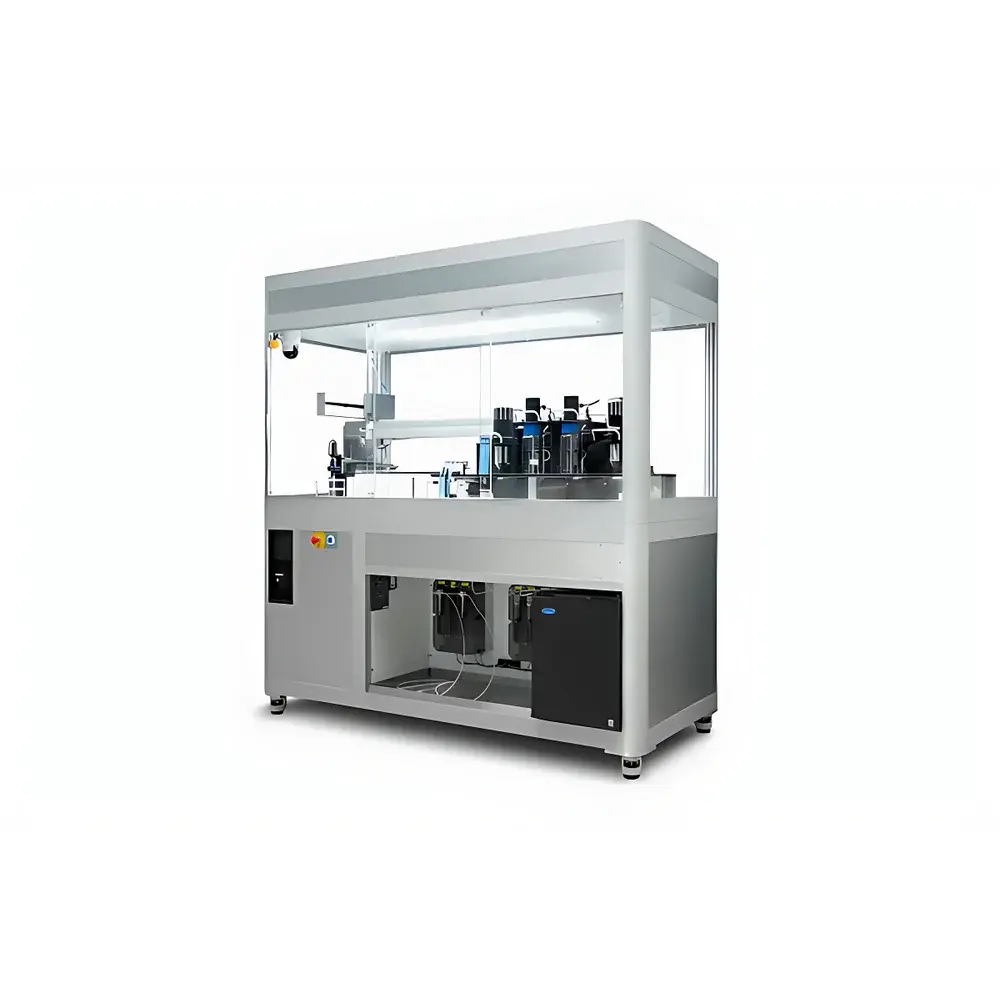
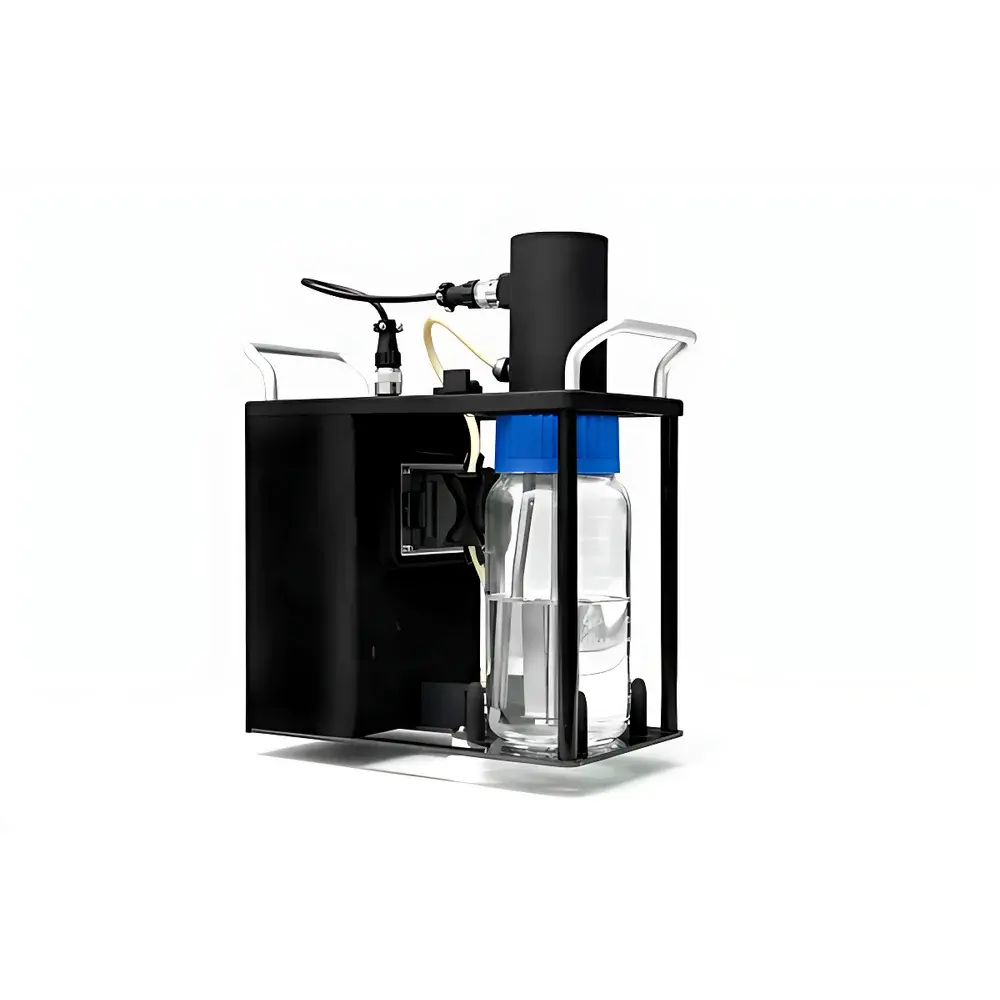
Labman AutoLiquid-Powder Dispensing System
| Brand | Labman |
|---|---|
| Origin | United Kingdom |
| Manufacturer Type | Authorized Distributor |
| Origin Category | Imported |
| Model | AutoLiquid-Powder Dispensing System |
| Price Range | USD 260,000 – 390,000 (converted at ~1:0.77) |
| Capacity | 45 × 50 mL centrifuge tubes |
| Dispensing Accuracy | ±1 mg (powder & liquid) |
| pH Measurement Range | 0–14 pH, ±0.01 resolution |
| pH Adjustment Precision | ≥1 µL acid/base delivery via syringe pumps |
| Temperature Measurement | −5 to 105 °C, ±0.1 °C |
| Conductivity Range | 10–200 mS/cm |
| Mixing | Integrated magnetic stirring during dispensing and pH adjustment |
| Calibration | Automated weight-based tare calibration and pH electrode 2-/3-point calibration |
| Cleaning | Automated probe rinse cycles for pH and conductivity sensors |
| Powder Feed Options | Dual-feed module (vibratory feeder for fine powders |
| Liquid Delivery | 3 peristaltic pumps + 3 syringe pumps |
| Cycle Time | Full 45-formulation workflow (dispense, mix, pH/conductivity monitoring, adjustment, capping) completed in ≤8 hours |
Overview
The Labman AutoLiquid-Powder Dispensing System is a fully integrated, benchtop-scale sample preparation workstation engineered for high-precision formulation development in regulated and research-intensive laboratories. Built upon Labman Automation Ltd.’s four-decade heritage in laboratory robotics, the system implements gravimetric dispensing (via high-resolution analytical balance integration), real-time electrochemical monitoring (pH and conductivity), and closed-loop feedback control to execute reproducible multi-step protocols. Its core architecture follows Good Laboratory Practice (GLP) and supports alignment with ISO/IEC 17025 method validation requirements. Designed for iterative experimental design—such as DoE (Design of Experiments) or QbD (Quality by Design) workflows—the system enables unattended preparation of 45 discrete formulations within an 8-hour shift, including solid/liquid mass dosing, homogenization, physicochemical stabilization, and endpoint verification.
Key Features
- Gravimetric dispensing with ±1 mg accuracy for both powder and liquid components, using loss-in-weight methodology synchronized with balance telemetry.
- Dual-mode powder handling: interchangeable vibratory feeders (for cohesive, micronized solids) and screw-driven auger feeders (for free-flowing granules or crystals), each with adjustable feed rate and jam-detection logic.
- Redundant liquid delivery architecture: three digitally controlled peristaltic pumps (for bulk solvents or buffers) and three high-precision syringe pumps (for sub-microliter acid/base titrant addition during pH fine-tuning).
- Integrated electrochemical monitoring suite: calibrated pH electrodes (glass-bodied, refillable, temperature-compensated) and conductivity probes (four-electrode cell, platinum black-coated), both equipped with automated rinse-and-dry sequences between samples.
- Real-time process control: dynamic pH adjustment triggered only after conductivity stabilizes (±2% over 30 s), ensuring ionic equilibrium prior to measurement—critical for buffer systems and colloidal dispersions.
- Modular mechanical platform: standardized tube rack interface (45-position, ANSI/SLAS-compliant 50 mL centrifuge tube footprint), motorized capping station, and programmable magnetic stirrer with variable speed (100–1200 rpm) and thermal feedback.
Sample Compatibility & Compliance
The system accommodates aqueous, organic, and mixed-solvent formulations across pH 0–14 and conductivity ranges from 10 to 200 mS/cm—covering applications from pharmaceutical salt screening to agrochemical emulsion optimization. All wetted parts comply with USP Class VI biocompatibility standards; fluid paths are constructed from PTFE, PEEK, and borosilicate glass. The system’s operational logs—including timestamped mass readings, pH/conductivity values, pump actuation events, and calibration records—are stored in tamper-evident binary format with SHA-256 hashing, supporting audit readiness under FDA 21 CFR Part 11 and EU Annex 11. Optional IQ/OQ documentation packages are available for GMP environments.
Software & Data Management
Controlled via Labman’s proprietary LAMS (Labman Automation Management Suite), the system runs on a Windows 10 IoT Enterprise OS with role-based access control (RBAC), electronic signature support, and full audit trail functionality. Protocols are defined using a drag-and-drop workflow editor with conditional branching (e.g., “if pH 7.2, dispense 1.8 µL 1M NaOH”). Raw sensor data, balance outputs, and actuator commands are exported in CSV and HDF5 formats, compatible with MATLAB, Python (Pandas/NumPy), and commercial statistical analysis platforms. Data backups are performed hourly to network-attached storage (NAS) with AES-256 encryption.
Applications
- Pharmaceutical preformulation: excipient compatibility screening, buffer optimization, and solubility mapping across pH gradients.
- Materials science: synthesis of metal-organic frameworks (MOFs), polymer dispersion stability testing, and catalyst precursor blending.
- Food & beverage R&D: flavor matrix balancing, preservative efficacy testing, and viscosity modifier titration.
- Environmental analytics: standard preparation for ICP-MS and ion chromatography, including matrix-matched calibration standards with trace-level acidification.
- Biotechnology: cell culture media component optimization, lyophilization buffer development, and transfection reagent formulation.
FAQ
What regulatory standards does the system support for data integrity?
It complies with ALCOA+ principles (Attributable, Legible, Contemporaneous, Original, Accurate, Complete, Consistent, Enduring, Available) and provides full 21 CFR Part 11 compliance when configured with digital signature modules and secure audit trails.
Can the system handle hygroscopic or air-sensitive powders?
Yes—optional inert-gas purged powder hoppers and sealed dispensing chutes are available to maintain argon or nitrogen atmospheres during transfer.
Is remote monitoring and troubleshooting supported?
The system includes embedded VNC server and TLS-encrypted REST API endpoints for secure remote status polling, log retrieval, and emergency protocol pause/resume—without requiring direct network exposure.
How is maintenance and calibration traceability managed?
All calibrations (mass, pH, temperature, conductivity) are logged with operator ID, reference standard IDs (NIST-traceable where applicable), environmental conditions, and pass/fail flags—automatically archived with version-controlled protocol definitions.
Related Products



