
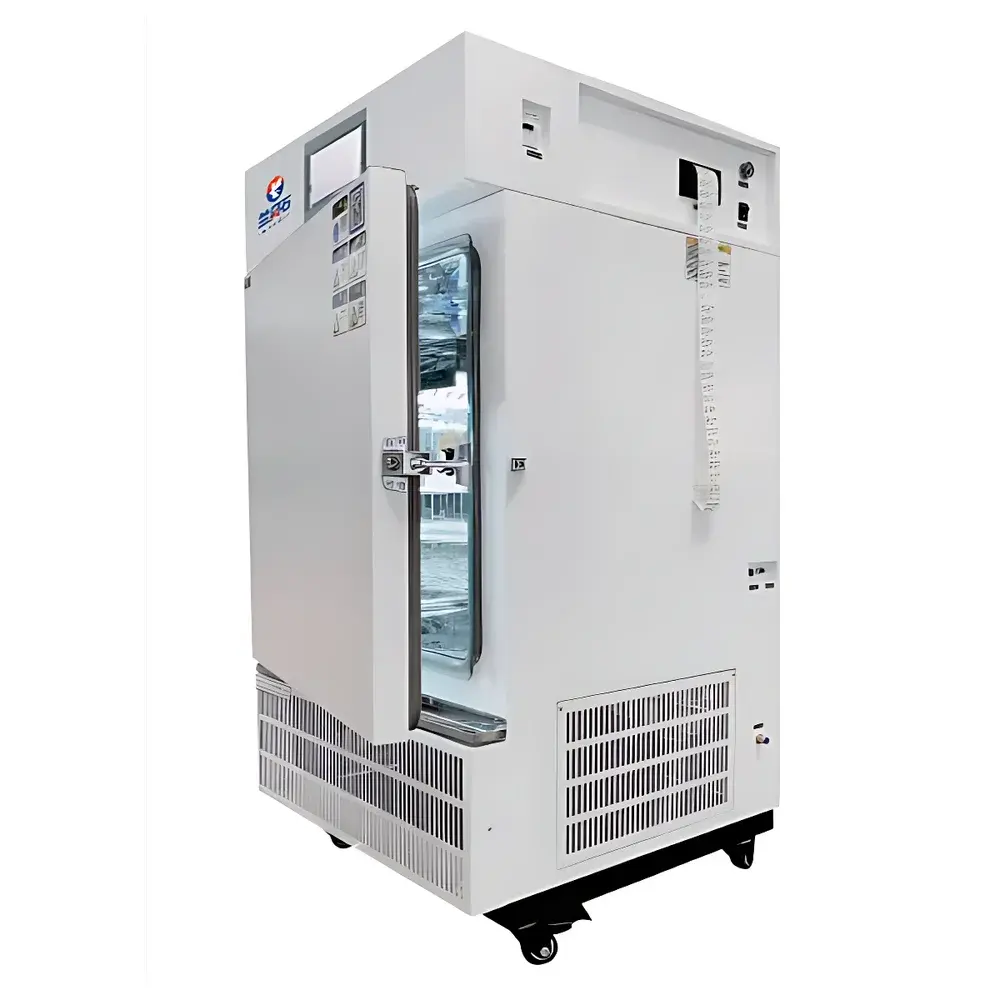
Labonce Labonce-150CGS-FC Drug Stability Testing Chamber with Visible Light & Near-Ultraviolet Illumination
| Brand | Labonce |
|---|---|
| Origin | Beijing, China |
| Manufacturer Type | Direct Manufacturer |
| Country of Origin | China |
| Model | Labonce-150CGS-FC |
| Quotation | Upon Request |
Overview
The Labonce Labonce-150CGS-FC Drug Stability Testing Chamber is an ICH Q1-compliant environmental simulation system engineered for long-term, high-reliability pharmaceutical stability studies under controlled temperature, humidity, visible light, and near-ultraviolet (UV-A) irradiation conditions. Designed in strict alignment with ICH Harmonised Tripartite Guideline Q1A(R3)–Q1E and the Chinese Pharmacopoeia (2020 Edition), this chamber implements a dual-loop, microprocessor-based control architecture to maintain precise environmental parameters required for accelerated, intermediate, and long-term stability protocols—including photostability testing per ICH Q5C. Its integrated illumination subsystem features independently calibrated visible-light (100–8000 lux) and near-UV (0.84–5 W/m²) sources, enabling simultaneous or sequential exposure per ICH Q1B Option 1 and Option 2. The chamber’s structural integrity, thermal-hygrometric uniformity, and data traceability framework meet core requirements for GMP and cGMP environments, supporting regulatory submissions to NMPA, FDA, EMA, and PMDA.
Key Features
- Imported inverter-driven hermetic compressor system delivering >50% energy and water savings versus fixed-speed alternatives, with continuous-duty rating for uninterrupted 24/7 operation.
- Triple-tier user access control (Administrator, Supervisor, Operator) with role-based authentication via username/password; all login attempts and privilege changes logged with timestamps.
- Auditable electronic record system compliant with ALCOA+ principles: full operational history—including setpoint modifications, alarm events, sensor calibrations, and manual interventions—is stored internally and exportable via USB to immutable .csv or .pdf formats.
- 7-inch full-color programmable touchscreen controller displaying real-time inverter output ratio, environmental trends, and active alarm status; supports multi-step ramp-soak profiles with up to 99 segments.
- High-density polyurethane foam insulation (≥120 mm thick, closed-cell structure) ensures thermal and moisture retention, minimizing external load impact and reducing recovery time after door opening.
- Interior constructed from electropolished AISI 304 stainless steel (mirror finish); exterior finished with corrosion-resistant powder-coated carbon steel—both non-shedding and compatible with common pharmaceutical cleaning agents (e.g., isopropyl alcohol, hydrogen peroxide vapor).
- Dual-door design: inner tempered glass door enables visual sample inspection without compromising internal environment; outer solid insulated door maintains thermal/hygrometric integrity and blocks ambient light interference.
- Capacitive humidity sensors (imported, factory-calibrated) with ±0.8% RH accuracy, <0.5% RH/year drift, and zero-maintenance service life—integrated into closed-loop PID humidity control.
Sample Compatibility & Compliance
The Labonce-150CGS-FC accommodates standard stability storage configurations—including open trays, sealed vials, blister packs, and primary packaging units—within its 150 L working volume (600 × 405 × 625 mm interior). Temperature uniformity ≤2.0°C (at no-load, dark condition) and humidity uniformity ≤3.0% RH across the working zone satisfy ICH Q1A(R3) spatial qualification criteria. Illumination uniformity is validated per ISO 17025-accredited procedures: visible-light irradiance deviation ≤±10% across sample plane; near-UV irradiance deviation ≤±15%. The system conforms to ASTM E2058 (Standard Practice for Conducting Photostability Testing of Pharmaceuticals), USP (Stability Considerations), and EU Annex 11 (Computerized Systems). Full IQ/OQ documentation packages are available upon request for GxP validation.
Software & Data Management
Data integrity is enforced through embedded firmware supporting 21 CFR Part 11-compliant audit trails: every parameter change, alarm acknowledgment, or report generation is timestamped, user-identified, and non-erasable. Internal memory retains ≥12 months of 1-minute-interval environmental logs (temperature, humidity, visible lux, UV irradiance). Optional Ethernet/WiFi connectivity enables remote monitoring via secure HTTPS web interface. Printed output includes date/time-stamped hardcopy reports from the built-in dot-matrix printer—each page bearing unique batch ID, operator ID, and chamber serial number. Electronic exports support CSV import into LIMS or statistical analysis platforms (e.g., JMP, Minitab) for trend analysis and shelf-life modeling.
Applications
- ICH Q1A–Q1E stability protocols: long-term (25°C/60% RH), accelerated (40°C/75% RH), and intermediate (30°C/65% RH) storage assessments.
- Photostability testing per ICH Q5C: forced degradation under visible light (≥1.2×10⁶ lux·hr) and near-UV (≥200 W·hr/m²) exposure, including Option 1 (separate visible + UV) and Option 2 (combined broad-spectrum).
- Reference standard storage under ICH Q5D-defined conditions for biologics and small-molecule APIs.
- Excipient compatibility screening under stress conditions (e.g., elevated humidity + UV).
- Regulatory filing support for ANDA, NDA, MA, and CMC sections requiring documented environmental control evidence.
FAQ
Does the Labonce-150CGS-FC comply with 21 CFR Part 11 requirements?
Yes—the system implements electronic signature enforcement, audit trail immutability, and role-based access controls aligned with FDA’s 21 CFR Part 11 Subpart B (Electronic Records) and Subpart C (Electronic Signatures).
What calibration standards are used for the visible-light and UV-A sensors?
Visible-light sensors are NIST-traceable to photometric standards (CIE 1931 color matching functions); UV-A sensors are calibrated against certified reference radiometers per ISO/IEC 17025 accredited methods.
Can the chamber be qualified per GMP Annex 15?
Yes—full IQ/OQ documentation templates (including DQ summary, URS cross-reference, test protocols, and acceptance criteria) are provided; PQ support services are available through Labonce’s qualified validation partners.
Is remote monitoring and alarm notification supported?
Yes—via optional GSM module for SMS alerts on temperature/humidity deviation, power failure, or door-open events; also supports SNMP trap integration into enterprise infrastructure monitoring systems.
What is the maximum allowable ambient operating temperature range?
The unit is rated for installation in rooms maintained between +5°C and +35°C ambient, with adequate ventilation and minimum 500 mm clearance around rear and side panels for heat dissipation.
Related Products





