
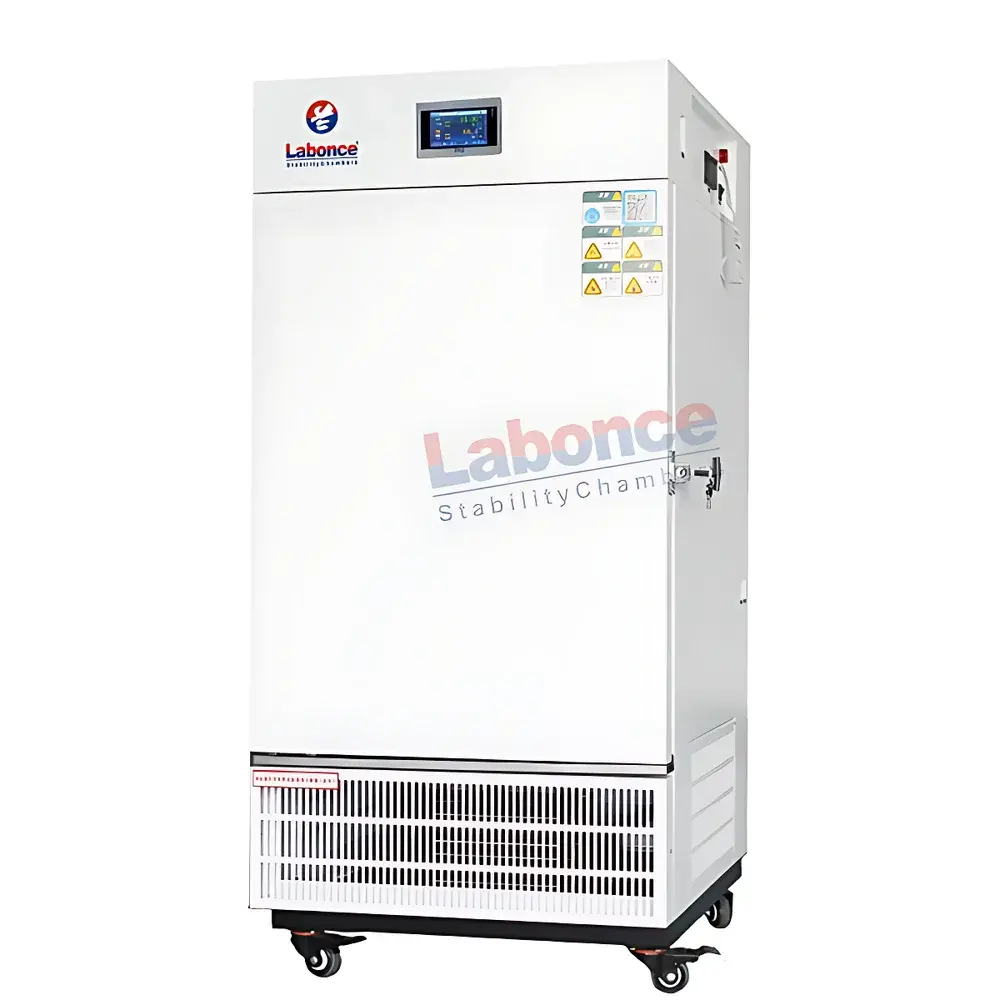
Labonce Labonce-250TT Drug Stability Testing Chamber
| Brand | Labonce |
|---|---|
| Origin | Beijing, China |
| Manufacturer Type | Direct Manufacturer |
| Product Category | Domestic Instrument |
| Model | Labonce-250TT |
| Pricing | Available Upon Request |
| Temperature Range | 0–85 °C |
| Chamber Volume | 250 L |
| Interior Dimensions (W×D×H) | 600×500×830 mm |
| Exterior Dimensions (W×D×H) | 780×880×1650 mm |
| Power Consumption | 1.5 kW |
| Standard Shelves | 3 pcs (4 positions) |
| Temperature Uniformity | ≤1.0 °C |
| Temperature Fluctuation | <±0.5 °C |
| Temperature Deviation | <±0.7 °C |
| Compliance | GB/T 10586–2006 |
| Control System | Programmable Color Touchscreen Controller with 3-Tier User Access & Audit Trail |
| Data Storage | Internal Electronic Logging + USB Export |
| Cooling System | Imported Inverter Compressor (≥50% Energy Savings) |
| Safety | Independent Over-Temperature Protection Circuit |
| Door Design | Dual-door — outer solid insulated door + inner tempered glass door |
| Construction | Exterior: Powder-Coated Steel |
| Interior | Stainless Steel (304) with Built-in Glass Observation Window |
| Optional | Pin-type Micro Printer |
Overview
The Labonce Labonce-250TT Drug Stability Testing Chamber is an ISO/IEC 17025-aligned environmental test system engineered for long-term, high-fidelity stability studies in pharmaceutical development and quality control laboratories. Designed in strict accordance with the technical requirements of GB/T 10586–2006 (equivalent to IEC 60068-3-5 for thermal performance verification), this chamber delivers precise, reproducible temperature control across its full operational range of 0 °C to 85 °C. Its core function is to simulate accelerated and real-time storage conditions required for ICH Q1A(R3), Q5C, and USP stability protocols—supporting bracketing and matrixing study designs per FDA Guidance for Industry (2022). The chamber employs a forced-air convection system with optimized airflow distribution to ensure thermodynamic equilibrium throughout the working volume, minimizing thermal gradients that could compromise degradation kinetics or polymorphic transition assessments.
Key Features
- High-precision temperature regulation: ±0.5 °C fluctuation and ±0.7 °C deviation, validated per ASTM E2293–22 Annex A2 methodology
- Dual-door architecture: Outer insulated solid door maintains thermal integrity; inner tempered glass door enables non-intrusive visual monitoring without disturbing chamber equilibrium
- Inverter-driven refrigeration system: Imported compressor with variable-speed operation reduces energy consumption by ≥50% versus fixed-speed alternatives while extending service life and lowering acoustic emissions (<58 dB(A))
- Triple-tier access control: Administrator, operator, and viewer roles with password protection, session logging, and immutable audit trail compliant with FDA 21 CFR Part 11 Subpart B requirements
- Robust chamber construction: 304 stainless steel interior (electropolished finish) resists corrosion from solvent vapors and cleaning agents; powder-coated carbon steel exterior ensures mechanical durability
- Dedicated safety redundancy: Independent over-temperature cut-off circuit with physical bimetallic switch provides fail-safe protection independent of main controller logic
Sample Compatibility & Compliance
The Labonce-250TT accommodates standard ICH-compliant stability batches—including blister packs, HDPE bottles, vials, syringes, and primary packaging materials—on three adjustable stainless steel shelves (4-position configuration). Its 250 L internal volume supports up to 120 × 10-mL vials or equivalent surface-area loading while maintaining uniform exposure per ISO 16774:2018. The chamber meets the thermal performance criteria defined in GB/T 10586–2006 and aligns with supplementary validation guidance in EU Annex 15 and WHO TRS 992 Annex 6. It is routinely qualified using IQ/OQ/PQ protocols per GMP Annex 15, with documented mapping studies demonstrating ≤1.0 °C spatial uniformity across all shelf levels under loaded conditions.
Software & Data Management
Equipped with an embedded programmable touchscreen controller, the Labonce-250TT records time-stamped temperature data at user-defined intervals (1 s to 60 min resolution). All logs—including setpoint changes, alarm events, door openings, and user logins—are stored internally with 32 GB flash memory capacity and exportable via USB 2.0 interface in CSV or PDF format. The system supports electronic signature capture for critical actions and generates tamper-evident audit trails traceable to individual operators. Data files comply with ALCOA+ principles (Attributable, Legible, Contemporaneous, Original, Accurate, Complete, Consistent, Enduring, Available) and are compatible with LIMS integration via optional RS485/Modbus RTU or Ethernet TCP/IP interfaces.
Applications
- ICH Q1A(R3) long-term (25 °C/60% RH) and accelerated (40 °C/75% RH) stability testing of APIs and finished dosage forms
- Photostability screening per ICH Q5C under controlled irradiance conditions (when integrated with optional UV/visible light modules)
- Package integrity evaluation: thermal stress testing of closures, laminates, and child-resistant mechanisms
- Forced degradation studies (thermal stress only) for method development and impurity profiling
- Material aging assessment of excipients, polymers, and elastomeric components used in drug delivery systems
- Reference standard storage under GxP-controlled ambient conditions (e.g., 15–25 °C, dry)
FAQ
Is the Labonce-250TT suitable for humidity-controlled stability studies?
No—the Labonce-250TT is a temperature-only chamber. For combined temperature/humidity testing, refer to the Labonce-250CT model series.
Can the audit trail be disabled or edited by users?
No—audit trail generation is firmware-enforced, non-bypassable, and write-protected. Modifications require physical hardware intervention and trigger immediate alarm logging.
What validation documentation is provided with the unit?
Each shipment includes Factory Acceptance Test (FAT) report, calibration certificate traceable to NIM (China National Institute of Metrology), and IQ/OQ protocol templates compliant with EU Annex 15 and ASTM E2500–22.
Does the chamber support remote monitoring or network connectivity?
Yes—optional Ethernet module enables SNMP-based status polling, email alerts for alarms, and integration with centralized environmental monitoring systems (EMS) via Modbus TCP.
What is the recommended preventive maintenance schedule?
Comprehensive service every 12 months, including refrigerant pressure verification, airflow calibration, sensor recalibration, and door gasket integrity inspection—per manufacturer’s Service Manual Rev. 3.2.






