
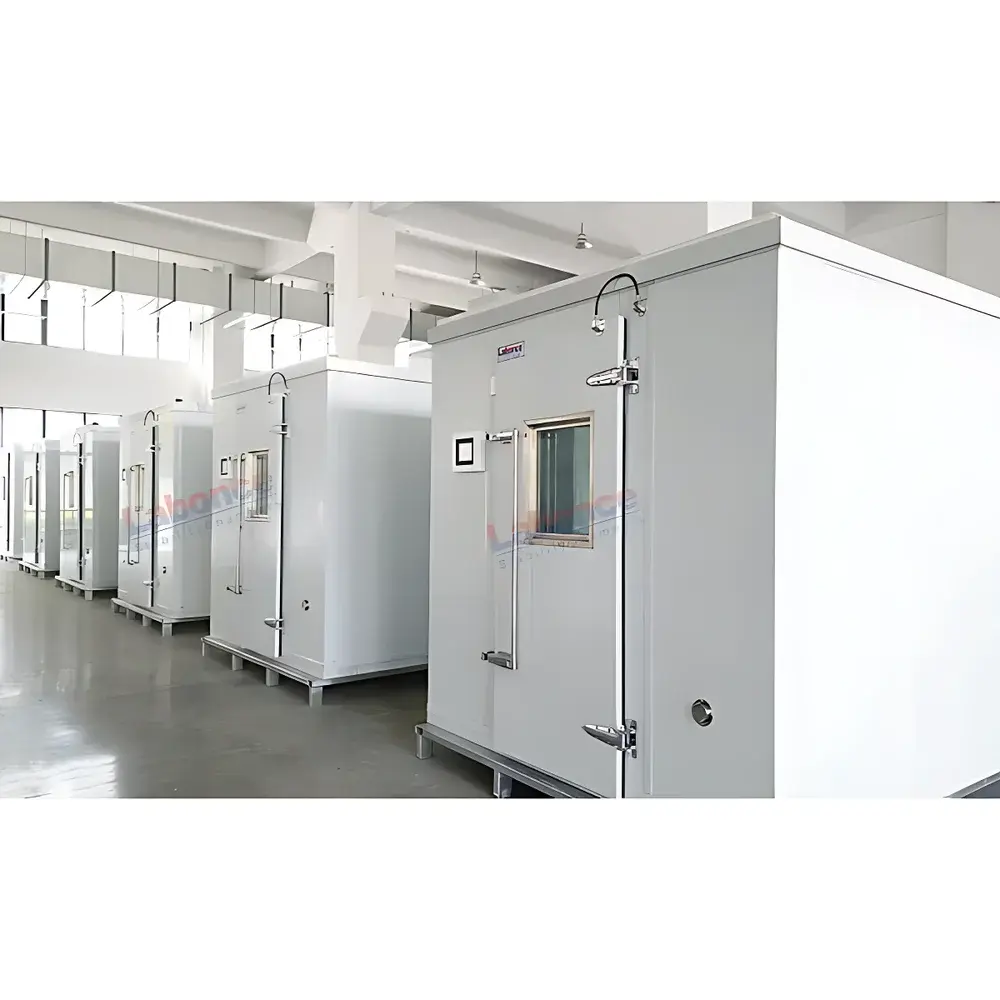
Labonce Labonce-33000GS Walk-in Pharmaceutical Stability Chamber
| Brand | Labonce |
|---|---|
| Model | Labonce-33000GS |
| Temperature Range | 20–45°C (±0.5°C uniformity, ±1.0°C deviation) |
| Humidity Range | 20–80% RH (±3.0% RH deviation) |
| Internal Volume | 33,000 L |
| Internal Dimensions (W×D×H) | 2950×5200×2200 mm |
| External Dimensions (W×D×H) | 3150×5400×2400 mm |
| Power Requirement | 6.5 kW |
| Compliance | GB/T 10586-2006, JJF 1101-2019, ICH Q1–Q5, ChP 2020, FDA 21 CFR Part 11 (with optional network server) |
Overview
The Labonce Labonce-33000GS Walk-in Pharmaceutical Stability Chamber is a GMP-compliant, large-volume environmental test system engineered for long-term stability studies of pharmaceutical products under controlled temperature and humidity conditions. Designed in strict accordance with ICH Q1A(R3), Q5C, and the Chinese Pharmacopoeia 2020 Edition, this chamber supports regulatory submissions by delivering precise, reproducible, and auditable environmental profiles across extended durations (e.g., 0, 3, 6, 9, 12, 18, 24, 36, and 60 months). Its core architecture employs a dual-loop air handling system with laminar airflow distribution, ensuring spatial uniformity per ISO 14644-1 Class 8 (cleanroom-equivalent air exchange) and minimizing thermal stratification. The chamber operates on the principle of combined refrigeration dehumidification and steam-based humidification—enabling stable setpoint maintenance without condensation risk or moisture lag, critical for hygroscopic dosage forms such as tablets, lyophilized powders, and biologics vials.
Key Features
- Stainless steel 304 interior construction—including floor with anti-slip patterned plating, seamless welds, and corrosion-resistant ductwork—ensures compliance with ISO 14644-1 cleanliness requirements and simplifies cleaning validation.
- Redundant refrigeration system featuring dual进口 (imported) scroll compressors with automatic failover; integrated hot-gas bypass and electronic expansion valves enable fine-grained capacity modulation and energy optimization.
- 7-inch full-color programmable touchscreen controller with three-tier user authentication (administrator, operator, viewer), role-based access control, and real-time parameter logging.
- Capacitive humidity sensors (imported, factory-calibrated) with ±0.8% RH accuracy and <0.1% RH/year drift—eliminating routine recalibration and supporting continuous monitoring per USP <1151>.
- Comprehensive safety architecture: mechanical door lock with key override and anti-jamming mechanism, internal emergency stop button, over-temperature/over-humidity cut-off, low-water-level detection, and power-failure alarm with SMS notification via GSM module.
- Integrated audit trail compliant with FDA 21 CFR Part 11: all user actions, setpoint changes, alarm events, and calibration logs are time-stamped, digitally signed, and exportable to encrypted .csv or PDF via USB drive in write-protected format.
Sample Compatibility & Compliance
The Labonce-33000GS accommodates diverse pharmaceutical packaging configurations—including nested cartons, palletized secondary packaging, and open trays—without compromising environmental homogeneity. It supports standard ICH storage conditions: 25°C/60% RH (long-term), 30°C/65% RH (accelerated), and low-humidity variants (e.g., 40°C/25% RH for moisture-sensitive APIs). Optional low-temperature configurations (2–8°C refrigerated or 15°C cool storage) extend utility to biologics and cold-chain validation. All performance verifications follow JJF 1101-2019 for temperature/humidity mapping, including minimum 9-point sensor grid placement (per ISO 14160 and WHO TRS 961 Annex 9), with final qualification reports aligned to ASTM E2500 and EU Annex 15. The chamber’s stainless-steel surface finish (Ra ≤ 0.8 µm) and absence of organic gaskets meet extractables/leachables assessment prerequisites.
Software & Data Management
The embedded controller provides local data storage for ≥12 months of continuous 1-minute interval logging (temperature, humidity, alarms, user activity). An optional network server module enables centralized fleet management across multiple chambers via secure HTTPS interface, supporting automated report generation (PDF/Excel), trend analysis, and electronic signature workflows. All exported datasets include cryptographic hash verification to ensure integrity. When configured with the optional server, the system satisfies FDA 21 CFR Part 11 requirements for electronic records and signatures—including audit trail immutability, system validation documentation (IQ/OQ/PQ templates included), and periodic review protocols compatible with GLP and GMP quality systems.
Applications
- IQ/OQ/PQ execution for stability-indicating method development and validation
- ICH-guided long-term and accelerated stability testing of finished drug products and active pharmaceutical ingredients (APIs)
- Real-time shelf-life determination and retest date establishment
- Excipient compatibility screening under variable humidity stress
- Package integrity evaluation (e.g., blister foil permeability, HDPE container water vapor transmission rate)
- Reference standard storage under certified environmental conditions (per USP <1031>)
- Biological product stability assessment at controlled refrigerated conditions (2–8°C option)
FAQ
Does the Labonce-33000GS support IQ/OQ/PQ documentation packages?
Yes—factory-supplied validation templates (including URS, FDS, SDS, and protocol-ready checklists) are provided, along with calibration certificates traceable to NIM (China National Institute of Metrology).
Can the chamber be validated for GDP-compliant storage?
Yes—the system meets WHO GDP Annex 9 requirements when equipped with ≥2 independent continuous monitoring probes and mapped per EN 12830:2018.
Is remote monitoring available without the optional network server?
Basic SMS alerts (for temperature/humidity excursions, power loss, low water) are standard; full web-based remote access requires the optional server module.
What is the recommended maintenance schedule?
Compressor oil and refrigerant filter replacement every 24 months; humidity sensor verification annually; full chamber mapping every 6 months or after major repairs.
How is humidity uniformity verified during qualification?
Using a minimum 9-point sensor array per ICH Q1A(R3) Annex 2, with data logged at 1-minute intervals over 24 hours at each target condition (e.g., 25°C/60% RH), followed by statistical analysis of mean deviation and standard deviation.



